
Nolita, New York
Ákos Ezer
Call of the Wild
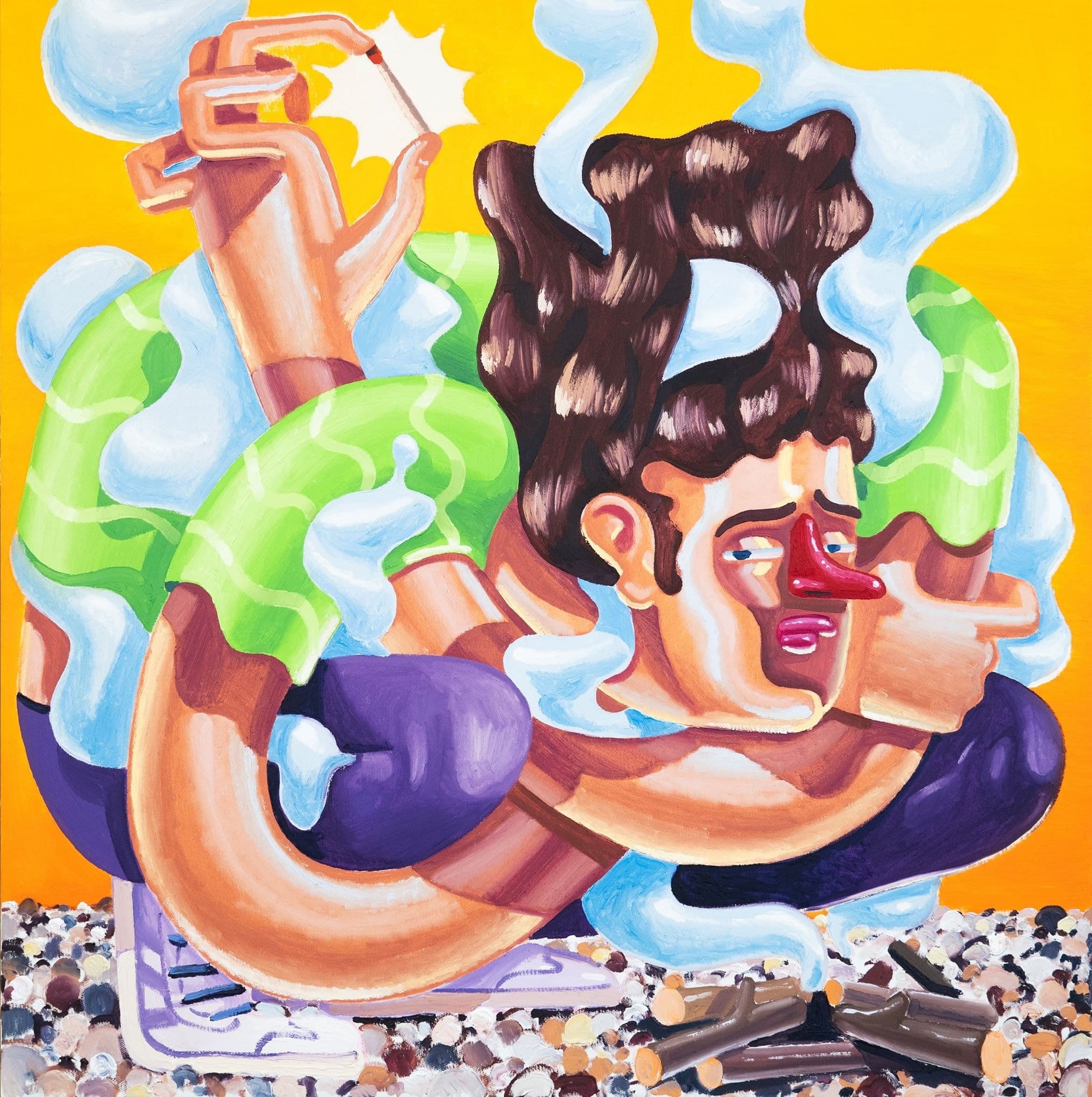
PlatoPlato is excited to present Ákos Ezer's solo exhibition, Call of the Wild, at Plato's lower gallery. "In a way, it reminds me of Plato's Allegory of the Cave: sometimes my figures leave the cave and go outside, only to hurry back inside to watch the shadows on the wall again." —Ákos Ezer on Call of the Wild Call of the Wild presents a new body of work by the Hungarian artist in which his signature dreamy youths, with their elongated limbs and expressive forms, venture into nature in search of solace. They roast marshmallows, knit scarves while whistling to the wind, drink mint tea, collect pebbles, pick apples, and blow soap bubbles. Their activities are deliberately ordinary—small acts of pleasure that recall the slower rhythms of childhood and offer an imagined respite from the accelerated, screen-saturated reality of contemporary life. Yet a retreat into nature may be less attainable than it seems. Are we still capable of having an unmediated experience, or is the urge to reach for our phones—to seek a dose of dopamine, capture an image, or immediately share it on social media—unavoidable? As a digital native living in the countryside outside Budapest, Ezer is no stranger to these contradictions, and neither are his subjects. His figures hunch, crouch, shrug, and shiver as they navigate their surroundings. Perhaps, as they attempt to light a fire with the last remaining match or gaze toward the horizon, they are secretly dreaming of a cozy couch and the glow of a television screen. Nature, in Ezer's paintings, is not always accommodating. Yet through contact with its elements, his unlikely frontier men are forced to confront themselves and their own feelings. The natural world becomes both a refuge and a mirror. Smoke, clouds, reflections, and bubbles frequently function as what Ezer describes as the "binding materials" of his paintings. They connect and separate, reveal and conceal, suggest the passage of time and establish atmosphere, while also opening the works to metaphysical and symbolic interpretations. Despite their relatively modest scale within Ezer's oeuvre, the paintings in Call of the Wild took at least as long to complete as many of his larger works. Their smaller scale demanded a more precise and focused articulation, while Ezer retained the thick, expressive brushstrokes that have become central to his practice. Ezer has spent decades considering the representation of the human figure in painting. He holds in high regard artists such as Georg Baselitz, R. B. Kitaj, and Willem de Kooning, whose distortions of the figure often imbue their subjects with a raw, visceral realism. Drawing from these traditions while incorporating his own language, Ezer has developed a distinctive approach to representing the modern human condition. The title Call of the Wild also brings to mind Henri Rousseau and the idealized visions of the natural world associated with naive painting. At the same time, Ezer draws inspiration from the digital world, contemporary subcultures, animation, 3D graphics, and comics. The result is a body of work that moves fluidly between art history and contemporary life, sincerity and irony. Ezer's figures leave the cave, but the shadows follow them outside. In Call of the Wild, nature becomes not an escape from the modern world, but another place in which to encounter it.