
Marais, Paris
Marc Johnson
The Sea is History (After Derek Walcott)
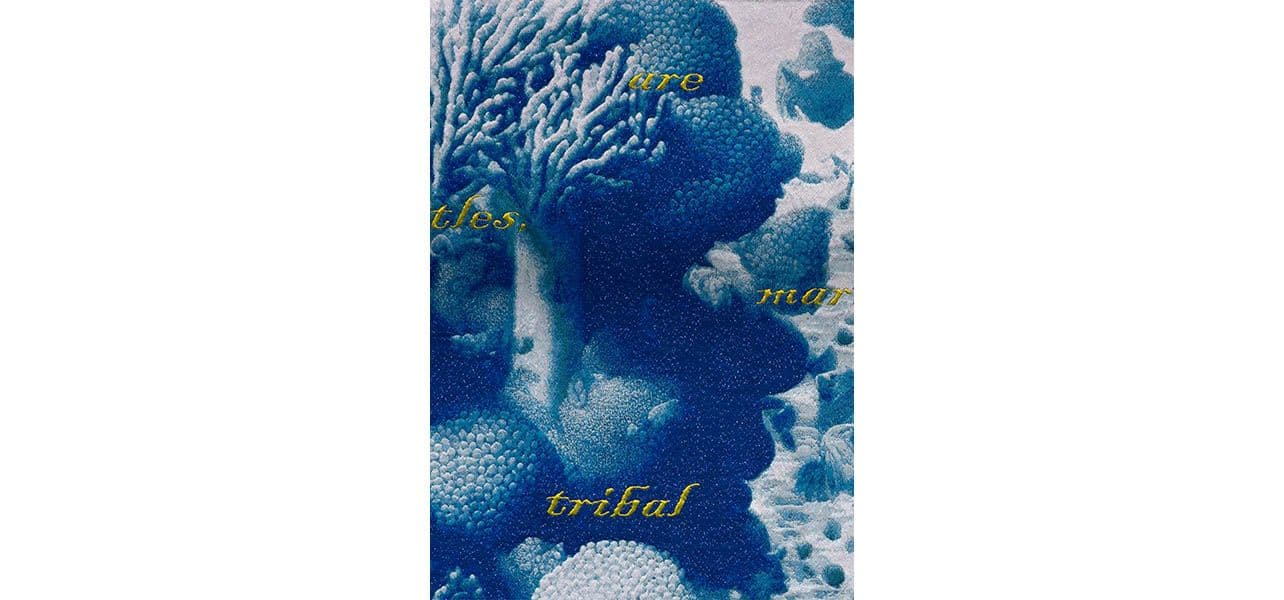
Mitterrand[Scroll down for French version / Veuillez trouver ci-dessous la version française] "Where are your monuments, your battles, martyrs? Where is your tribal memory? Sirs, in that grey vault. The sea. The sea has locked them up. The sea is History." —Derek Walcott Gallery Mitterrand is pleased to present a solo exhibition devoted to the work of the French/Beninese artist Marc Johnson. Following several award-winning films and years of research, Marc Johnson unveils for the first time a series of textile works exploring ideas of an aquatic, post-human society. Echoing the myth of Drexciya, the Detroit-born myth of a Black Atlantis, as well as the reflections of figures such as Donna Haraway, Marc Johnson invites us to a reading of Derek Walcott’s poem The Sea is History, first published in 1979. Walcott’s poem is known for the author’s singular ability to mobilize the rich references of the biblical narrative to reframe the story of the Transatlantic slave trade. By claiming the very image of a chosen people, struck by tragedy, cast away and yet essential like a corner stone, Walcott sought to underline their profound contributions to the construction of contemporary society, anchoring firmly the descendants of slaves into the larger canon Western societies are built on, from politics to religion, economy to languages and food. And yet, simultaneously, like a seer, the poet aimed to free them from this restrictive frame by opening his text towards the aquatic underworld of possibilities. Already a few years before the publication of Walcott’s poem, Sun Ra, another seer of an artist, had indeed claimed that “It’s already after the end of the world”. Just like Walcott, Sun Ra invoked ancient times and mythical narratives, most especially those of Egypt, to conjure a past lost in the Atlantic passage, and call to manifest a world of future possibilities born from the very process of loss. These three artists, the musician, the poet, and the visual artist, each bring us from their respective vantage points to the question: “What lies thus, after the end of the world?” "and in the salt chuckle of rocks with their sea pools, there was the sound like a rumour without any echo of History, really beginning." Born in 1986, Marc Johnson is a French Beninese visual artist and filmmaker. Through his practice, he explores and traces the dynamics of postcolonialism and the unequal distribution of power between humans and other agents, such as animals, landscapes, machines, and networks. His work has been exhibited worldwide, with important personal exhibitions held at The Jan Shrem and Maria Manetti - Shrem Museum of Art, UC Davis, United States, in collaboration with the Kramlich Collection; La Maréchalerie, contemporary Art Center, Versailles, France and The Zentrum fur Medienkunst, Halle, Germany. Johnson has participated in the Sundance Film Festival twice (2016 & 2018), the Biennale of Moscow for Young Art twice (2016 & 2018), The Berlin International Film Festival, Berlinale Shorts, The Yvonne Rainer Project at the Galerie Nationale du Jeu de Paume, and more than 50 film festivals worldwide. Majorgroup exhibitions include Ghosts of the Machine, the Polygon Gallery, Vancouver (Canada, 2022), OLHO, Museo de Arte Moderna, Rio de Janeiro (Brazil, 2018); ATM tempo I/II/III, Ginza Maison Hermès Le Forum, Tokyo (Japan, 2017), constellation•s, new ways of living in the world, arc- en-rêve centre d’architecture, Bordeaux (France, 2016); trans(?)duction, CNEAI Centre National Edition Art Image, Chatou (France, 2015). Marc Johnson received the LVMH Young Artist Award in 2009, was awarded the Jean-François et Marie-Laure de Clermont-Tonnerre prize in 2009, the Best Short Film Award from the Las Palmas International Film Festival de Gran Canaria in 2016, the Cornish Family Prize for Art & Design Publishing from the National Gallery of Victoria, Melbourne in 2017 and the Best Short Film Award from the 10th Annual Milwaukee Film Festival in 2018 and received the i-Portunus, European Commission’s mobility scheme for artists in 2019. ***** "Où sont vos monuments, vos batailles, vos martyrs ? Où est votre mémoire tribale ? Messieurs, dans ce gris coffre-fort. La mer. La mer les a enfermés. La mer est l’Histoire" —Derek Walcott La Galerie Mitterrand est heureuse de présenter du 28 mars au 16 mai 2024, une exposition personnelle de l’artiste franco-béninois Marc Johnson. Après plusieurs films primés et des années de recherche, Marc Johnson dévoile pour la première fois une série d'œuvres textiles explorant le mythe d'une société aquatique post-humaine. En écho au mythe de Drexciya, cette Atlantide noire imaginaire, ainsi qu'aux réflexions de théoriciens tels que Donna Haraway, Saidiya Hartman ou James Clifford, Marc Johnson nous invite à une relecture du poème de Derek Walcott, The Sea is History, publié pour la première fois en 1979. Ce poème est notamment saisissant pour la capacité singulière de son auteur à mobiliser les complexes références du récit biblique, pour recontextualiser l'histoire de la traite transatlantique des esclaves. En revendiquant l'image même d'un peuple élu, frappé par la tragédie, rejeté et pourtant essentiel comme une pierre angulaire, Walcott cherche à souligner ses profondes contributions à la construction de la société contemporaine, ancrant fermement les descendants d'esclaves dans le canon plus vaste sur lequel les sociétés occidentales et le monde globalisé se sont construits, de la politique à la religion, de l'économie aux langues, de la culture à la circulation des denrées alimentaires. Et pourtant, simultanément, le poète entend les libérer de ce cadre restrictif, en ouvrant son texte en direction des profondeurs, vers le monde aquatique des possibles. Quelques années avant la publication du poème de Walcott, Sun Ra, un autre artiste visionnaire, affirme en effet que nous sommes « déjà après la fin du monde. » Tout comme Walcott, Sun Ra a invoqué les temps anciens et les récits mythiques, en particulier ceux de l'Égypte, pour évoquer un passé perdu dans le passage de l'Atlantique et appeler à révéler un monde de possibilités futures nées du processus même de la perte. Ces trois artistes, le musicien, le poète et le plasticien, nous mènent, depuis leurs points de vue respectifs, à la question : « Qu’y a-t-il donc, après la fin du monde ?» "dans le rire de sel des rochers aux flaques marines, s’éleva le bruit comme une rumeur sans écho de l’Histoire, son vrai commencement." Né en 1986, Marc Johnson est un artiste visuel et cinéaste franco-béninois. À travers sa pratique, il explore les dynamiques du postcolonialisme et la distribution inégale du pouvoir entre les humains et les autres créatures, tels que les animaux, les paysages, les machines et les réseaux. Son travail a été exposé dans le monde entier, avec d’importantes expositions personnelles organisées au Jan Shrem et Maria Manetti - Shrem Museum of Art, UC Davis (United States) en collaboration avec la Kramlich Collection; La Maréchalerie, centre d’art contemporain, Versailles (France) et le Zentrum für Medienkunst, Halle (Allemagne). Johnson a participé au Sundance Film Festival à deux reprises (2016 & 2018); à la Biennale internationale de Moscou pour l’art émergent (2016 & 2018); au Festival international du film de Berlin, Berlinale Shorts; au Projet Yvonne Rainer à la Galerie Nationale du Jeu de Paume, ainsi qu’à plus de 50 festivals de cinéma dans le monde. Ses oeuvres ont été inclues dans de nombreuses expositions de groupe dont Ghosts of the Machine, Polygon Gallery, Vancouver (Canada, 2022); OLHO, Museo de Arte Moderna, Rio de Janeiro (Brésil, 2018); ATM tempo I/II/III, Maison Hermès Le Forum Ginza, Tokyo (Japon, 2017); constellation•s, new ways of living in the world, arc-en-rêve centre d’architecture, Bordeaux (France, 2016); trans(?)duction, CNEAI Centre National Edition Art Image, Chatou (2015). Marc Johnson a reçu le prix LVMH des jeunes créateurs en 2009, et la même année le Prix Jean-François et Marie-Laure de Clermont-Tonnerre; le Prix du meilleur court métrage au Festival international de cinéma de Las Palmas Gran Canaria (2016); le Cornish Family Prize for Art & Design Publishing de la National Gallery of Victoria, Melbourne (2017) et le Prix du meilleur court métrage du 10ème Milwaukee Film Festival (2018). Il a été en 2019 lauréat de i-Portunus, le programme pour la mobilité des artistes de la Commission européenne.