

Marais, Paris
Benjamin Sabatier
Concrete & Colors
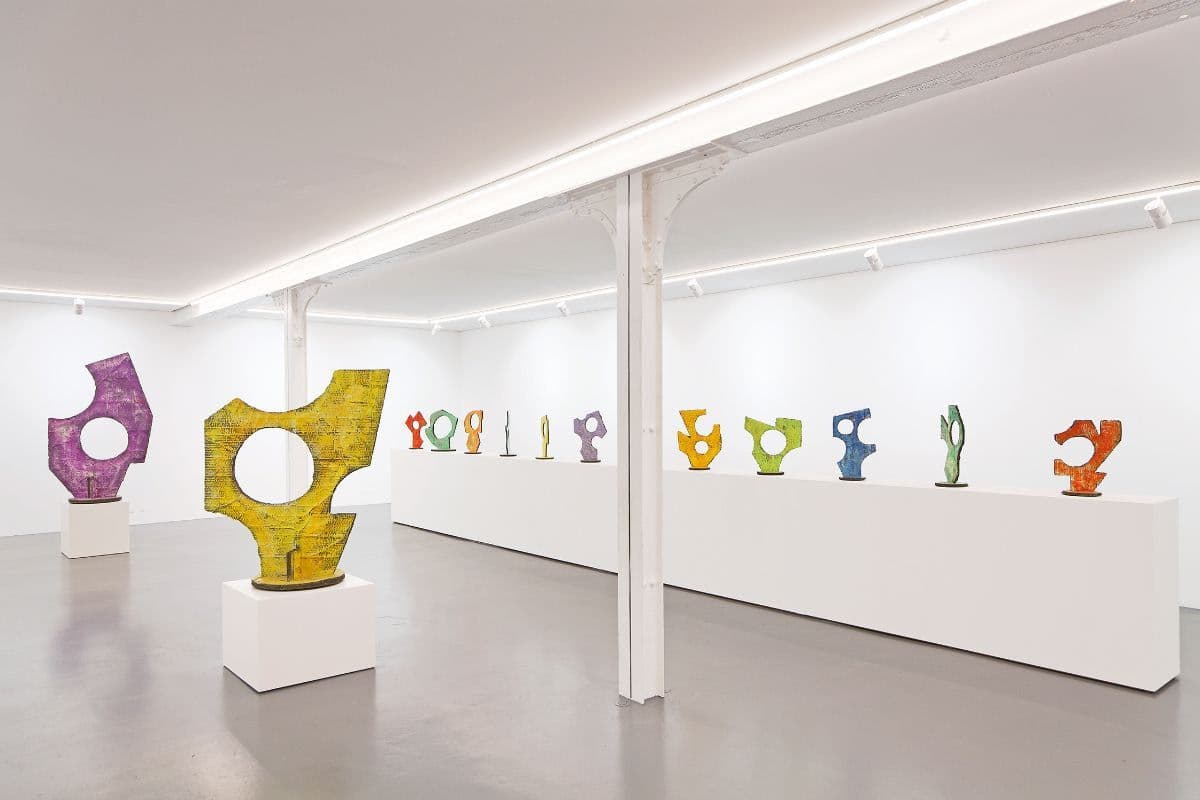
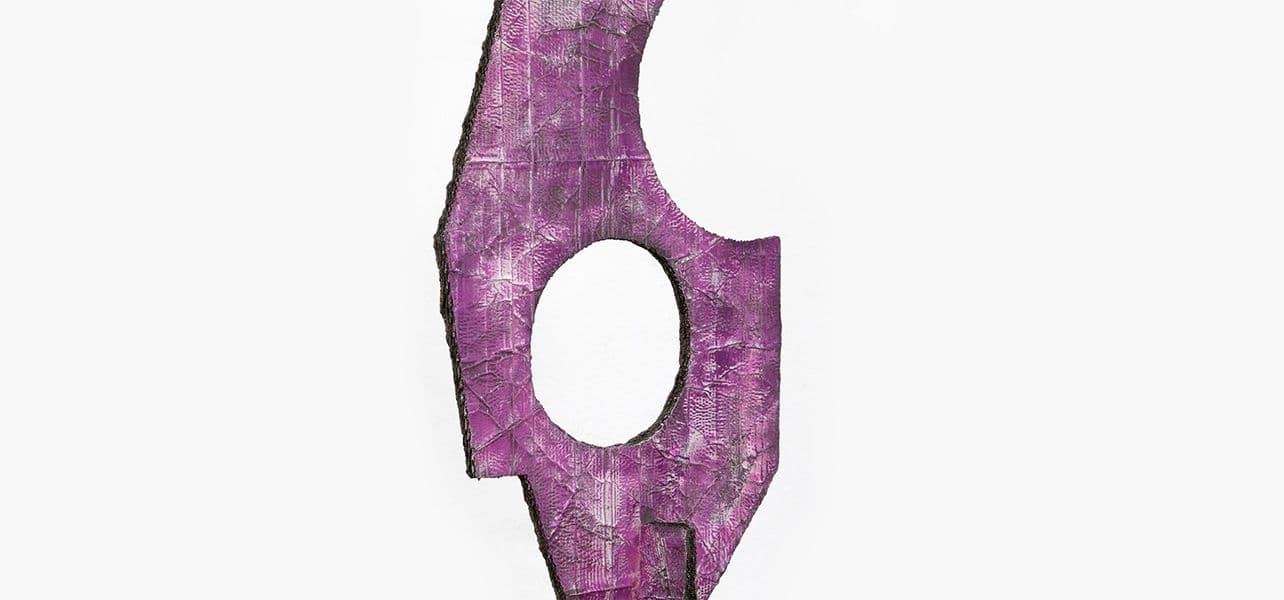
Xippas[Scroll down for French version / Veuillez trouver ci-dessous la version française] "The gesture is the other side of the commodity." —Giorgio Agamben Xippas is pleased to present Concrete & Colors, the first solo show by Benjamin Sabatier within the gallery. The exhibition brings together a series of previously unseen works which occupy the entire space. As a sculptor, Benjamin Sabatier does not deny the performative dimension of his practice. Exploring the relationship between art and labor, between action and object, through the use of raw or fragile materials (concrete, cardboard or brick) and an abstract vocabulary which references Modernity, the artist critiques the productionist logic of our capital-centric world by making the transformative process of matter visible. Concrete & Colors, whose title evokes both construction sites and modern painting (Matisse's cut-outs, for example), presents Home Work, a series of large flat sculptures in painted reinforced concrete, as well as smaller ones, arranged on a pedestal in a layout reminiscent of a forest. They recall Barbara Hepworth's perforated sculptures, Nancy Holz's monumental installations, but also Joseph Beuys' treatment of materials. Despite often playing with a certain formalism, Benjamin Sabatier's works bear witness to an experience of transformation. The act of making is central to the work, to the extent of evoking self-construction (the kit). The process induces the form: the technique (assembly, moulding, cutting), based on cardboard moulds, enables the paint, which is applied at the end, to reveal the fragility of the piece, whose roughness can be seen on the edges of the sculptures. The artist explores two scales: the interior and the exterior. This duality is echoed by the presence of a void at the heart of the sculptures, which are essentially solid. It is through this void that each piece finds its balance. The subtracted disc becomes the base, and the hole becomes a visual tool. But who is looking at whom in front of a work of art? And what are we looking at: the material or the hole? The opening provides a perspective on our social space. The gestural dimension of the shaping process is combined with the relationship between the works and the audience. The philosopher Nelson Goodman explains that "the digging and filling of a hole functions as a work of art, insofar as our attention is directed towards it as an exemplifying symbol." The hole is a common motif in metaphysics and Western art history. For Sartre, it is a void to be filled in order to unite us with others. The artist therefore approaches the exhibition as a relational space, a phenomenology, conceiving the gaze as an active gesture, viewing the visitor as part of a larger device – a situation. Benjamin Sabatier sees sculpture as a vector of ecology, making use of discarded materials such as waste and scrap. This upcycling, which illustrates the effects of industrialisation – the main cause of climate collapse – lends a "second hand" to these materials, that of the artist, who places his work at the centre of a socio-economic reality. Through a construction site aesthetic, the symbolism of concrete evokes the social and political history of large urban complexes. It also harks back to the history of the working class, built on the alienation of labour and productivity sustained by the liberal world. The series is assembled on a long pedestal, similar to those found in department stores. The base ("socle" in French, from socolo, the "shoe" that raises the work) becomes the support for another fundamental asset: the social landscape. The whole, inhabited by the energy of life (the creative act), thereby highlights the performativity and sustainability of neglected and precarious things. We should interpret the prevalence of this gesture in our world, where movement is a source of concern. Concrete & Colors invites us to coexist in transformation, to make membership an ecological tool. —Agnès Violeau Born in 1977 in Le Mans (France), Benjamin Sabatier lives and works in Paris. Benjamin Sabatier is a sculptor whose work explores and transforms the forms of modern art and their history in a simple vocabulary. His use of concrete, a constant in both his volume-based compositions and his reflections on abstract painting, draws on the history of this basic material of modern architecture as well as its current use in the history of sculpture since the 1970s. The use of cardboard or plastic panels creates an unexpected surface texture that is sometimes reinforced by the addition of paint, at the risk of disturbing the appearance of the materials. His works are part of important public collections: Artothèque, Villeurbanne, France; Fondazione Ghisa Art Collection, Locarno, Switzerland; FRAC Normandie Rouan, France; Fondation Galila Barzilaï-Hollander, Brussels, Belgium; Collection Société Générale, Paris, France; Collection Raja, Paris, France; Collection FdG Project, Brussels,Belgium; Latvian Centre for Contemporary Art, Riga, Latvia. ***** "Le geste est l’envers de la marchandise." —Giorgio Agamben Xippas a le plaisir de présenter Concrete & Colors, la première exposition personnelle de Benjamin Sabatier à la galerie, à travers une série inédite occupant la totalité de l’espace. Sculpteur, Benjamin Sabatier ne nie pas pour autant la dimension performative de sa pratique. Sondant la relation entre art et travail, entre action et objet, à travers un usage de matériaux précaires ou bruts (le béton, le carton ou la brique), et un vocabulaire abstrait se référant à la Modernité, l’artiste critique les logiques productivistes de notre capitalosphère, en visibilisant le processus transformateur de la matière. Sous un titre évoquant à la fois le chantier (concrete est l’anglais pour béton) et la peinture moderne (les découpes de Matisse, par exemple), Concrete & Colors présente Home Work, série composée de grandes sculptures plates en béton armé peint, ainsi que de plus petits formats, agencés sur un socle telle une forêt. On pense aux sculptures percées de Barbara Hepworth, aux installations monumentales de Nancy Holz mais également au traitement de la matière chez Joseph Beuys : si les œuvres de Benjamin Sabatier se jouent souvent d’un certain formalisme, elles témoignent d’une expérience de la transformation. Le faire est conducteur dans le travail, allant jusqu’à évoquer l’autoconstruction (le kit). Le processus induit la forme : le procédé usité (assemblage, moulage, découpe) à partir de l’empreinte de moules en carton, permet à la peinture apposée à la fin d’en révéler la fragilité, dont les aspérités ressortent sur la tranche des sculptures. Deux échelles sont explorées, celle de l’intérieur et celle de l’extérieur. À cette dualité, répond la présence du vide au centre des sculptures, par essence des pleins. C’est par l’évidement que chaque pièce trouve son équilibre. Le disque ôté devient le socle, et la trouée outil visuel. Mais qui regarde qui devant une œuvre ? Et, qu’est-ce que l’on regarde : la matière ou le trou ? L’ajour ouvre une perspective sur notre espace social. À la dimension gestuelle du façonnage, vient s’associer la relation entre les œuvres et les publics. Le philosophe Nelson Goodman explique que “le creusement et remplissage d’un trou fonctionne comme œuvre, dans la mesure où notre attention est dirigée vers lui en tant que symbole exemplifiant.” Motif usuel dans la métaphysique et dans l’histoire occidentale de l’art, le trou est, chez Sartre, un néant à remplir pour nous unir à l’autre. Ainsi l’artiste aborde-t-il l’exposition comme un espace relationnel, une phénoménologie : l’artiste y conçoit le regard comme geste actif, envisageant le.la visiteur.euse comme élément d’un dispositif plus large : une situation. Benjamin Sabatier pense la sculpture comme un vecteur d’écologie, en faisant usage de supports délaissés : résidus et rebuts. Cet upcycling, faisant parade aux effets de l’industrialisation -principale cause de l’effondrement climatique-, occasionne une “deuxième main”, celle de l’artiste, qui place son travail au centre d’une réalité socio- économique. Via une esthétique de chantier, la symbolique du béton convoque l’histoire sociale et politique des grands ensembles urbains. Également, l’histoire ouvrière, construite sur une aliénation du geste et la productivité soutenue par le monde libéral. La série est rassemblée sur un long piédestal ou display, de type grands magasins. Le socle (de socolo, la chaussure qui réhausse l’œuvre) devient alors support d’un autre bien fondamental : le paysage social. L’ensemble, habité par l’énergie du vivant (l’acte créateur), fait ainsi prévaloir performativité et durabilité du délaissé et du précaire. Il faudrait lire la prévalence du geste, au sein de notre monde que le mouvement inquiète. Concrete & Colors nous enjoint à convivre dans la transformation, à faire de l’adhésion un instrument écologique. —Agnès Violeau Né en 1977 au Mans, Benjamin Sabatier vit et travaille à Paris. Son usage du béton, constant aussi bien dans ses compositions en volume que dans ses réflexions sur la peinture abstraite, s’inspire de l’histoire de ce matériau fondamental de l’architecture moderne ainsi que de son emploi dans l’histoire de la sculpture depuis les années 1970. L’utilisation de panneaux de carton ou de plastique génère une texture de surface inattendue, parfois renforcée par l’ajout de peinture, au risque de troubler l’apparence des matériaux. Ses œuvres font partie d’importantes collections publiques : Artothèque de Villeurbanne (France), Fondazione Ghisa Art Collection à Locarno (Suisse), FRAC Haute-Normandie (France), Fondation Galila Barzilaï-Hollander à Bruxelles, Collection Société Générale à Paris (France), Collection Raja à Paris (France), Collection FdG Project à Bruxelles, Latvian Centre for Contemporary Art à Riga (Lettonie).