
Germain, Paris
Julien Berthier
Passion Potelet
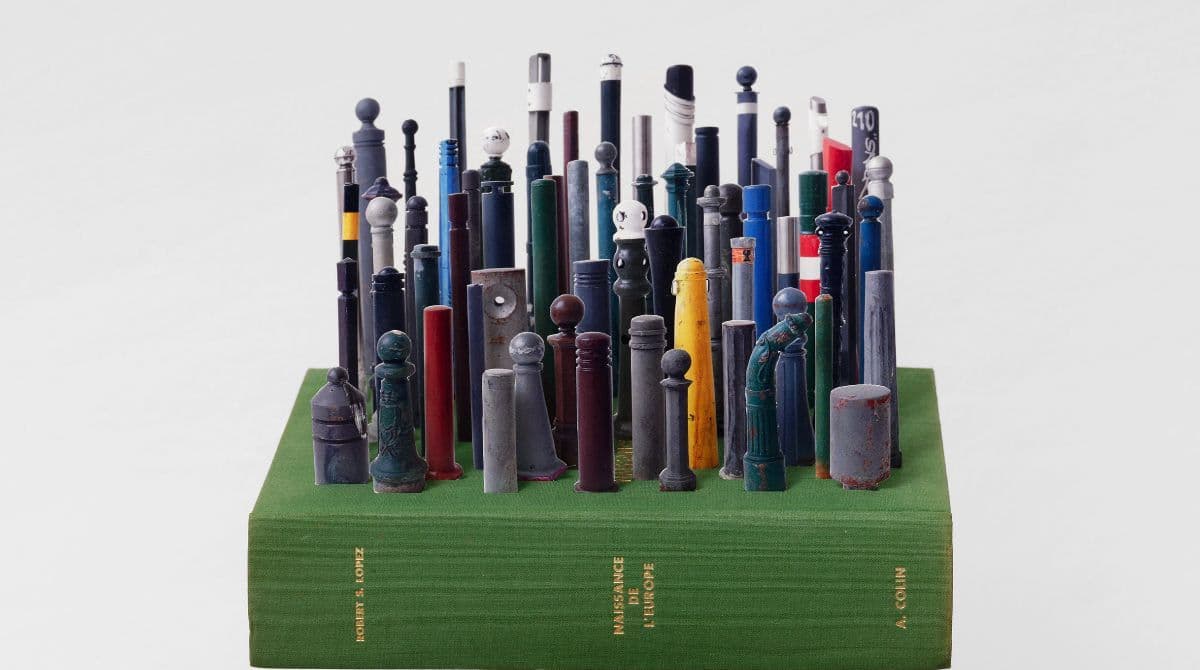
Georges-Philippe et Nathalie ValloisEver since I spoke with Julien Berthier, I haven’t been able to stop looking at the bollards scattered throughout every city. Until now, I hadn't found much interest in these rather bland vertical elements. Much like anyone else, I'd skirted around them. I'd had a bit of a grudge against them, aware that parking on sidewalks should never be an option, although... I remember I'd often tried to tie my bike to them when I was younger. I know that my son and I used to play with the idea of straddling them without fear. But I confess I never really looked at them. So, for the past few days, I've been unable to keep my eyes off them. They all look the same, but there are many variations. And none of their shapes are simple. Each bollard must have been carefully designed (...) The elegant silhouettes of steel bollards, for which Julien Berthier has an unsettling passion, are like punctuation marks in urban spaces. A bollard rarely stands alone. They are often part of a suite or series. Together, they trace lines along sidewalks, park edges and sports facilities. They temporize possibilities and accentuate levels. If the city were a chessboard, they'd be its pawns, which we poor chess players only regret as the game progresses. They have nothing going for them, except their group cohesion. Their space is that which links them to others or to an architectural element, a wall, a fence, a palisade or even a tree. In itself, a bollard seems such a small thing that it's never really discussed. In the shared location that is public space, there are few inclusions that are not the subject of discussion. Even if I don't pay much attention to municipal debates, I don't seem to have heard of any exciting exchanges for or against the installation of bollards. The bollard is a quasi-furtive object, the solution to all urban planning failures. After all, why put up bollards if not to correct errors in thinking about the sharing of common space? They are like the meshes of a net. They keep the different flows at a distance from each other. They are the virtuous correctors of theoretical thinking about shared spaces, dear to architects and urban planners. They are like the stitches of a small seam, distinguishing the paths of some from the daydreams of others. The public space is theirs, and they brighten it by their mere presence. Their value in usage is open to interpretation, but there is little room for misappropriation. They exist to enable us to be together. I really hadn't thought about it until I spoke with Julien Berthier. But since then, I've grown so fond of these little pawns that I wonder whether they might not be the exact metaphor for what can still make artistic work relevant in the public space. We no longer expect towers to rise, monumental queens to freeze, equestrian statues to trample our flowerbeds, or a few bishops to zigzag through the rosebushes, but rather for weak elements to weave links between themselves to keep our spaces porous yet supportive of others. I don't know if I have a passion for them, but now I look at them and might even envy them for being what they are: poetic elements of a city capable of understanding without signposts or bans. —Samuel Gross