
Weho, Los Angeles
Lynn Hershman Leeson
Deep Fake
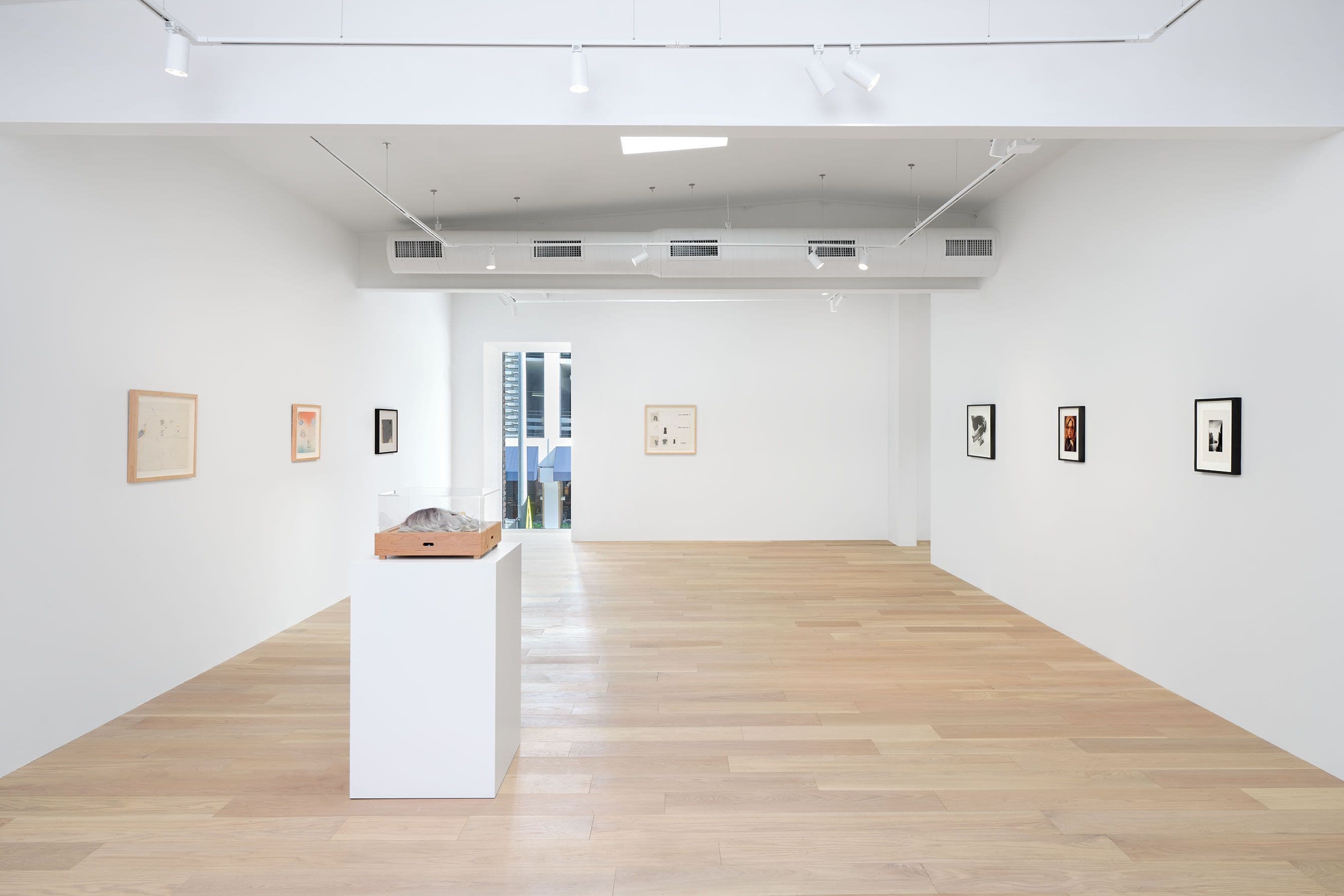
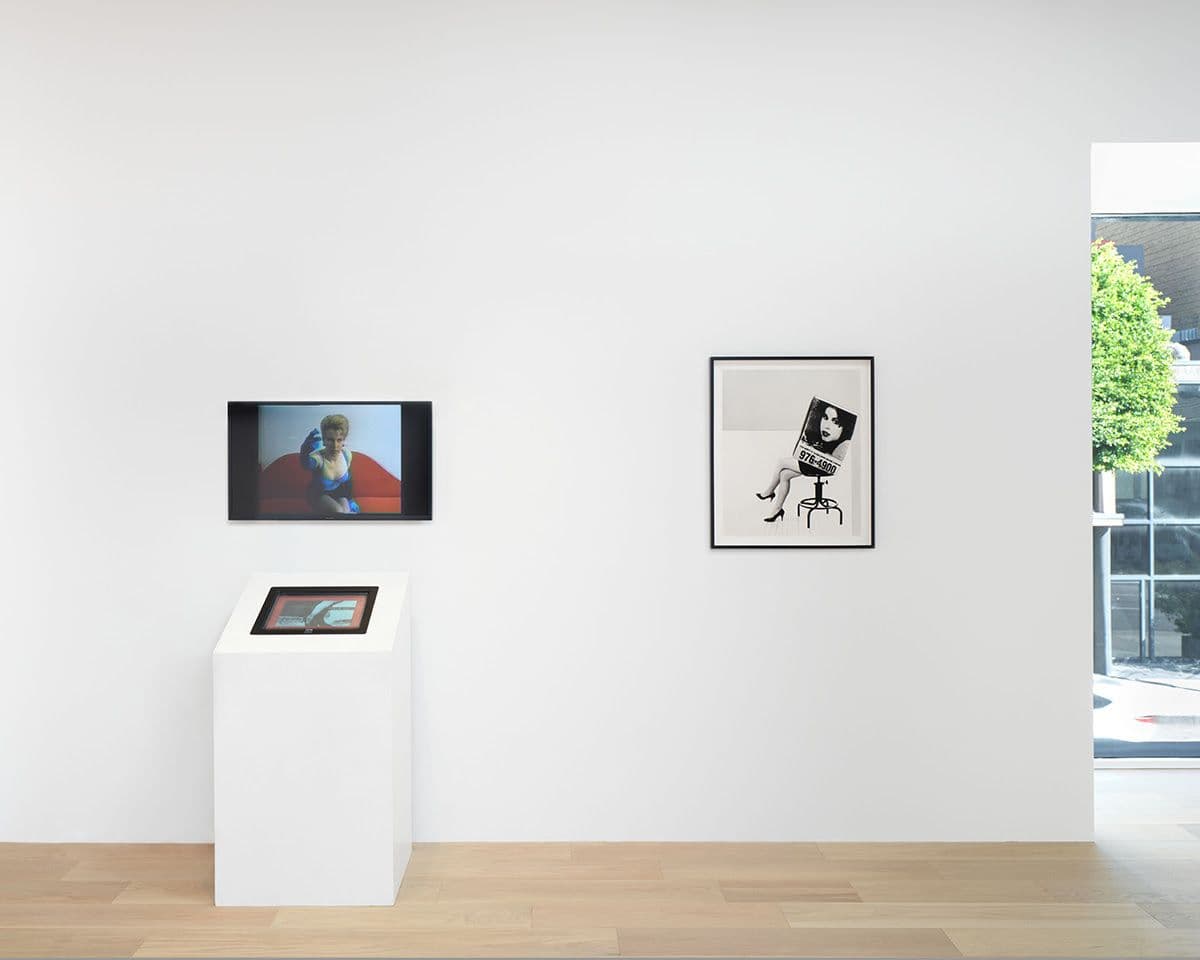
Hoffman DonahueMarilyn Monroe spent years in analysis and even consulted Freud’s daughter Anna Freud at one point while filming in London. But she never met the father of psychoanalysis himself, which makes their coupling in an artwork by Lynn Hershman Leeson particularly surprising and satisfying. The artist has layered photographic negatives to combine their faces into a portrait—his head sprouting from hers like Athena from Zeus, or the conscious mind emerging from the unconscious. And vice versa, as her head grows from his in another work, and the two titans of human desire become one. These experiments were the start of a larger series, Hero Sandwiches, where the artist fused publicity stills of two stars—one male, one female—to create pre-Photoshop composite images. Dolly Parton merges with John Wayne, Janis Joplin with James Dean and David Bowie with Audrey Hepburn, the latter blending, in their androgyny, the most seamlessly of all. Otherwise the pairings tend to be awkward and unresolved, pointing to the cultural construction of self and gender. This series is even richer in light of the artist’s own history of developing personas, most notably the character she called Roberta Breitmore. For six years in the 1970s, while living as an artist and (married) mother in San Francisco, Hershman Leeson went out on the town as a lonely (unmarried) woman, Roberta. By the end of this reality-confounding, category-defying performance, Roberta had her own driver’s license, dental records and checkbook. She had dating adventures, really mishaps, with men met through classified ads. She went to Weight Watchers and gained weight. Not unlike Marilyn, Roberta was blonde, sexualized, and an easy screen for male projections, holding a mirror up to the exploitation of women. Some students today first encounter Hershman Leeson in gender studies—as the progenitor of Roberta and creator of !WAR: Women Art Revolution, an important documentary of feminist art. Others first discover her work as a pioneering digital artist, who made the first interactive laserdisc artwork (the user controls the actions of an agoraphobic woman) and early bots that anticipated Siri and Alexa in their chatty interactivity. But the real thruline in her long career is her obsession with and deep insights into the construction of self. How is our sense of self developed, constructed, or, thinking about one of the great innovations of modern art, collaged? What happens when its boundaries are violated? And now that we work and socialize so much online, a phenomenon Hershman Leeson anticipated decades ago, how are our identities replicated, reconfigured or filtered—and also surveilled and extracted— by Internet-based technologies? Or as the artist says in an early video, the 1978 A Commercial for Myself, assuming the role of somebody who is not Lynn to introduce Lynn: “We’re becoming obsolete so fast, almost before we do anything. But we also have the option of becoming second and third generations of ourselves, which is really exciting in this new electronic era that we’re entering—not only psychically but also biologically.” (Yes, cloning, gene editing and DNA archiving also play a central role in her work.) One of her greatest and least appreciated works, the bell-jar-shaped, web-based sculpture Synthia (Stock Ticker) from 2000-02, gets at the feedback loop of consumer behavior. It uses real-time data from the S&P 500, NASDAQ and other market indices to determine the actions of a female character who appears on a monitor under the glass. When the market rises by two points or more, you can see her go to shop at Dior or dance. When the market is down, she goes shopping at Goodwill or starts chain-smoking. Roberta, the chatbots and Synthia count among the artist’s many avatars, alter egos that she has extended into different realms not just to comment on technology but to expose the various inputs forming the self, what some philosophers call the porosity of the self. Today, of course, we live in an age of deepfakes. Sora can generate a walking-and-talking AI video likeness of you from a quick recording of you pronouncing three numbers, while digital Frankensteins of celebrities push products on Tik Tok. Tech giants are putting the “deep learning” of artificial neural networks to use in simulating human behavior. But Hershman Leeson’s alter egos are deep fakes of another variety: profound attempts to understand what it means to be human. Jori Finkel writes about art for The New York Times and The Art Newspaper from Los Angeles. In 2007, she curated “Identity Theft: Eleanor Antin, Lynn Hershman, Suzy Lake 1972-78” for what is now the Institute of Contemporary Art, Los Angeles. Marking her first solo exhibition in Los Angeles in 40 years, Deep Fake surveys Lynn Hershman Leeson’s six-decade career, bringing together works from her iconic series Phantom Limb, Breathing Machines, Roberta Breitmore, and Hero Sandwich, alongside never-before-seen early drawings, rare video works, and newly manipulated photographs. —Jori Finkel on Lynn Hershman Leeson: Deep Fake Lynn Hershman Leeson (b. 1941, Cleveland, OH) is widely recognized as one of the most influential media artists of her generation. Since the late 1960s, with near uncanny foresight, Hershman Leeson has repeatedly anticipated technological shifts, working with emerging technologies from interactive video to artificial intelligence and genetic engineering. Spanning photography, film, performance, installation, and networked media, her practice persistently investigates issues now central to contemporary society, including identity, privacy in a time of surveillance, and the psychosocial relationship between humans and technology. Hershman Leeson’s work has been the subject of major international exhibitions and retrospectives, including Twisted at the New Museum, New York in 2021, and Civic Radar, first organized by ZKM | Center for Art and Media Karlsruhe in 2015 and later presented at Yerba Buena Center for the Arts, San Francisco in 2017. Her work was recently on view in major exhibitions, including Sixties Surreal, The Whitney, New York, NY; Are Our Eyes Targets?, The Julia Stoschek Foundation, Dusseldorf, Germany; The 36th Bienal de São Paulo, São Paulo, Brazil; and Data Dreams: Art and AI, MCA Sydney, Australia. Her work is held in major public collections including the Museum of Modern Art, Tate Modern, LACMA, the Walker Art Center, Hammer Museum, the National Gallery of Canada, San Jose Museum of Art, the Zentrum für Kunst und Medientechnologie, and the William Lehmbruck Museum. Hershman Leeson’s feature films—Conceiving Ada, Teknolust, Strange Culture, and the landmark documentary !Women Art Revolution—have screened at festivals such as Sundance, Berlin, and Toronto, and received numerous awards. Her memoir, Private I, was published by ZE Books in November 2025. Hershman Leeson lives and works between San Francisco, CA and New York, NY.