
Chelsea, New York
Cora Cohen
A Decade (2012–2022)
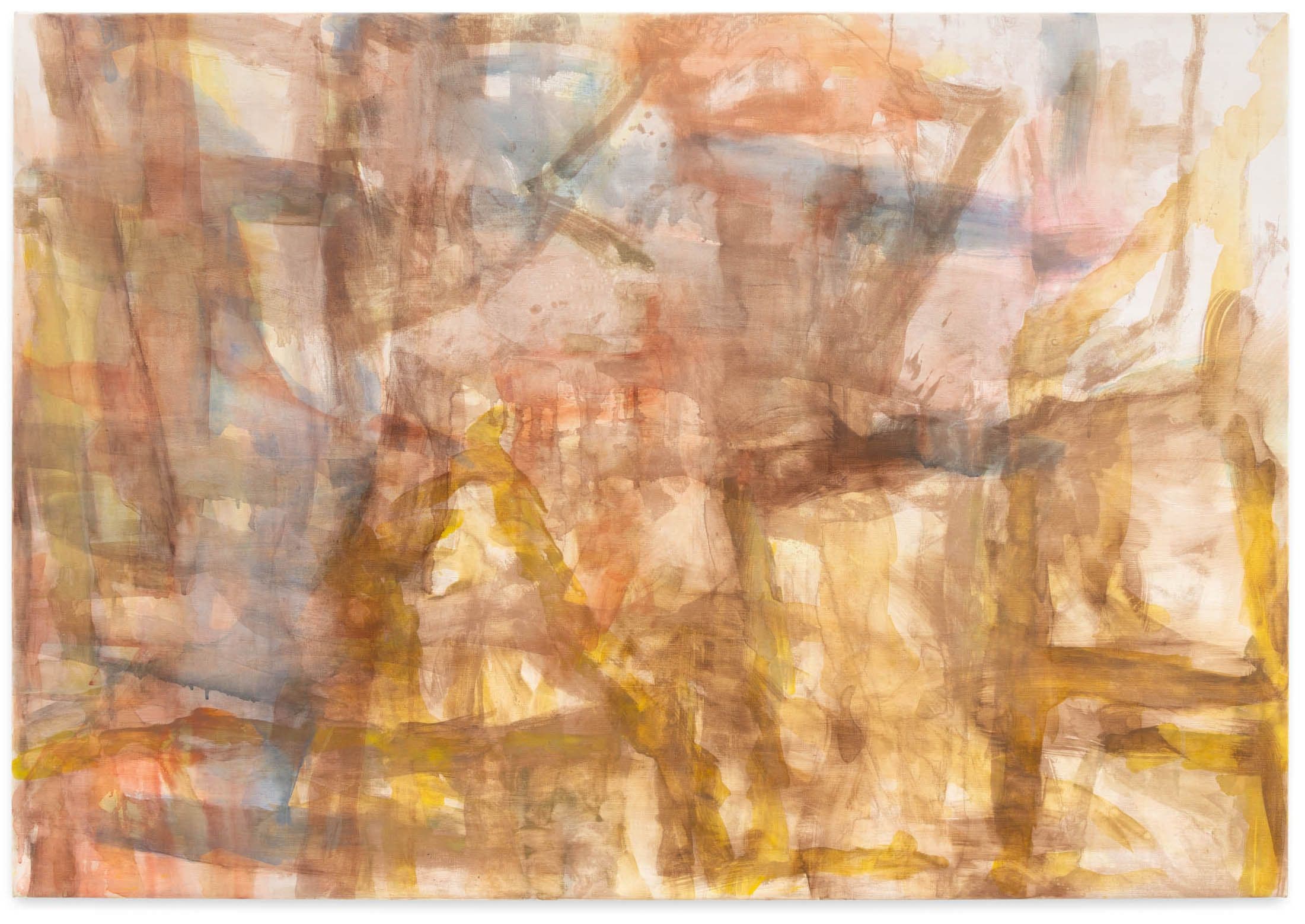
Greene NaftaliFrom the 1970s until her death in 2023, Cora Cohen widened the net of gestural abstraction's possibilities. A highly regarded painter's painter who lived and worked between New York and Cologne, Cohen remained dedicated to the medium despite errant (but oft-repeated) claims of its demise. Alongside peers such as Louise Fishman, Joan Snyder, Pat Steir, and Stanley Whitney, Cohen found new outlets for abstraction, inventing forms to assert that "modernism has the possibility to be about beginnings and not endings." This focused survey—Cohen’s first at Greene Naftali—centers on the final decade of her career, juxtaposing the chance operations unleashed in her late paintings with the layered deliberations of her works on paper. “The beautiful and the sublime are not uninteresting,” she once remarked, “but my urgency is for a different experience,” and her work’s calibrated play of control and abandon allows for such complexities. Atmospheric scrims seep into the picture plane; collage elements stud the surface; paint vies with colored pencil, ink, pastel, and graphite in a push-pull of productive conflict. The variety of Cohen’s touch affirms that, as her friend Joan Mitchell often said, “abstraction is not a style,” but rather a fierce commitment to capturing the material world, as perceived from a specific view. Born in New York City in 1943, Cora Cohen Studied painting at Bennington College in Vermont, where her instructors included Lawrence Alloway and Paul Feeley. Her extensive exhibition history began with a solo presentation at the Everson Museum in Syracuse in 1974. She showed regularly in New York galleries—including Wolff, Holly Solomon, and Jason McCoy—and solo institutional exhibitions have been held at Omaha’s Joslyn Museum of Art and the Museum Insel Hombroich in Neuss, Germany, among others.