
Mitte, Berlin
Daniel Spoerri
No Friend of Stagnation
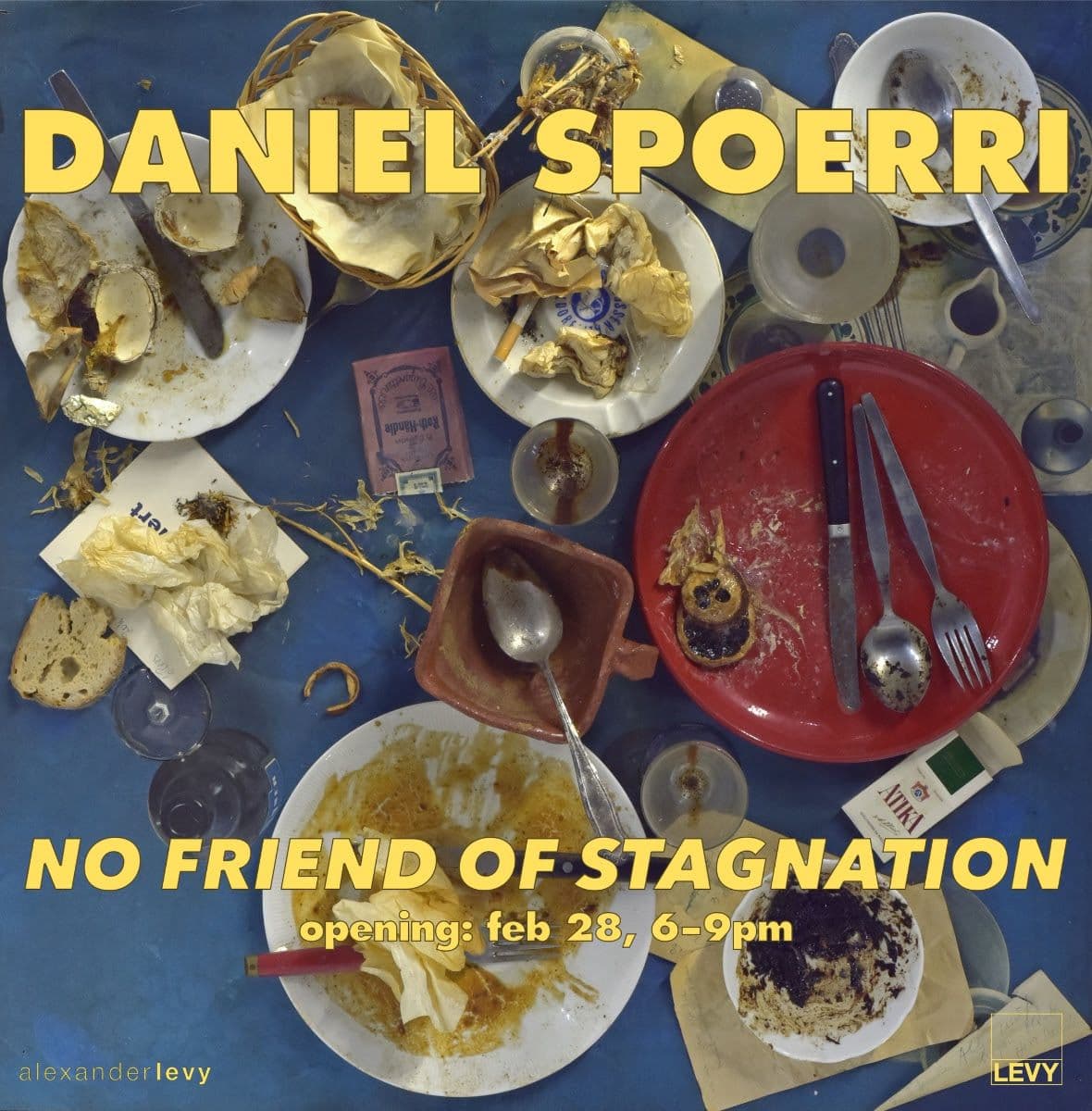
Alexander LevyDaniel Spoerri - ballet dancer, explorer of the "multiple", object artist, Nouveau Réaliste, Eat-artist, master of chance - is 95 years old in March 2025. At the beginning of this year, Levy Galerie and Alexander Levy dedicate an extensive exhibition to Spoerri in Berlin. As early as 1959, Daniel Spoerri impresses his audiences with his three-dimensional gravity defying still lifes, the Trap-pictures. But Spoerri does not content himself with this invention, time and again, he continues to deliver the unexpected. As is exemplified in his banquets, where he explores and questions eating habits, making them tangible as Eat Art. This was also the case with his bread dough objects. In Paris, he sees how fresh, unsold bread is thrown away in the evening. He reverses the process adding waste into bread dough, which he then bakes. In 1961, the resulting taboo-shattering objects, Catalogue Taboo, are presented at an exhibition opening in Copenhagen eliciting their desired effect: visitors are outraged. Daniel Spoerri wonders in bewilderment why people would be upset by his bread dough objects, and not over the fresh bread that ends up wasted every day. Spoerri's motto seems to be change; he is reluctant to settle into the familiar or the tried and tested. In 1967, the artist withdraws to a small Greek island for nine months to escape fame, and audiences' fixation with his Trap-pictures. There he focuses on "meals and kitchen utensils" as a subject, the result is the "Gastronomic Diary". A year later, in Düsseldorf, the Spoerri restaurant opens and shortly after the Eat Art gallery, for art made from or with food, such as the objects made from the bread dough series. The restaurant quickly becomes a "hotspot" in the art scene. During 1972, a table is selected every evening and fixed as a Tableau Piège. Unfortunately, not all 365 pictures survive a fire in the Galerie Bischofberger. The Tableux Piège's become Daniel Spoerri's hallmark, even though he dislikes the idea. (It becomes a regular sight to see people hold up their empty glass horizontally against walls whenever they hear his name while saying "This Spoerri?"). At Seville's 1992 Expo, several large-scale Spoerri tables – the Seville series – adorn the walls of the restaurant at the Swiss pavilion. The "Trap-pictures" principle sees numerous variations. In Spoerri's Faux Tableau piège, the artist cites himself, however, he no longer leaves the arrangements of the objects to chance. "Why should I have to stick to my own rules" he justly asks. Fascinated by the diversity of the simplest objects, Daniel Spoerri collects pocket knives, egg slicers, peelers and pasta wheels. Spoerri believes that "the Darwinian principle of evolution can be seen in people's efforts to constantly change and improve things". His preoccupation with the natural sciences is reflected in many of his works. For the series Carnaval des Animaux (1995), he enlarges prints by Charles Le Brun, court painter in the 17th century, onto canvas and adds objects to them. Le Brun's depictions of similarities between humans and animals appeal to Spoerri's sense of humor. It seems as though the artist is writing his way through world history. This is evidenced in a literal manner in his Boîtes à lettres, assemblages consisting of type setting trays with large wood letters. "The alphabet" according to Spoerri "contains all kinds of texts: from court rulings to love letters. I am fascinated by the idea that all poems, novels, pornographic texts, the Bible, legal texts … come from 27 letters. That's why I buy type setting trays whenever I find them." Thomas Levy first exhibits works by Daniel Spoerri in 1978. From then on, they develop a close friendship, not least due to their shared connection to artist Meret Oppenheim. Since 2000 LEVY Galerie officially represents Spoerri. Over the years, Thomas Levy organizes numerous Daniel Spoerri exhibitions in museums around the world, decisively contributing to the reception of his work. —Barbara Räderscheidt