
East, London
Cynthia Hawkins
Maps Necessary for a Walk in 4D: Chapter 4
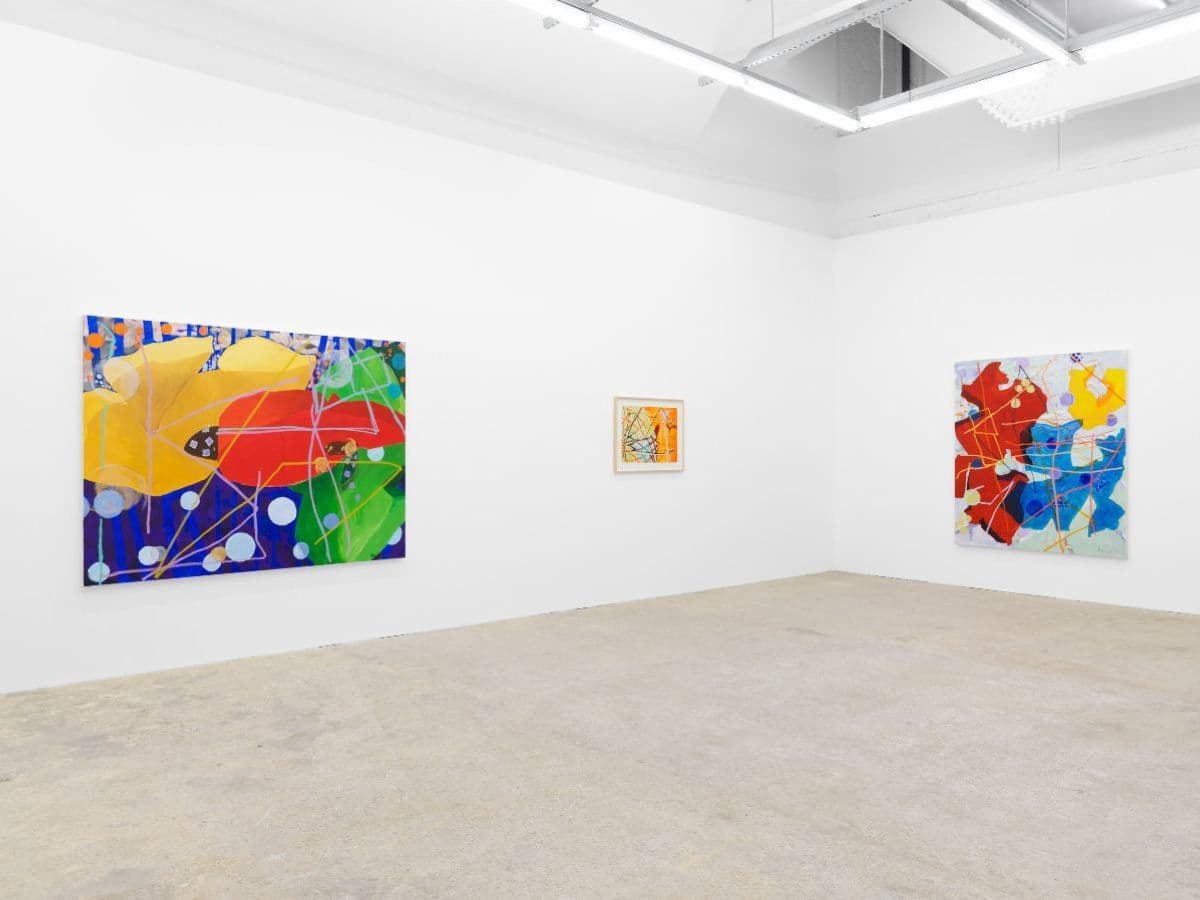
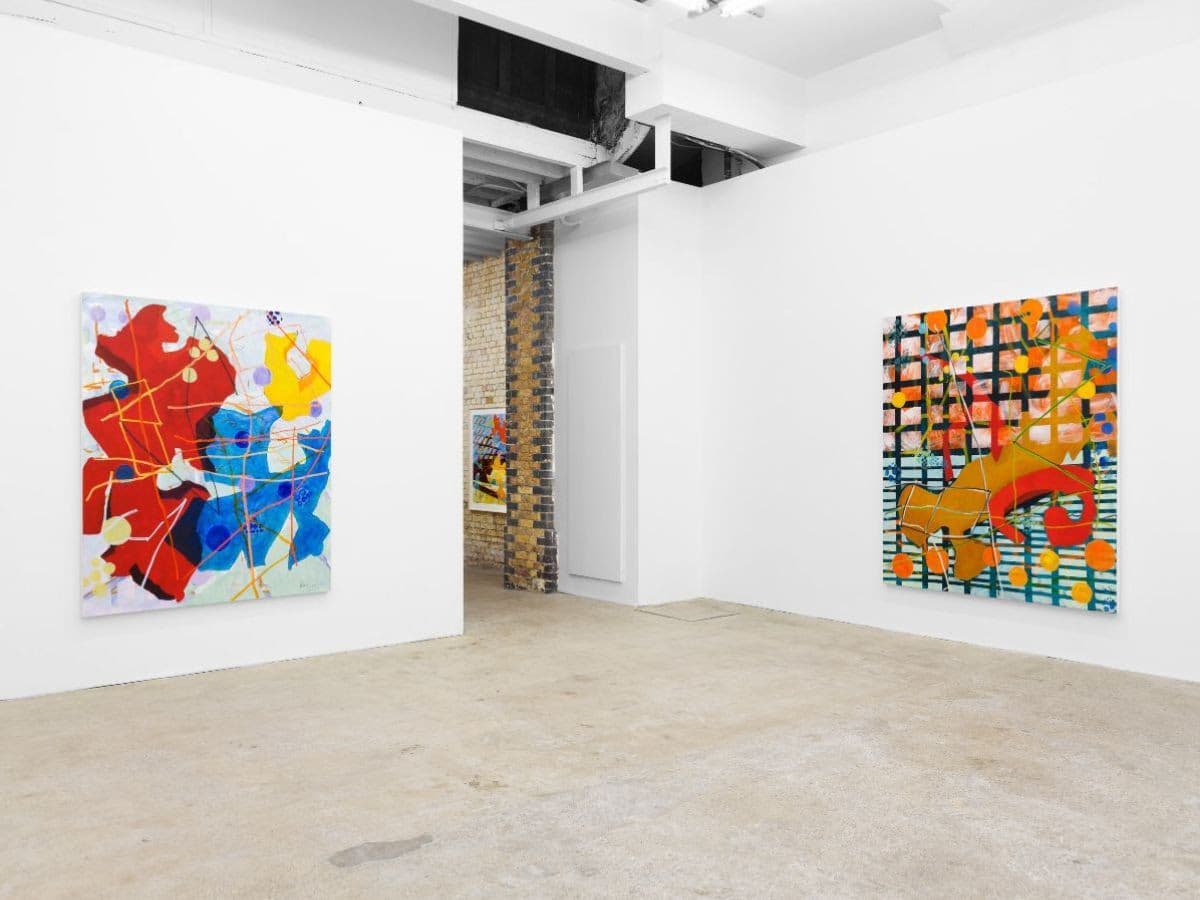
Hollybush GardensCynthia Hawkins has investigated the potential of abstract painting since the 1970s. Her process-oriented practice explores diverse literary, philosophical, and scientific influences and embraces the improvisational, whilst simultaneously creating a systemised space for her continually evolving vocabulary. Hawkins’ first solo exhibition at Hollybush Gardens features a new body of large-scale paintings from her ongoing series Wander/Wonder: Maps Necessary for a Walk in 4D (2023–), alongside a number of smaller works on paper. The paintings refer directly to a series of drawings the artist made for a sculpture titled A Walk in 4D (1978/79), based on the journey from her Upper West Side apartment to the 86th Street subway station in New York. She writes: ‘Lately I’ve been using my own history of work to make new work.’[1] Hawkins situated this walk in the fourth dimension: space-time, as she perceived it in that moment, elevating the path at a forty-five degree angle, speaking to one’s movement through time and the world. The series is also inspired by Marshall Island stick charts, made from wooden strips and cowrie shells, which represent a system of mapping ocean swells and wind patterns. The charts were studied by inhabitants of the Marshall Islands prior to voyages on the Pacific Ocean, as a form of cartography reliant on memory and bodily navigation. Each painting is comprised of multiple layers. Hawkins begins with a single map laid on the background which is transformed into new iterations and populated by her lexicon of forms – transparent circles, translucent orbs and biomorphs of varying shapes and sizes – which recur and appear to float in suspension across the canvases. Some elements are discrete, but intentionally so. The grid is always present – sometimes enlarged and fully visible, such as the deep blue grid which lies flush with the picture plane in Chapter 4: Maps Necessary for a Walk in 4D #4 atop swirling orange gestural brush marks underneath, and at other times partially obscured or slanted away from the canvas, as in Chapter 4: Maps Necessary for a Walk in 4D #10. The grid serves to accentuate depth and create a sense of three dimensional space within the works. The final layer of each painting is a surface map composed of cartographic lines, or paths, rendered in different colours of oil bar, which criss-cross over each other; a reference perhaps to Hawkins’ interest in quantum entanglement: the theory that everything in the universe is connected by intersecting lines. Chapter 4 also features large paintings in landscape format, such as Chapter 4: Maps Necessary for a Walk in 4D #7, which depicts three overlapping biomorphs in golden yellow, red and green against a vivid blue gridded background, which shift in tone as the elements meet and touch, and is populated by circles of varying densities which pulse across the canvas like particles of energy. Working in this orientation allows Hawkins to move across the surface of the painting in a new way, forcing a ‘stretch’ in the way that paint is applied to the canvas and the way the drawing occurs, initiating a structural change, and impacting the colour choices made at the beginning of the work. The works on paper are often smaller scaled with varying intensity; they are not preliminary studies, but rather, executed during the course of making the paintings, as ongoing experimentations as to their possible outcomes, such as Untitled: Regarding Chapter 4 #8, which includes a spherical pistachio green grid against a deep orange background. For Hawkins, abstraction is an act of resistance, allowing her to draw upon what is objectively real and concrete, whilst enabling her to reinterpret or reimagine it as something cosmic and limitless. The works do not offer easy answers, but are open to possibilities. Her maps are about getting somewhere – another dimension, another galaxy, or another place – making connections between what is near and what is far. As Kris Cohen writes: ‘Her abstraction is a cosmology. A mesh that is never certain of its coordinates, only its tendencies and its traditions for unlearning and mending. In Hawkins’ ligamental abstraction, there are no enemies, only obstacles, assays, re-assessments, and moving on.’[2] Cynthia Hawkins (b. 1950, Queens, New York; lives and works in Poughkeepsie, New York) has exhibited widely in New York and the United States throughout her career. She received her doctorate in American Studies from the University of Buffalo, SUNY, with a dissertation titled, ‘African American Agency and the Art Object, 1868–1917’. From 2007– 2021, she was director and curator at the Bertha V.B. Lederer Gallery, SUNY Geneseo, New York. She has presented solo exhibitions at Just Above Midtown, New York (1981); Frances Wolfson Art Gallery, Miami (1986); Cinque Gallery, New York (1989); Queens College Art Center (1997); Buffalo Museum of Science, Buffalo (2009); STARS, Los Angeles (2022); Ortuzar Projects, New York (2023), kaufmann repetto, Milan (2024) and Paula Cooper, New York (2025). Hawkins is included in the 36th Bienal de São Paulo Not All Travellers Walk Roads, on view until January 2026, and was included in the significant survey exhibition Just Above Midtown: Changing Spaces at the Museum of Modern Art, New York (2022). Hawkins has received numerous awards, including the Helen Frankenthaler Award for Painting (2023); the Black Metropolis Research Consortium Fellowship (2009); The Herbert and Irene Wheeler Foundation Grant (1995); and the Brooklyn Museum Art School Scholarship (1972). CARA presented Hawkins with its annual Legacy Award in October 2024. Her work is in numerous public collections, including the Studio Museum in Harlem, New York; the Bronx Museum of the Arts, New York; Kenkeleba Gallery, New York; the La Grange Art Museum, Georgia; and the U.S. Department of State, Washington, DC. In 2024, Bomb published an expansive Oral History with Hawkins and Art Notes, Art, a new publication that records her early work and the Black gallery scene of 1970s and 1980s New York, was published by CARA. 1 - Cynthia Hawkins, ‘An Oral History with Cynthia Hawkins by Julia Trotta, Bomb Magazine, July 2024, bombmagazine.org/articles/ 2024/07/02/an-oral-history-with-cynthia-hawkins-by-julia-trotta/ 2 - Kris Cohen, ‘Cynthia Hawkins: Ligamental’, Cynthia Hawkins, Maps Necessary for a Walk in 4D, Hollybush Issue 19, 2025