
Chinatown, New York
Doug Henders
Gradient Maps
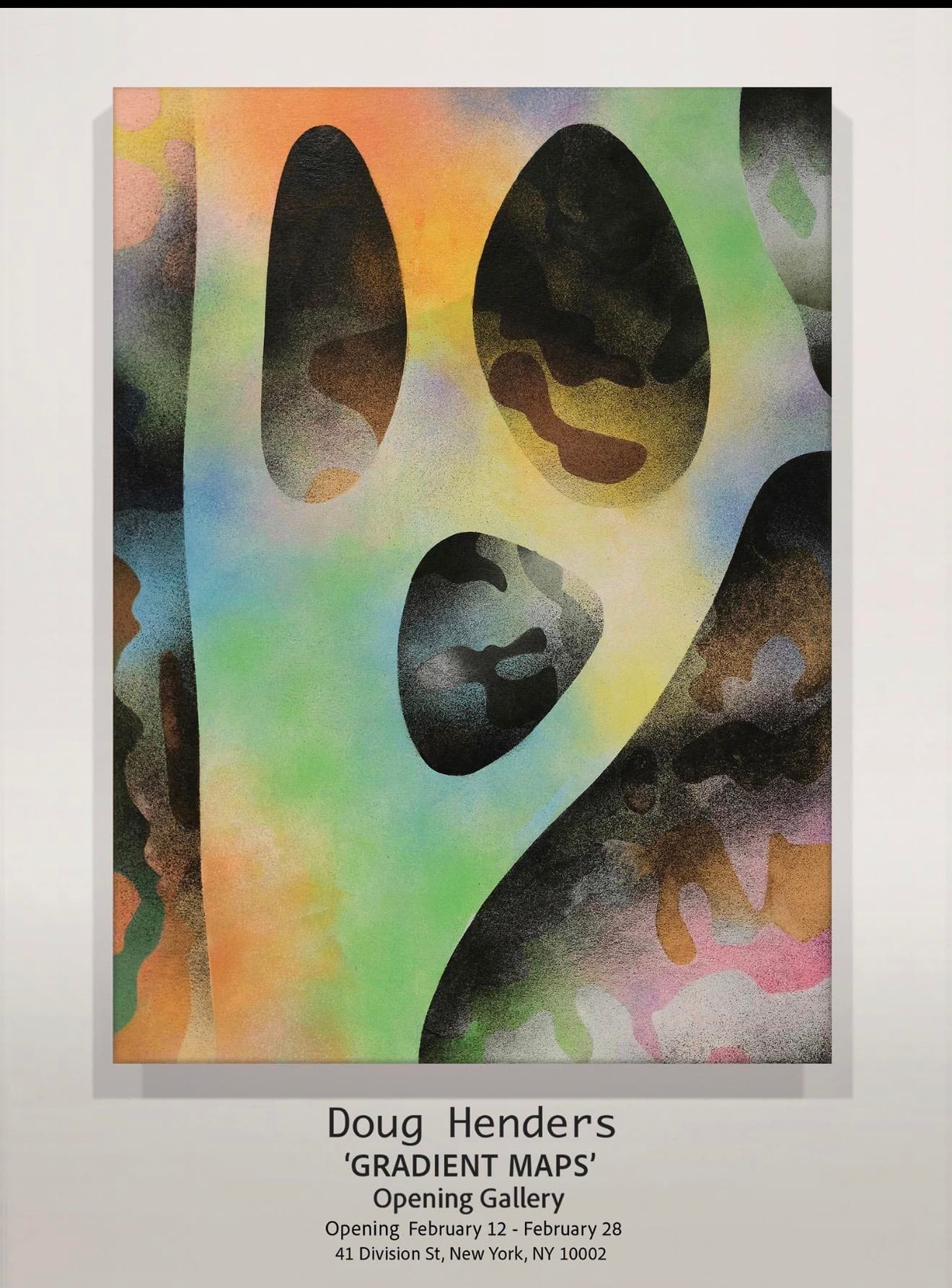
The Opening GalleryThe Opening Gallery is pleased to present Gradient Maps, a solo exhibition of new paintings by Doug Henders. The works explore how perception, memory, and attention take shape through images that bypass language and circulate faster than thought, shaping how attention is captured and experienced. Spray-painted abstractions and biomorphic forms suggest imagined landscapes while simultaneously turning inward—toward the body, intuition, and shared experience. The work proposes mapping not as a fixed system, but as a fluid process shaped by feeling, movement, and time. Created using industrial spray guns, rollers, and stencils, the painting allows color and spatial depth to emerge fluidly, without fixed hierarchy or narrative. Layered surfaces create a sense of ambient space, where color and gesture circulate freely. Henders’ use of stencils—often evolving into sculptural works—blurs the boundary between process and product. Familiar forms—faces, gestures, and fragments of visual memory— surface and dissolve, hovering between recognition and ambiguity. Gradient Maps reflects a contemporary condition in which seeing and experiencing are increasingly shaped by scanning, repetition, and image circulation. The work invites slower looking and open interpretation, offering painting as a space where attention becomes something felt, chosen, and continually in motion. The works examine how perception and attention are shaped in an image-saturated environment, where images circulate rapidly and bypass language. Using spray-painted abstractions, biomorphic forms, and layered surfaces, Henders approaches mapping as a fluid, intuitive process rather than a fixed system, inviting sustained looking in contrast to the speed of contemporary image culture. Doug Henders is a contemporary artist whose work explores the intersections of identity, perception, and place through layered portraits, figures, and imagined landscapes. His practice is informed by an early background in cartography at U.S. Army Headquarters in Germany during the 1980s, where the visual logic of mapping, surveillance, and spatial abstraction—alongside exposure to German painters such as Polke, Richter, and Oehlen—first shaped his thinking. Blending analog and digital processes, including photography, music, painting, and sculpture, Henders reflects on how identity is formed and mediated within a media-saturated environment. His work seeks to slow perception and restore a sense of presence, drawing on mindfulness and spiritual resonance as counterpoints to acceleration and image overload. Subtly, the work plays on the historical connection between modernism and information gathering—an association that officially “does not exist in the work itself,” borrowing the language of intelligence. Over the past 25 years, Henders’ work has been exhibited internationally in galleries, museums, and biennials.