
Marais, Paris
Tunji Adeniyi-Jones
Fragments
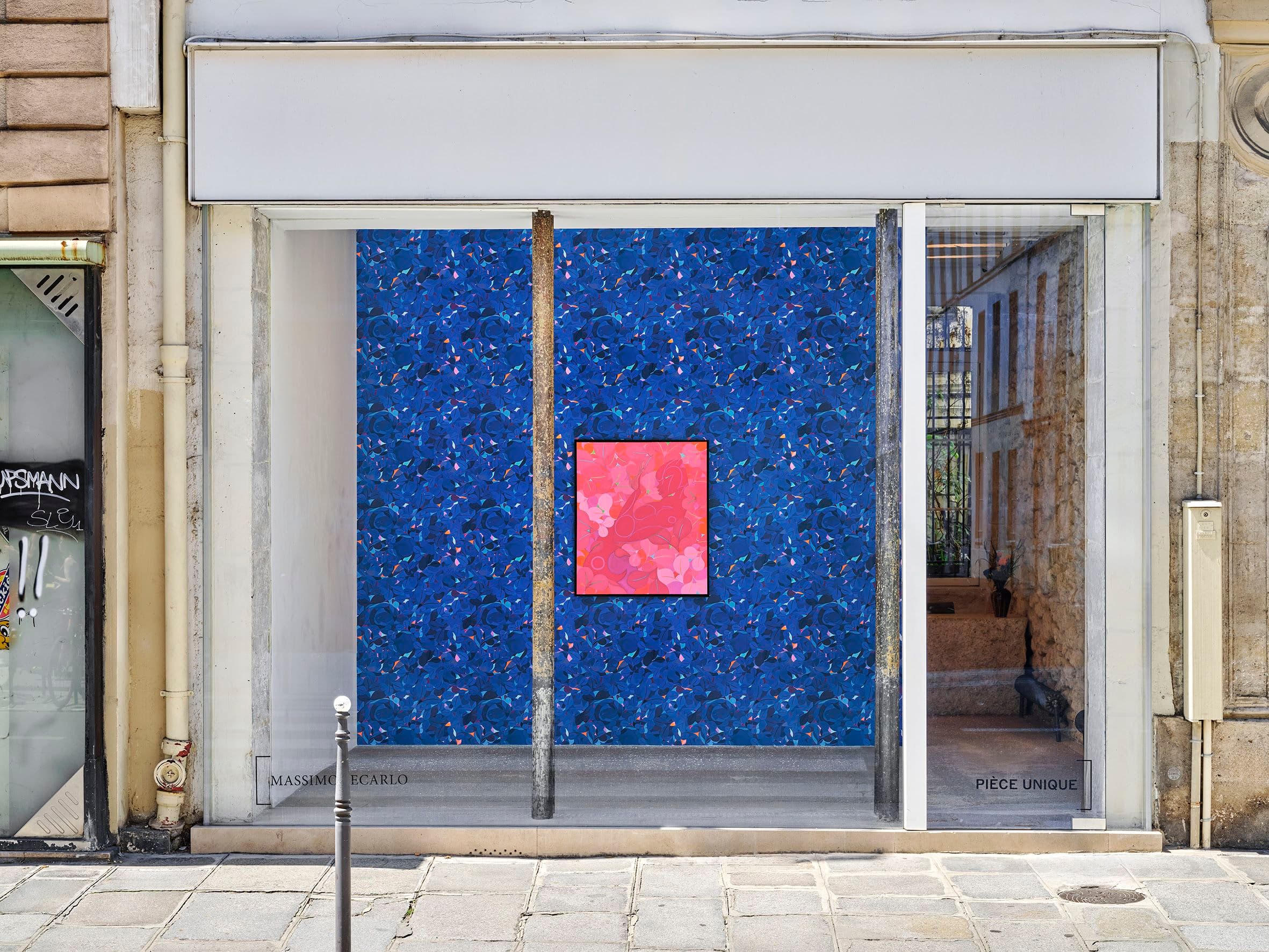
Massimo De Carlo Pièce UniqueMassimo De Carlo Pièce Unique is pleased to present Fragments, an exhibition of new work by Tunji Adeniyi-Jones. Fragments is the most public Adeniyi-Jones has been in Paris. Born in London, based in New York, and equally at home between West African, African American and European art histories, he is an artist whose practice has always been shaped by movement - by what happens to a body of work as it crosses contexts. The show occupies the window of Pièce Unique - a new wallpaper of hand-drawn leaf and floral motifs on the wall, a single pink painting against a blue ground. Adeniyi-Jones has been thinking about this kind of exposure for a while. The wallpaper, begun at the end of last year, is his newest attempt to work it out - a way of expanding beyond the canvas, as he puts it, while keeping the hand at the centre. “The subject, the core of it, is hand-drawn always,” he has said, and you can feel it beneath the pattern's regularity, that slight pulse of a line a body made. Translated into repeat, it becomes something else: part painting, part printmaking, part textile. It's a conversation he has always wanted to have. He has described William Morris and William de Morgan as "a rare point of kinship between British culture and African textile," two lineages he grew up with in equal measure, and has pointed out that Josef Albers, whose colour theory still runs through most Western art education, built it on the quiet study of African and South American antiquity - a debt that rarely gets named. The pink painting, Rose Sentinel (2026), pressing against the blue wallpaper, is no different: not a decorative choice but a structural one, the chromatic push and pull that runs through all his work, stretched here from the canvas across the entire room. For an artist who draws equally from Yoruba mythology, the Harlem Renaissance and European art history, Paris is not a neutral setting. Adeniyi- Jones has talked about how the same work takes on entirely different connotations depending on where it's shown - in West Africa the motifs become immediately legible as textile and fabric; in Paris they enter a conversation with classical ornamentation, with the city's decorative history, with everything visible through the glass. “There's not really one place it comes from,” he has said. Each one leaves a mark. Fragments follows Celestial Gathering (2024), the ceiling painting Adeniyi-Jones made for the Nigerian Pavilion at the 60th Venice Biennale, which he describes as the beginning of a new way of thinking about space - not as a container for painting but as something painting can generate. Ideally, he says, this is the start of something.