Chinatown, New York
Sally Scopa
Ready for Ceremony
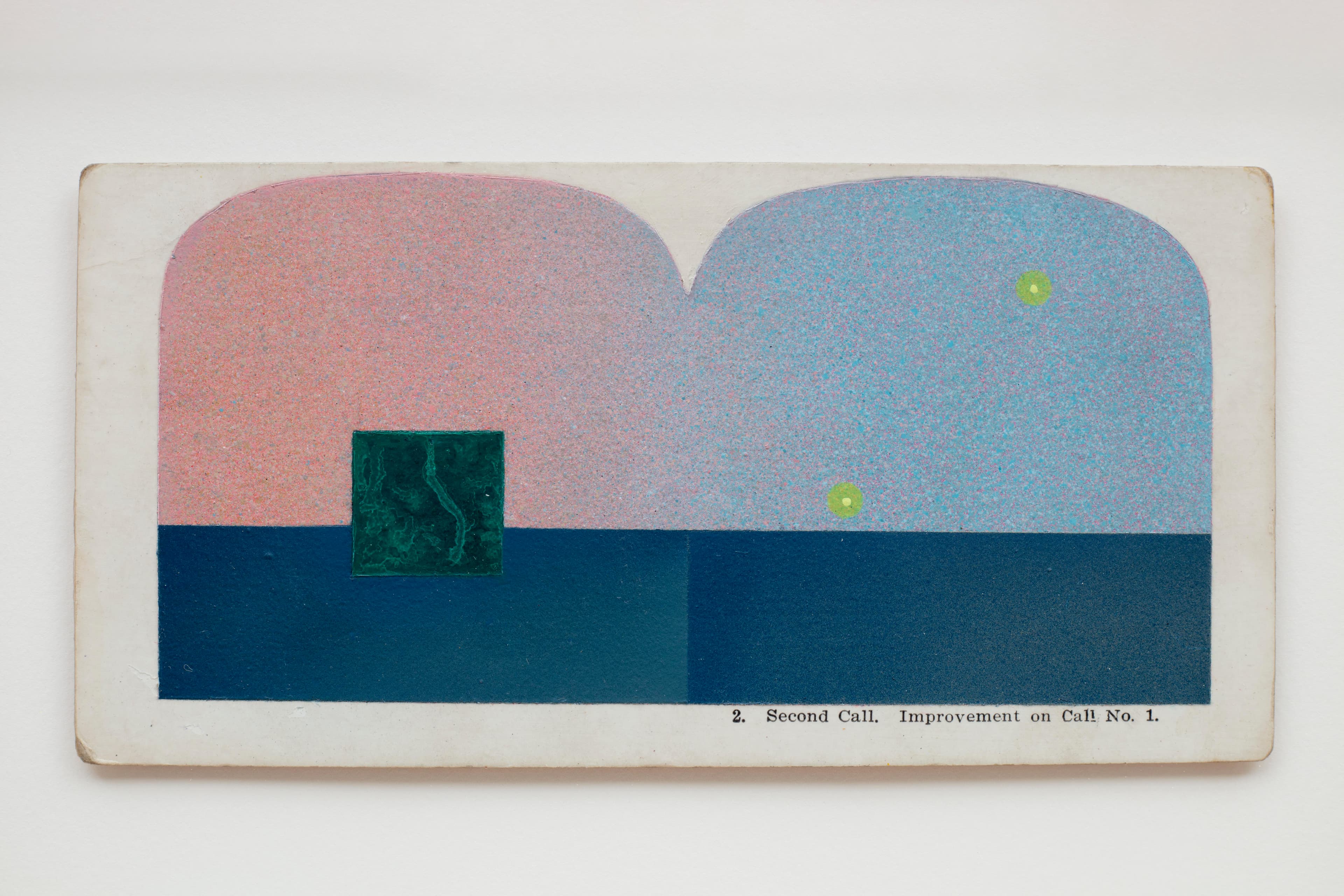
Oolong GalleryThe third solo presentation by the artist with Oolong Gallery "A show of small paintings over stereocard (nineteenth-century paper slides of paired photographs that appear to form a 3D image when viewed through a stereoscope) presented to us like small jewels—busy pointillist dreamscapes in pink, yellow, and blue that totally obscured the underlying pair of photographs. It seemed no coincidence that many of the compositions mimicked the multicolor petri dish of dots that form Ishihara color blindness tests, drawing connections to the imperfect mechanics of human vision." —recent SF highlight in Art Forum by Bryan Barcena w/ Andrew Berardini Sally Scopa is a painter based in Bellingham, Washington. She has been awarded residencies at the Skowhegan School of Painting and Sculpture (Madison, ME), Mass MoCA (North Adams, MA), the Cité internationale des arts (Paris, France) and SOMA (Mexico City, Mexico). Recent shows include solos with Bass & Reiner Gallery (San Francisco, CA) and Oolong Gallery (Rancho Santa Fe, CA). Recent fair presentations include Nada Miami Solo (2024) and Felix Art Fair, Los Angeles (2026), both presented by Oolong Gallery. She has participated in group exhibitions at El Museo de la Ciudad (Querétaro, MX), 550 Gallery (New York), Ladies’ Room LA (Los Angeles) and Radio28 (Mexico City). Scopa holds a BA in Visual and Environmental Studies from Harvard University and an MFA in Art Practice from Stanford University. Her work has been featured in a variety of publications including Artforum, Variable West, New American Paintings and KQED. She is originally from San Francisco, California. Artist Statement about the new body of work: "In my work, paired images on antique stereographs become a framework for miniature paintings that play with doubling, erasure and time. Stereographs date back to the 19th century, when they were a popular form of home entertainment. The stereoscope—a handheld viewfinder resembling wooden binoculars —leveraged the newly discovered phenomenon of binocular vision to create an illusion of three-dimensionality. At three inches tall and seven inches wide, stereograph cards are shaped like elongated postcards, and each one bears two near- identical copies of an image.When observed through the viewfinder, the paired images on a card converge to give the appearance of depth. I love that many stereographs are captioned with text, and the tension I can create by covering over the original image with my own while leaving the caption visible. The cards in Ready for the Ceremony were printed in 1905, and come from an incomplete set of stereographs showing “The 25 Stages From Courtship to Marriage” of a Victorian-era couple. I think about how one form of image-making can exist like a barnacle upon or within another form, and how paintings can be like interlopers in other technologies. Though the captions on each piece in this series are about a couple approaching their wedding day, I wasn’t thinking much about romantic marriage when making the work; rather, I was thinking about how to reconcile or join together two different, seemingly incompatible views of the world. Painting the remains of a device that came from an earlier era of rapid technological transformation allows me to think about our current technological moment, which strips people of their attention and erodes faith in what they see. It becomes almost essential to reflexively blunt the keenness of our observational powers to withstand the constant torrent of information shaping the media environment. I’m driven to make art by a sense that we don’t need to surrender to this tide and can remain rooted in a material present. Though it is easy enough to paint a functional stereograph that looks three-dimensional within the stereoscope’s viewfinder, it is important to me that my paintings interrupt the original illusion. The small abstractions I paint gum up the works, replacing the three-dimensionality of the stereoscope with painted imagery that remains stubbornly what it is. The structure of the card invites the desire to look through or into a space, but the painting on top frustrates this desire, asking viewers to remain where they are and to reflect on the act of looking itself." —Sally Scopa