

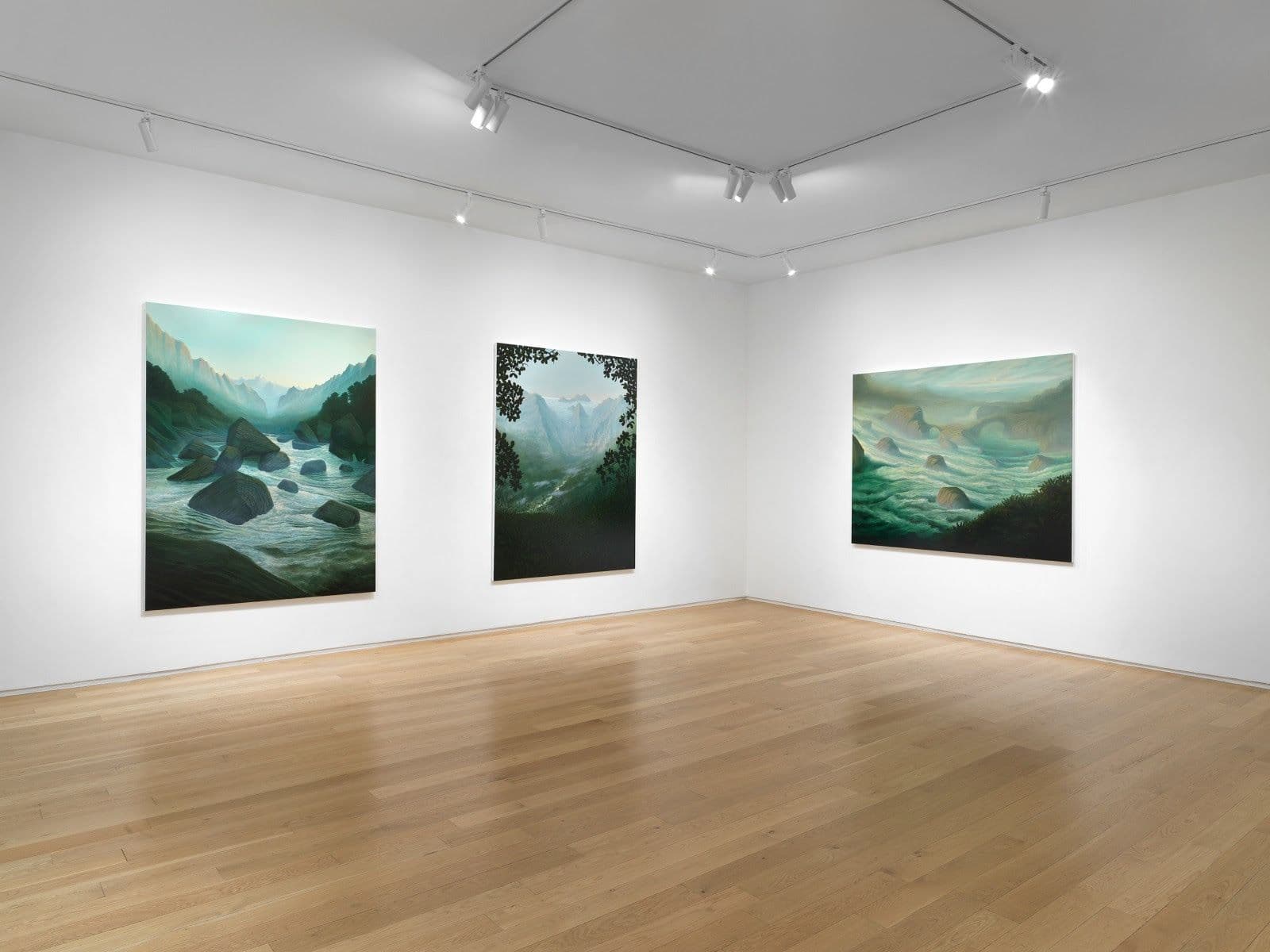
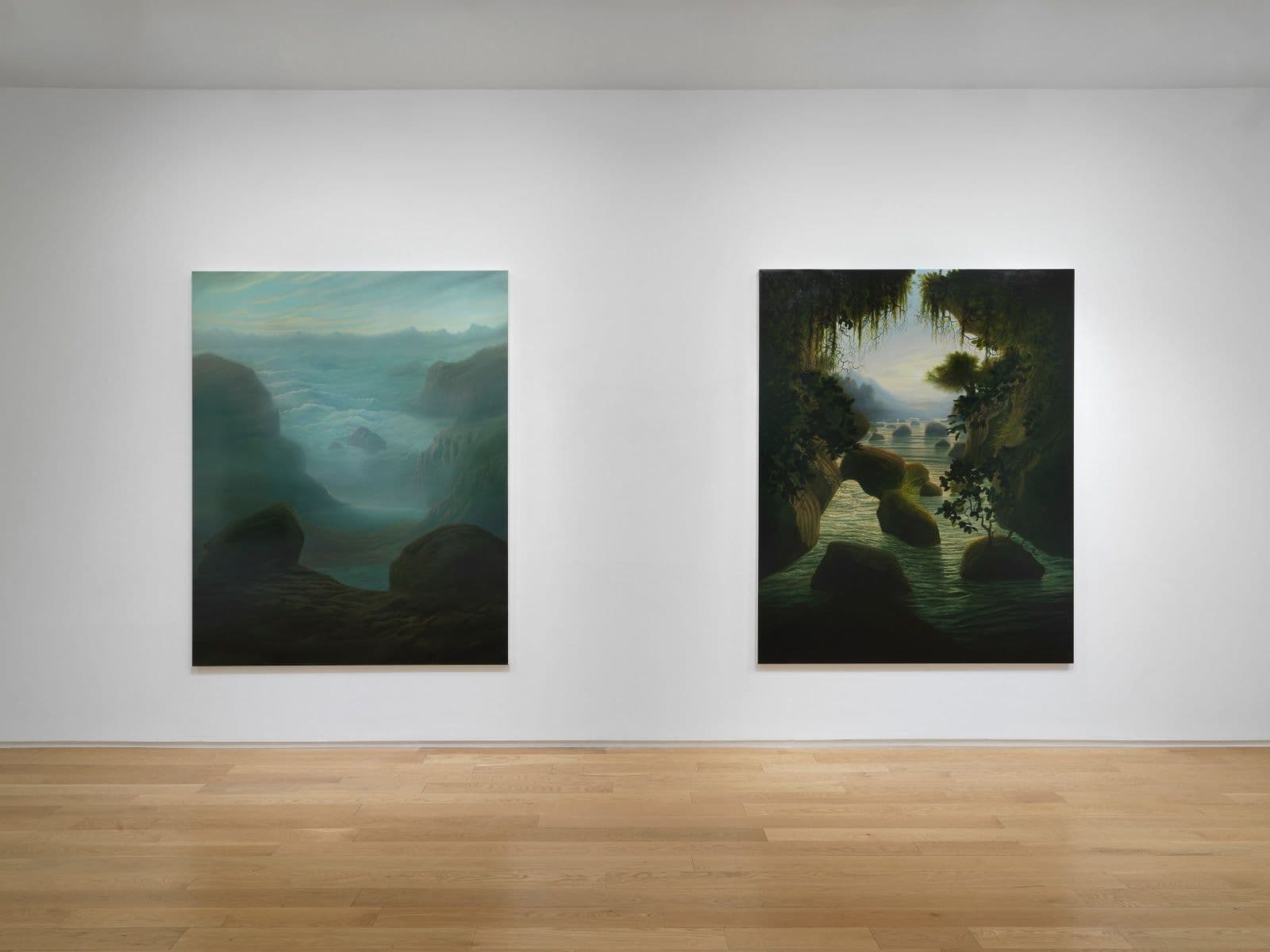
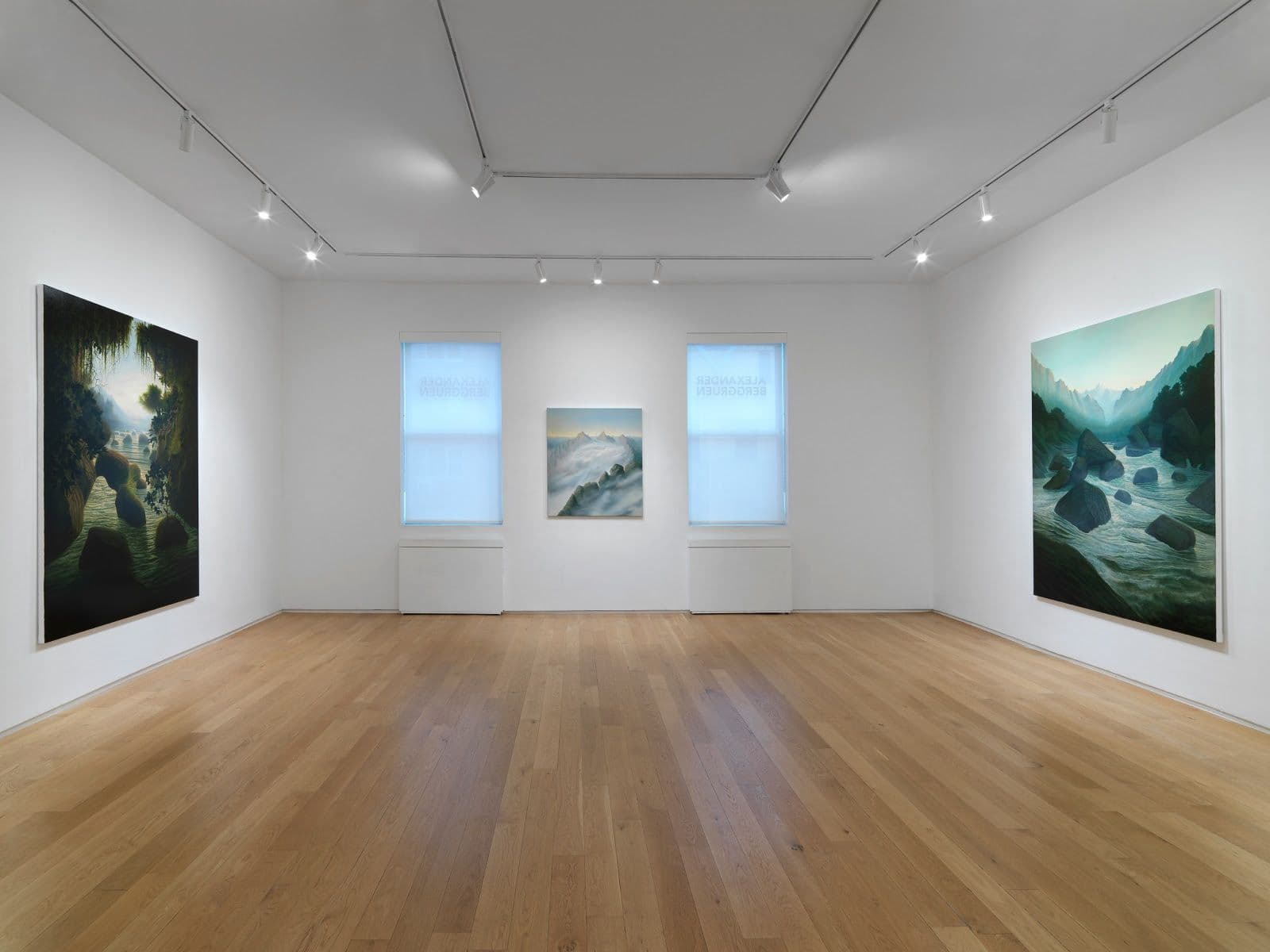
Upper East Side, New York
Sholto Blissett
The White Heat of Cold Water
Alexander BerggruenAlexander Berggruen is pleased to present Sholto Blissett: The White Heat of Cold Water. Sholto Blissett’s paintings explore the powers of nature and time through depictions of the strong forces of water. Notably absent from his new body of work is any semblance of human presence. Instead, the scenes in The White Heat of Cold Water present a dramatic relationship between water and the land it carves. His imagined landscapes continue to probe at our constructed understandings of the natural world, challenging the ways humans are alienated from it and often take it for granted. Where Casper David Friedrich’s monumental landscapes acted as a tool for contemplating God and the sublime, Blissett’s landscapes act as a tool for questioning how we define reality. In The White Heat of Cold Water, Blissett depicts nature’s sculptor in action: flowing and frozen water. Water is sacred in the paintings, as it is in many religions and belief systems. These scenes depict the erosion of land by water and ice. In the artist’s words, here, “as in the world, water is not a passive component of the landscape but rather the active architect of a landscape.” With a background in geography, the artist chose landforms that are the product of cold water’s force: deep u-shaped valleys, sculpted cave mouths, open plains, cavernous gorges, and rock arches. Alongside them are plants that are dependent on water, carrying, in the artist’s poetic words, “rivers of sap within them.” The title The White Heat of Cold Water refers to both the sensation of cold water and its erosive qualities. The artist describes “the white heat” as “the strange almost burning sensation you feel when you swim in cold water and the blinding brightness of clear, fast flowing water or ice when illuminated by sunlight.” He also points to “white heat” as “synonymous with action, dynamism, and technology.” The oxymoron of “heat” and “cold” in the title mimics the contradictory potentials of water: life-giving and constructive, while also destructive, inhospitable, and even deadly. Although the nature depicted resembles familiar real landscapes, they are neither from a specific location nor time. Conjured from a combination of the artist’s lived travels and fantastical fiction, they evoke an atemporality, perhaps from far into the past or future—or Life in deep time, as Blissett aptly titled his previous series. Inspired by the poetic light and allure of Arcadian idylls depicted by artists such as Claude Lorrain and J. M. W. Turner, Blissett’s convincing fluvial mountainscapes are shrouded in misty veils of humidity and water spray. They are composed of meticulous yet also Impressionistic short brushstrokes. This body of work presents a range of climates and light, some warm as in wanderer or descent, and some cooler as in vortex and sublimation. In most cases, Blissett dramatically employs chiaroscuro contrast by rendering the foreground much darker than than the center of the composition. The foreground is often used to disrupt the almost perfectly symmetrical composition. Here, a viewer is often placed on an angular patch of land or rock at one of the lower registers of the canvas. In other cases, the symmetrical order is interrupted by a body of water flowing from one side of the canvas to the other. Further, two of the paintings in this show sublimation and furrowed portray a waxing gibbous moon just above the mountain peaks, mimicking the artist’s theory of near-perfect symmetry and gesturing towards the cycle of life. Much like the contradictory nature of water and the title of this show, though the paintings present a harmonious order and peaceful landscapes, they also depict the wild turbulence of water. Through human invention and interference, the life of water has been divorced from much of our everyday interactions. While this has benefited humankind immensely, it often removes us from contemplating the element’s many forms. In fact, humans often abuse water, perhaps forgetting that it is a finite resource. A recent example includes AI data centers that guzzle copious amounts of water in already dry locations to keep the computing equipment both cool and protected from humidity. In Manhattan, where The White Heat of the Cold Water is exhibited, the artist points to the 1865 Viele Map which depicts a number of rivers that once flowed through New York City. Today, the subway system often floods where there was once a wetland.[1] The artist reminds us, “We often forget that New York is a city that arose precisely because of its location at the mouth of the Hudson. Like many great cities around the world and through time, it is born from a river.” The ways nature is depicted and understood in culture has political consequences. In Blissett’s work, nature prevails. —Kirsten Cave 1 - According to Eric Sanderson, the vice president for Urban Conservation Center for Conservation and Restoration Ecology at the New York Botanic Garden, as cited by Stephen Nessen and Ramsey Khalifeh in “NYC subway geyser caused by ancient Manhattan stream,” Gothamist, Jul 18, 2025.