

Marais, Paris
Ugo Rondinone
A Rainbow . A Nude. Bright Light . Summer
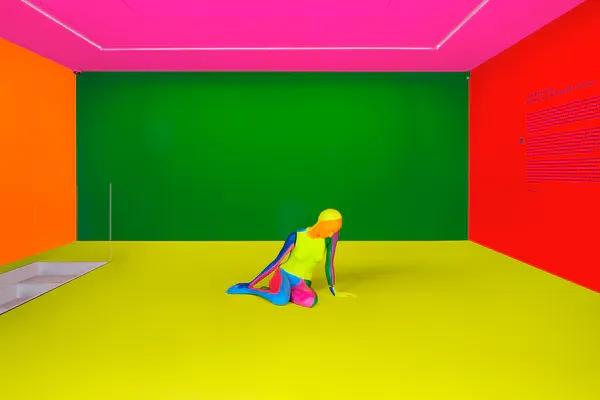
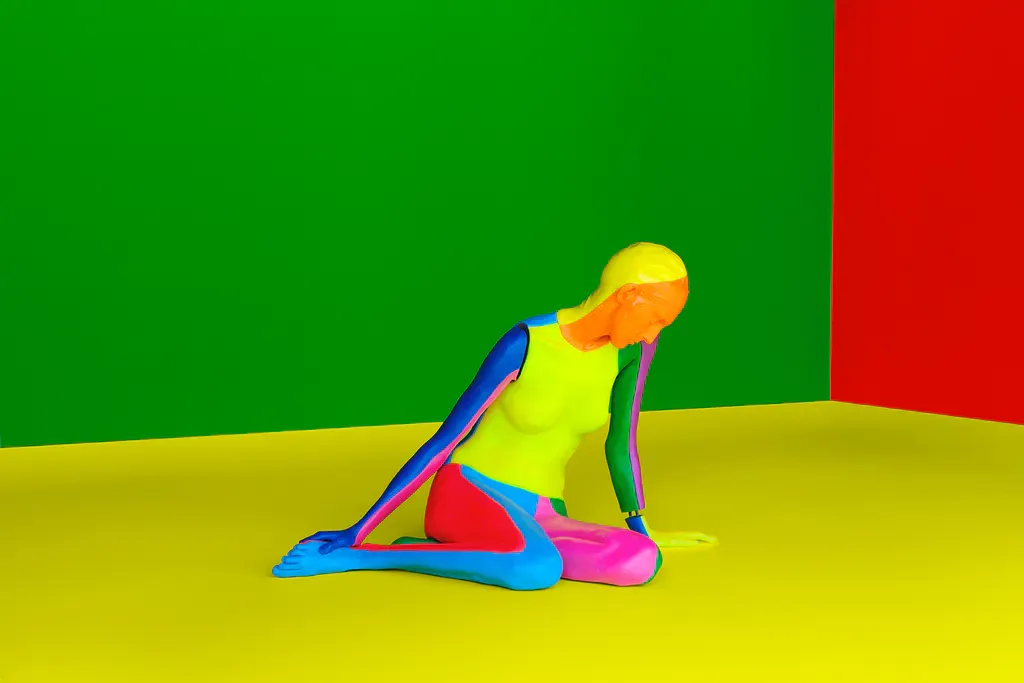
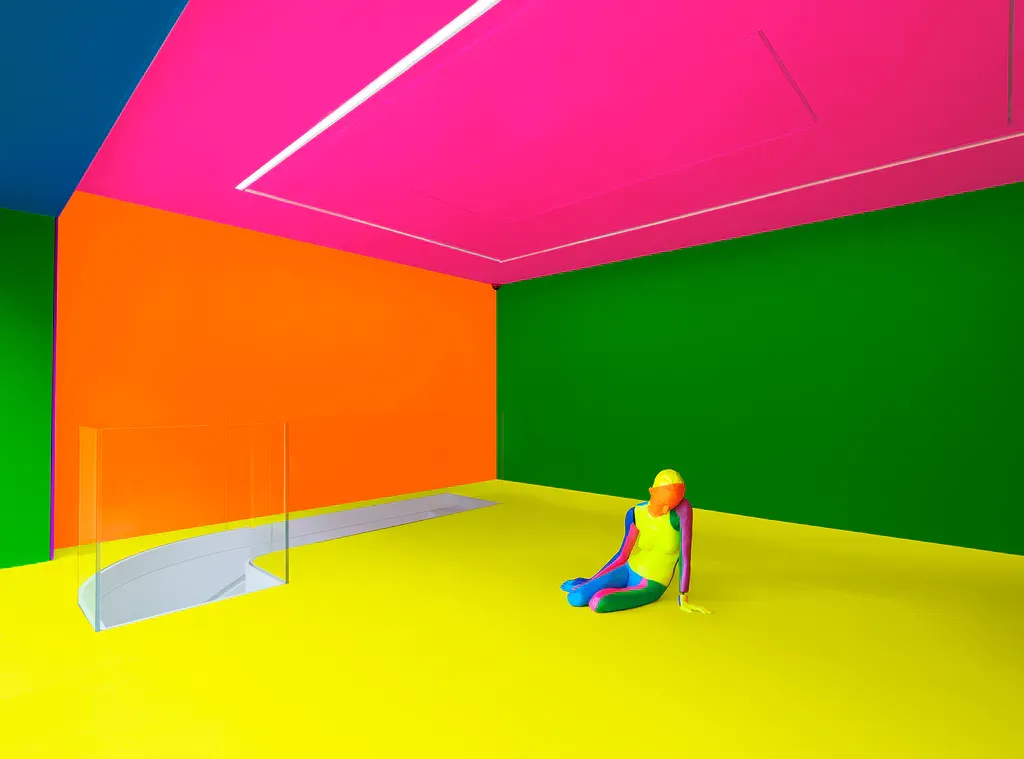
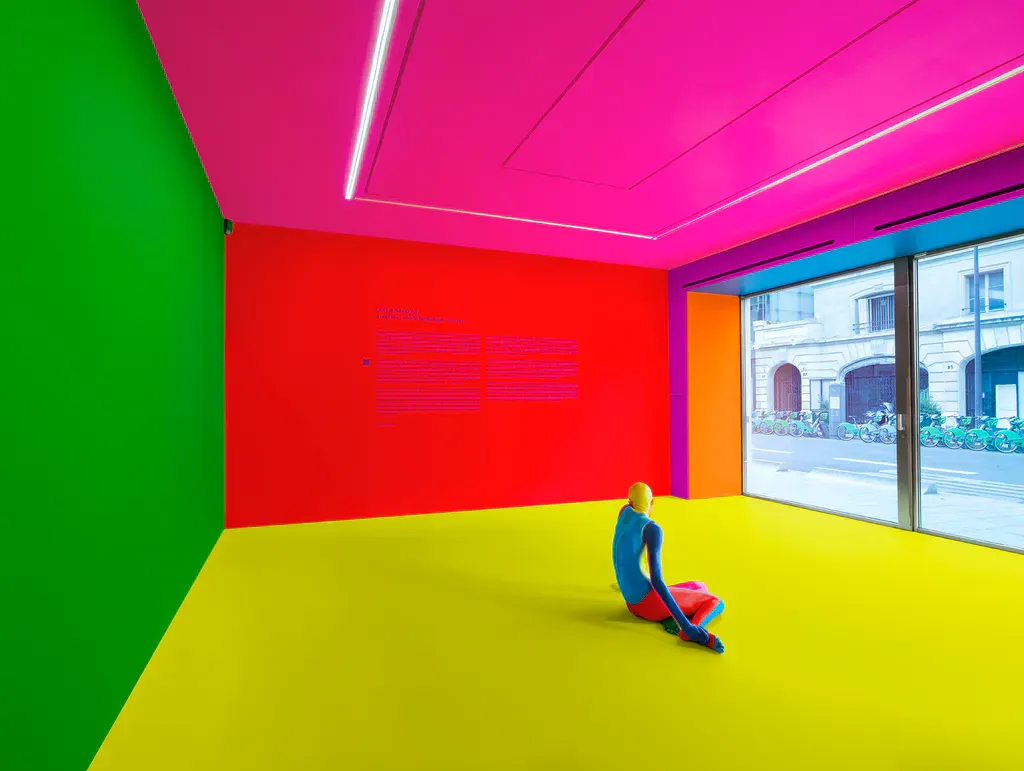
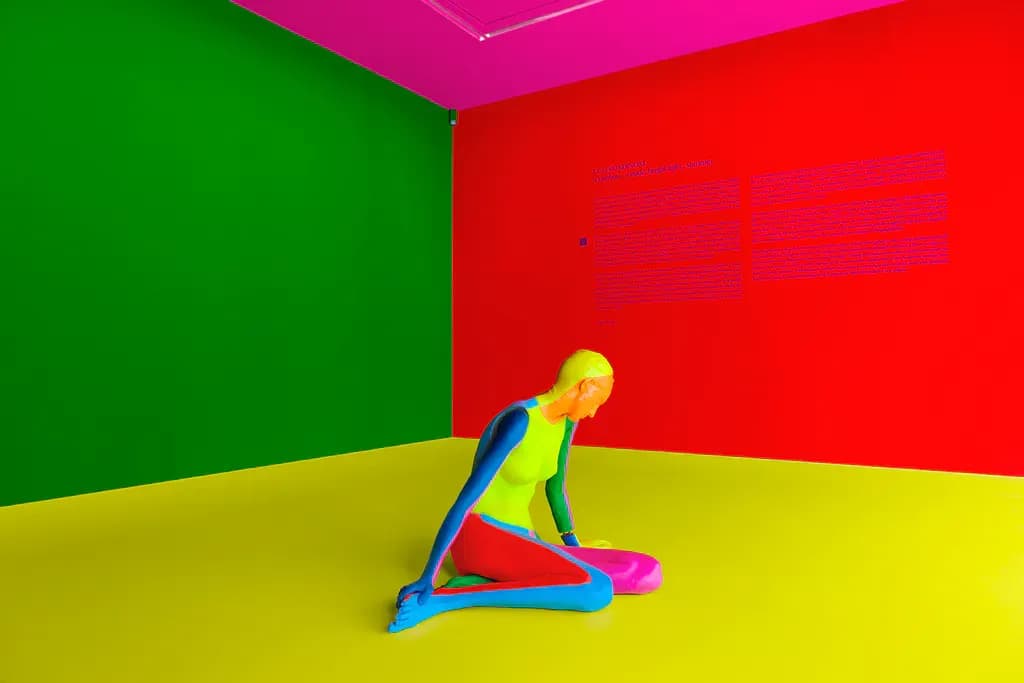
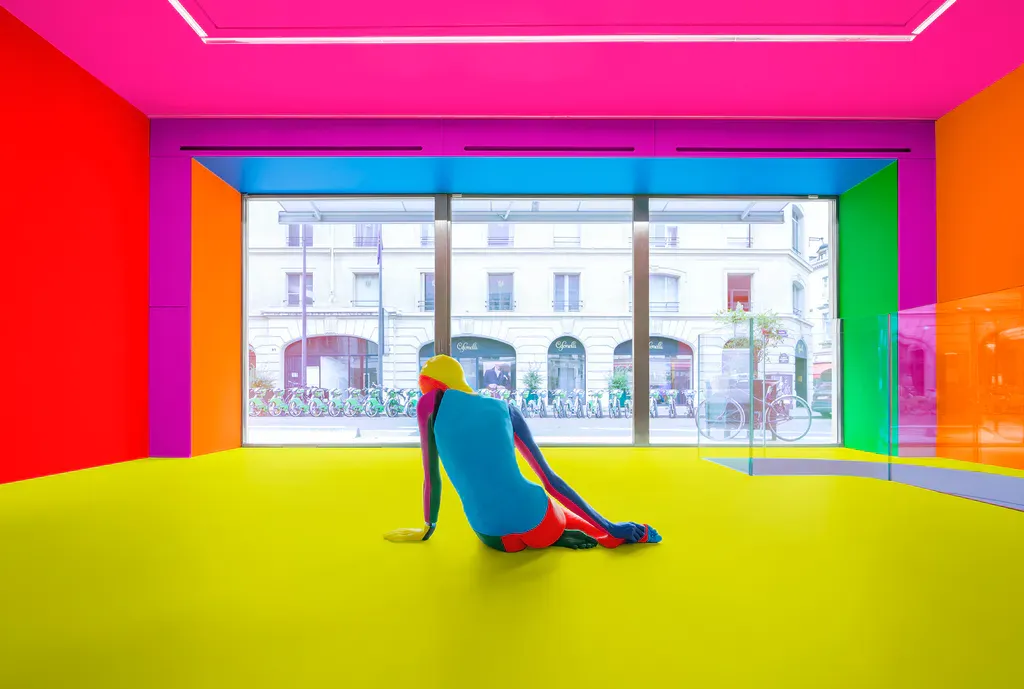
Kamel Mennour[Scroll down for French version / Veuillez trouver ci-dessous la version française] A naked woman is sitting on the floor. Her eyes are closed. Her head is bowed. As is her upper body, stabilised by her left arm, while her right arm, slightly further back, rests on her foot. The sculpture is human in appearance and visibly moulded from a model full of bodily vigour – and for good reason: this is a dancer. Yet this sculpture makes no attempt at concealing an artificiality – reinforced by the application of colour on the body – springing from the production process, as attested by the treatment of certain joints and the intentional visibility of strings which, like those of a puppet, exclude any pretensions to hyper‑realism. The woman is situated in a polychrome space open to the street, allowing her surroundings to be flooded with summer light. She blends into her setting, where the more "natural" matrix sculptures had made play with contrast. The work derives from a family of nudes Rondinone created in 2010‑2011, using a mix of wax and earth colours. In this group dating back 10 years or so, as in the sculpture on display here, we can detect speculation about tempus fugit that is only exacerbated by the disparity between the vitality of the mature bodies and the fragility of the wax. A beautiful, all but untranslatable German word reflects this separation and transience: Vergänglichkeit. Equally significant is the polychrome character of this sculpture, echoed in the gallery's walls, ceiling and floor (it should be remembered that for Ugo Rondinone, the exhibition and its presentation approach constitute a “form” in their own right and are in no way reducible to a mere “neutral” envelope). Coming in the wake of a number of polychrome sculptures produced in recent years, this is a perfect example of the transmutation characteristic of the Rondinone method: from family to family, processes of hybridisation, transfer and mutation intermingle and enrich his work with additional intertextual layers. A constantly renewed work in progress of which this nude is a new chapter. —Erik Verhagen ***** Une femme nue est assise par terre. Ses yeux sont fermés. Sa tête inclinée. Tout comme son buste stabilisé par son bras gauche tandis que le droit, légèrement en retrait, s’appuie sur son pied. D’apparence humaine et visiblement moulée à partir d’un modèle témoignant d’une vigueur corporelle – et pour cause, il s’agit d’une danseuse –, la sculpture ne dissimule pas pour autant son artificialité, renforcée par les couleurs appliquées sur le corps, née du processus de fabrication comme l’attestent les jonctions au niveau de quelques articulations laissant en outre transparaître des fils qui, à l’image de ceux d’un pantin, désolidarisent le nu de toute ambition hyperréaliste. La femme prend place dans un espace polychrome ouvert sur la rue qui permet à celui‑ci d’être inondé d’une lumière estivale. Elle se fond dans le décor là où les sculptures matricielles, plus « naturelles », jouaient la carte du contraste. L’œuvre découle en effet d’une famille de nus créée par Ugo Rondinone en 2010‑11 et produits à base d’un mélange de cire et de pigments de terre. On peut déceler dans le groupe conçu il y a une dizaine d’années comme dans la sculpture ici présente une interrogation sur le tempus fugit que l’écart entre la vitalité des corps arrivés à maturité et la fragilité de la cire ne fait qu’exacerber. Un très beau terme allemand difficilement traduisible reflète ces écartèlement et passage : la Vergänglichkeit. Reste à évoquer la qualité polychrome de cette sculpture qui trouve un écho dans les murs, plafond et sol de la galerie (rappelons que pour Ugo Rondinone, l’exposition et les dispositifs de présentation relèvent d’une « forme » à part entière et ne se résument en aucun cas à une simple enveloppe « neutre »). S’inscrivant dans la continuité de nombre de sculptures polychromes produites ces dernières années, elle est le parfait exemple d’un phénomène de transmutation propre à la démarche de cet artiste où de famille en famille, des processus d’hybridation, de transfert et de mutation s’opèrent et s’enchevêtrent afin d’enrichir son œuvre de couches intertextuelles supplémentaires. Un work in progress incessamment renouvelé dont ce nu compose un nouveau chapitre. —Erik Verhagen