
East, London
Ian Hamilton Finlay
Fragments
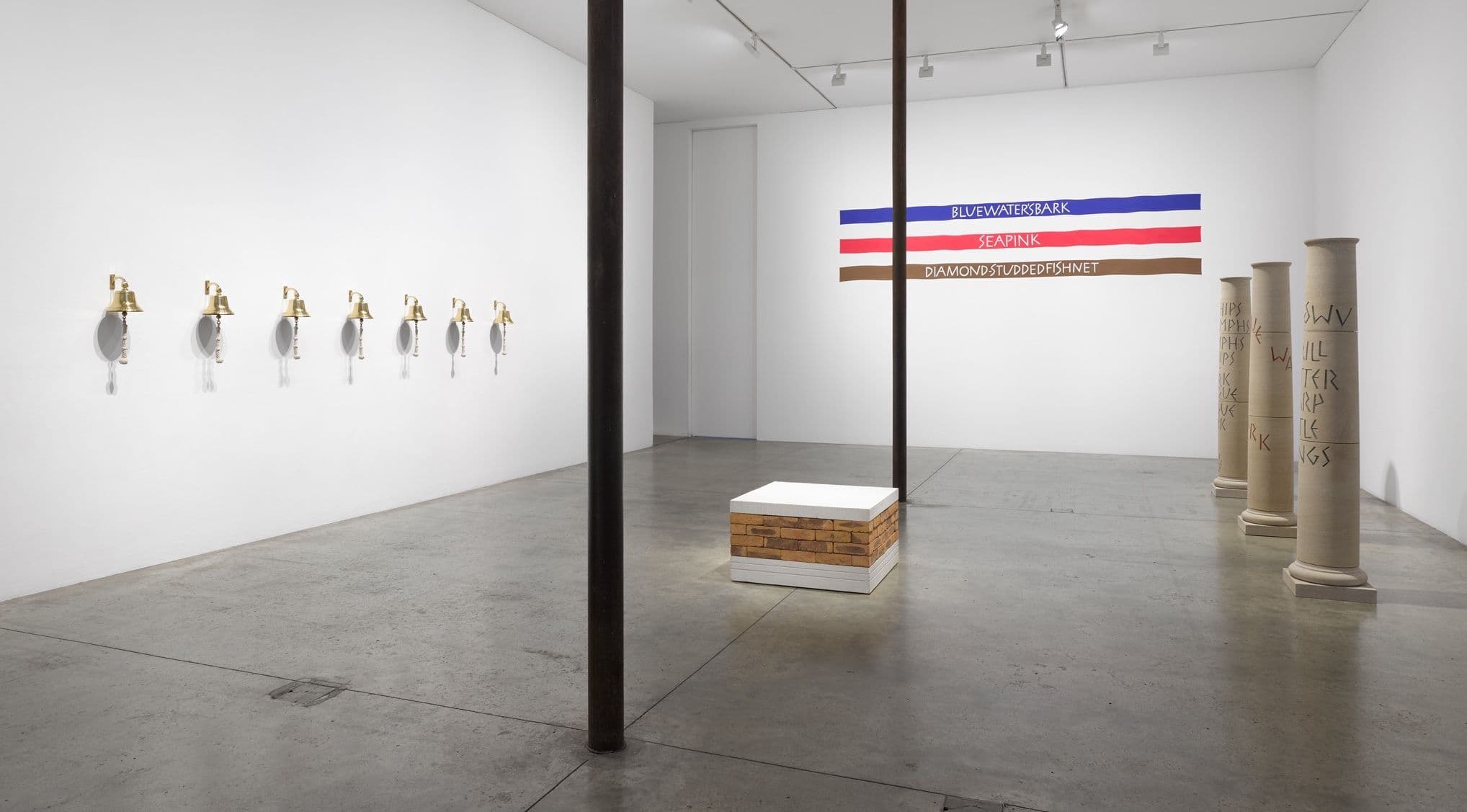
Victoria MiroAn exhibition marks the centenary of the birth of one of Scotland's greatest artists, Ian Hamilton Finlay. Fragments is both a major new book and eight international exhibitions, curated and edited by Pia Maria Simig. An artist, poet, and landscape designer, Ian Hamilton Finlay (1925–2006) reinvigorated the classical tradition in a body of work that encompasses a variety of creative forms to celebrate the sustaining power of words. He is best known for his garden Little Sparta, set in the Pentland Hills, near Edinburgh, where he lived and worked for the last 40 years of his life. He significantly influenced the concrete poetry movement, and his extensive printed poetical and graphical works were published by Wild Hawthorn Press, which he co-founded in 1961. His visual art work, achieved in collaboration with expert artists and craftspeople, can be found in museums, parks, and gardens worldwide. Drawn principally from the 1990s, and featuring sculpture in stone, wood, and neon, as well as wall painting, tapestry, and print, works on view at Victoria Miro are curated around the themes of ‘revolution' and ‘maritime'. Representing a moment of enormous political and aesthetic rupture and signaling a great moral as well as political leap, the French Revolution proved a rich subject for Finlay; he first received international attention for his guillotine installation A View to the Temple at Documenta 8 in Kassel in 1987 and thereafter the guillotine became one of the most enduring elements of his iconography. The late author, critic, and artist Tom Lubbock commented, ‘A prominent (and to some, puzzling) theme of this period is the French Revolution. Finlay once explained its origins simply. His first public installations had been constructed to such low standards that he had thought, "We need a revolution. So I looked to see what revolutions there had been." The (classically inspired) French Revolution, especially the Jacobin phase, became for Finlay the exemplary historical event. Its episodes, personalities, and ideas provided the terms in which he framed his conflict with the contemporary world. It also embodied his tragic conception of politics, where idealism and catastrophe are inextricable.' The sea and maritime themes such as boats, fishing, and seafaring were recurring sources of inspiration for Finlay. He was born in Nassau, the Bahamas, and later, during the winter of 1955-56, lived on the small island of Rousay, Orkney, a location that inspired the symbolic landscapes of his later works. "Finlay understood as few other artists the emotional power of letters cutting into form, shape and colour." —Laura Cumming, reviewing Ian Hamilton Finlay’s centenary display at the Scottish National Gallery of Modern Art Among centenary commemorations for Finlay is a special display at the Scottish National Gallery of Modern Art, Edinburgh (on view until 26 May 2025). Reviewing it in The Observer, Laura Cumming comments, ‘His is an art of distillation, juxtaposition, thrift and contemplation. A poet before he became a concrete poet, a sculptor who became an “avant gardener”, as he put it, of that fabled landscape known as Little Sparta in the Pentland Hills beyond Edinburgh, Finlay understood as few other artists the emotional power of letters cutting into form, shape and colour.’