Dates
Jun 25 – Aug 28, 2026
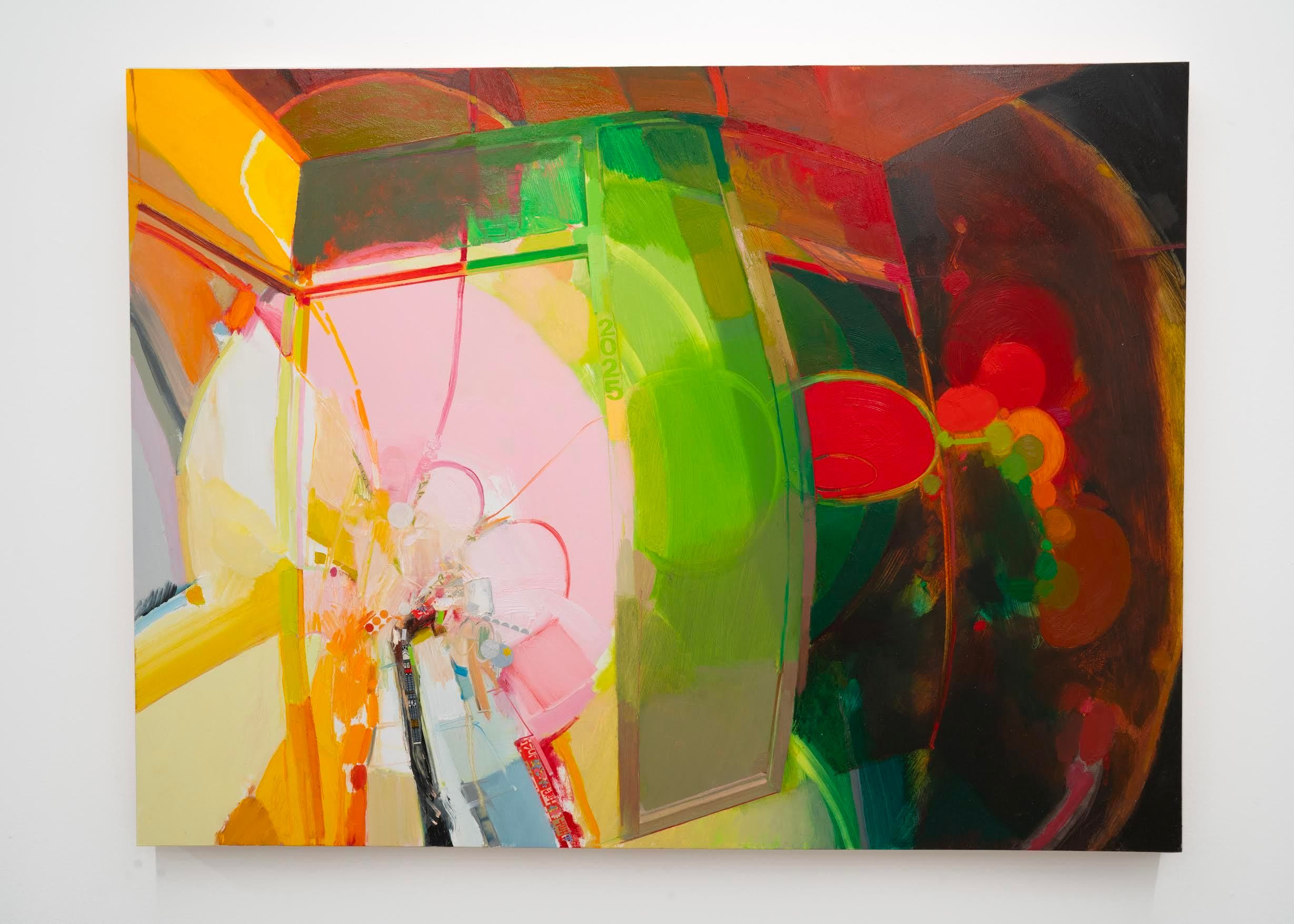
Betty Goodwin Alexa Hawksworth Irene F. Whittome "Strolling through Montreal streets, in and out of its buildings, peeking through windows, dishes left on the table, reconfigured studios, home addresses that read like dates. As summer begins and temperatures shift, I catch myself time-jumping, trying to make sense of wh4tever turm0il." After exchanging ideas for this show during a studio visit together, Alexa Hawksworth found herself walking on Bélanger, where she stumbled upon the 2025 door. Something amusing about an address that reads like a year. In 2025 Bélanger (2026), the door is the literal portal that it is, vivid and turbulent, as if something had split between one moment and the next. Maybe if you'd get in, you'd end up in Betty Goodwin's Mentana Street Project (1979). For two months, Goodwin refashioned an empty ground-floor apartment in a building owned by her then gallerist, Roger Bellemare, in Montreal, treating the space itself as a found object. In its vacant rooms, she stripped wallpaper and applied gesso, cut the walls while meticulously tracing their surfaces. Revisiting Goodwin's earlier print works, Me and a Still Life and Nature morte II (both 1963), with Mentana in mind, the still life subjects already seem to haunt the vacated rooms Goodwin had not yet made. This ghost-like quality, encompassed in found objects, finds its way into her early 1970s work, where a new phase of figuration began and soft ground etching allowed her to embed found objects alongside the traces they leave behind. The imprint became a haunting vessel, as in Chemise VI (1971). AaaAa4aaa... In 1980, Irene F. Whittome cleared her Saint Alexandre Street studio, shoving everything into a corner and repainting its brick walls and columns white. Over nearly two years, she painted a succession of minimal forms on the wall facing the arched windows. Each transformation was systematically photographed, and those photographs became the work itself: Room 901 (1980–1982). P.S.1-2... CcccCcccc... Throughout Alexa's oil paintings, letters and numbers float and slip across generous compositions, their meanings and semiotic weight pulling towards repetition and abstraction, qualities that echo printmaking and découpage, creating resonance with Goodwin's Rauschenberg-esque print Empreintes Main bleue (1969). In Cells (2025), characters are caught in this process, reorganising bits and blocks, reconfiguring their space, their time, both. These blocks' shape and repetition recall Whittome's L'aveugle regarde partout no. 1 (1974), a series of glass cases filled with discarded objects, meaning built through accumulation. A persistent motif across that work is the eye: the left eye of the Portrait of a Young Girl by Flemish painter Petrus Christus (circa 1450), photographed by the artist in 1964 and reproduced again and again throughout her work, centuries compressed into a gaze. This eye resurfaces in Alexa's The Look (2025), and again in Goodwin's Me and a Still Life (1963). A repeated threshold. Something that was already looking before you arrived. Betty Goodwin (1923–2008, Montreal, Canada) was an important member of Montreal's artistic community. She used drawing, sculpture, and printmaking to represent the fragility of life in a complex and uncertain world. Attracted by the materiality of the objects and places she found, Goodwin made their history and innate characteristics visible. Themes of loss, mourning, transition, and the difficulty of communication permeate her work. Her art evolved in series and shows a great affinity with that of Joseph Beuys and Bruce Nauman, two artists whom Goodwin greatly admired. The subject matter of her work evokes ideas related to the memory of the body and where the body has been, as well as the passage of time. Some of her best-known works are a series of prints done in the early 1970s. With these, Goodwin used copper plates to take impressions of vests, gloves and tarpaulins, creating innovative etchings that look almost like X-rays or ghostly imprints of the objects. A renowned Canadian artist, Betty Goodwin, won several awards and honourable acknowledgements. In 1995, she was chosen to represent Canada in the Venice Biennial. Notable awards included the Lynch-Stauton Award of Distinction in 1983, the Banff Centre National Award for Visual Arts in 1984, the Prix Paul-Émile Borduas in 1986, a Guggenheim Foundation Fellowship in 1988 and the Gershon Iskowitz Prize in 1995. Goodwin was the first recipient of the Harold Town Prize for Drawing in 1998, and in 2003, she received the Governor General's Award in Visual and Media Arts. She also received honorary doctorates from various Canadian universities. Irene F. Whittome (b. 1942, Vancouver, Canada)’s artistic career spans close to fifty years. The artist took up residence in Montreal in 1968 where, alongside her creative activities, she pursued a career as a professor in Fine Arts at Concordia University until 2007. The recurrent themes that emerge in her work are collection, exhibition, the museum, duration, time and traces. Over the years she has produced a considerable body of work using a great variety of techniques such as printmaking, photography, painting, drawing, sculpture and installation. Her work has been widely exhibited in Canada and abroad, including, among others, her solo exhibitions at the CIAC – Centre international d’art contemporain de Montréal (1995), at the Musée d’art contemporain de Montréal (1997), at the Canadian Centre for Architecture (1998), the Musée national des beaux-arts du Québec (2000) as well as at the Art Gallery of Bishop’s University (known today as the Foreman Art Gallery) (2004). Irene F. Whittome has received numerous awards for her artistic excellence: the Victor Martyn Lynch-Staunton Award awarded by the Canada Council for the Arts (1991), the Gershon Iskowitz Prize, Toronto (1992), the Prix Paul-Émile Borduas awarded by the Government of Quebec (1997), and the Governor General’s Awards in Visual and Media Arts (2002). In 2005, she was made an Officer of the Order of Canada. Her works are included in the collections of Canada’s most important museums. Since 2005, she has been represented by the Galerie Simon Blais in Montreal. Alexa Hawksworth (b. 1994, Hamilton, Canada) is a painter and illustrator based in Montreal, Canada. Hawksworth populates her oil paintings and graphite drawings with both fantastical and realistic characters unique in their exaggerated gestures and expressions: grimacing teeth, elastic limbs, and unhinged cackles show a dizzying range of physical and psychological states. Her scenes are often imbued with an innovative sense of movement and time, as bodies and objects are propelled across the canvas or captured by the whims of a powerful environmental force. Together, her work shows an imagined, off-kilter world in which desire and emotion burst from the body and collide with the physical realm with maximum, high-velocity impact. Drawing from theatre, performance, and film sources, Hawksworth’s distinct illustrative style combines meticulous rendering with bold painterly gestures, set to an electrifying colour palette. She received her BFA from Concordia University in 2020. She has presented solo exhibitions at Bradley Ertaskiran (Montreal) and Theta (New York), with notable two-person and group exhibitions staged at Public Gallery (London), Harkawik (Los Angeles), Franz Kaka (Toronto), Afternoon Projects (Vancouver), Sibling Gallery (Toronto), and Projet Casa (Montreal).