
Chelsea, New York
Tishan Hsu
Emergence
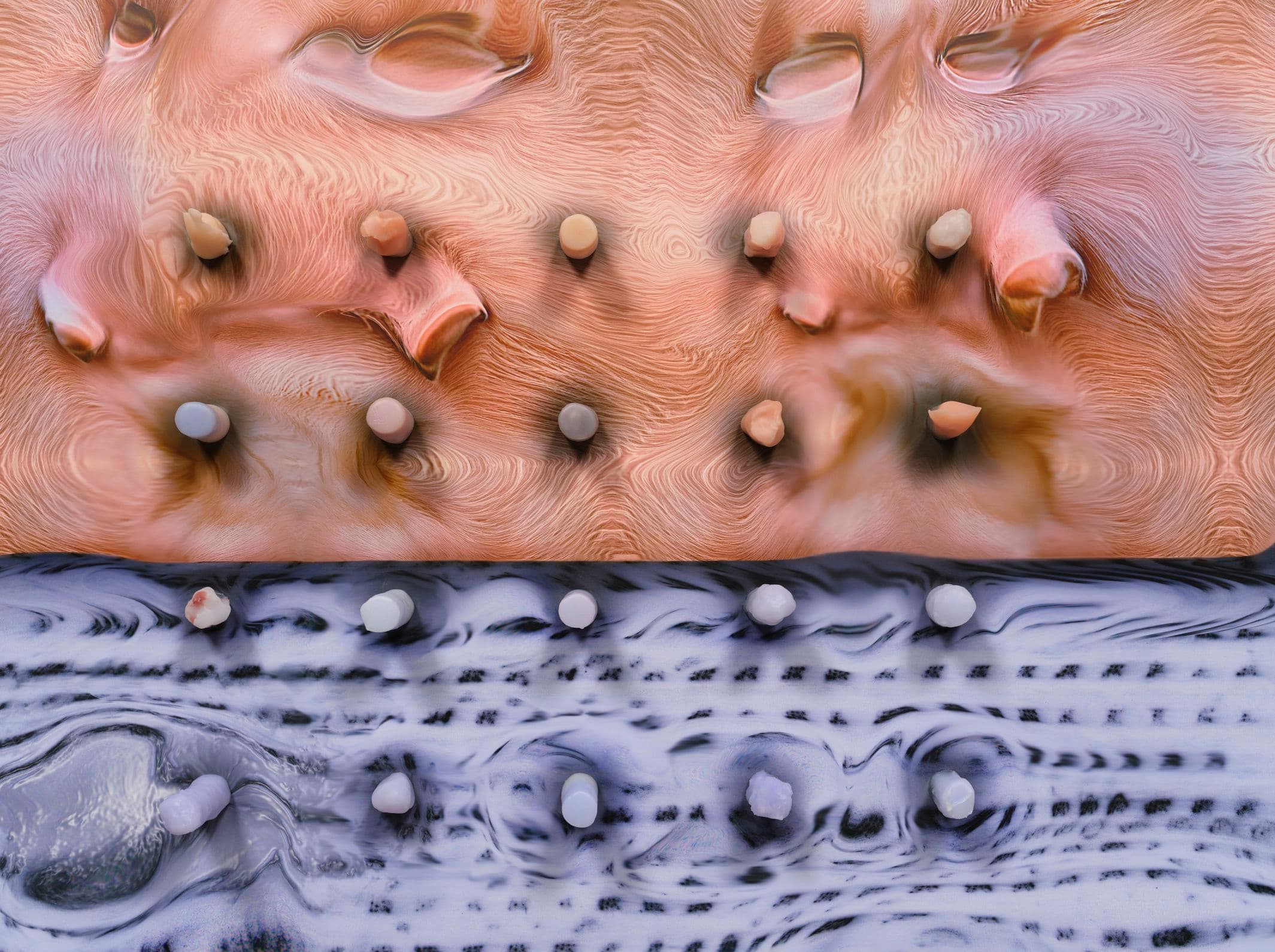
LissonLisson Gallery is pleased to present its first solo exhibition by Tishan Hsu. For over four decades, Hsu has investigated the advancing intersection between the human body and technological systems, developing a singular material language that blends digital imagery, industrial surfaces, and biomorphic forms. His latest show features a range of wall-based pieces, sculptural LED screens, and large-scale visual environments, all of which reflect a heightened engagement with both computational and medical infrastructures. Hsu's painting practice seems far from traditional, although his early artistic training reflected many of the high Western canons and skills; ranging from the study of Renaissance glazing techniques to the epic landscapes of the Hudson River School and even the stippling and coloration of French Impressionism. Further studies in architecture, film and photography are also evident in the hybridised paintings made since the mid-1980s. This influence continues in this latest series of combinatory painted reliefs, which blend UV printing, illusionistic paint effects and prosthetic protuberances (silicone additions or cavities). Aside from his technical prowess and pictorial heritage, Hsu's abiding interest remains the increasingly blurred frontier between man and machine or, more accurately, between society and the screen. This junction is increasingly tipping toward a wholesale remixing of our beings, our emotions, identities and sensations. Whether accessed through a phone, browser or another interface, the internet has become more than just a repository for information; it now acts as a primary mediator of reality, a surrogate friend and, ultimately, a mirror reflecting our fragmented selves. Hsu conveys this liminal state, our collective and evolutionary transmutation into technological entities, in works like skin-screen revealed (single) (2025). Retaining key aspects of human physicality, through the use of skin-like effects or hair proxies, these ambiguous, bio-tech surfaces are often punctured or peeled away, as though the artist were unwrapping a layer of epidermis, scrolling through apps on a tablet or leafing past a printed page. Incorporating the simulation of backlighting into some of these panels, Hsu references not only the slick, fetishist design of most personal computing devices nowadays, but also suggests a connection between the neon glow and the environmental conditions and effects of screen usage. The exhibition's immersive environment is further extended by Hsu's new wallpaper installation. AI and other predictive software have informed not only elements of the wallpaper designs but also a continuation of the series of Grey Zone paintings, where a grisaille background or grid is punctuated by machine-generated approximations of body parts – human or animal, it is not clear. The frames also present flesh-like qualities and skin tones, suggesting an intimate integration of screens into organic tissue, perhaps the logical conclusion of the drive towards wearable technology. Rich in tactile complexity and conceptual depth, the exhibition underscores Hsu's continued role as a vital voice in contemporary art, offering a timely meditation on perception, identity, and the engineered world around us. Since the mid-1980s, Tishan Hsu (b. 1951, Boston) has been at the forefront of exploring the effects of technological transformation, rendering poetic reimaginings of the human body through innovative materials and digital processes. His approach to the intersections of organic and artificial life has made him one of the most prescient voices in contemporary art today. For nearly five decades, Hsu has investigated the evolving relationship between humans and technology. Though he gained early recognition in the 1980s with solo exhibitions in New York, he spent much of the following decades working outside the public eye, refining his ideas about digital culture, the body, and perception. Early works from this period introduced his now recognizable aesthetic— blurring the boundaries between flesh and technology through biomorphic forms, industrial surfaces, and a visual language evocative of digital systems. While Hsu’s initial explorations stemmed from his musings as an architecture student at MIT and then an early user of the word processor when it was first implemented, the work now resonates even further in an era where physical and virtual realities are increasingly enmeshed. In 2019, Hsu’s exhibition Delete at Empty Gallery in Hong Kong marked a turning point in his career, confronting themes of data, memory, and personal history. Prompted by the rediscovery of family photographs following his mother’s death, the show explored the impermanence of technological memory and its relationship to identity. His first survey exhibition, Liquid Circuit (2020–21), organized by SculptureCenter and the Hammer Museum, reintroduced his pioneering 1980s works. Pieces such as Interface Remix (2001), depicting fragmented body parts dissolving into a screen-like vortex, struck a chord with digital natives grappling with the effects of technological acceleration. Following this, in late 2023, the Secession in Vienna hosted an exhibition of entirely new pieces which fused industrial manufacturing with hand-crafted processes with materials like translucent acrylic and silicone casts to depict the interpenetration of both physical and virtual realms. This trajectory continued with Hsu’s largest retrospective outside the US to date at the Musée d’art moderne et contemporain (MAMCO) in Geneva in March 2024, bringing together works from over four decades. These presentations underscore Hsu’s interest in human-machine interaction up to his recent exploration of artificial intelligence and the larger ontological implications it raises. Hsu’s work has been widely exhibited internationally, with recent solo presentations at the Museum of Contemporary Art Toronto (2024), Secession in Vienna (2023-24), and MAMCO in Geneva (2024). He has participated in major group exhibitions such as The Milk of Dreams at the 59th Venice Biennale (2022) and Is it morning for you yet? at the 58th Carnegie International (2022).