

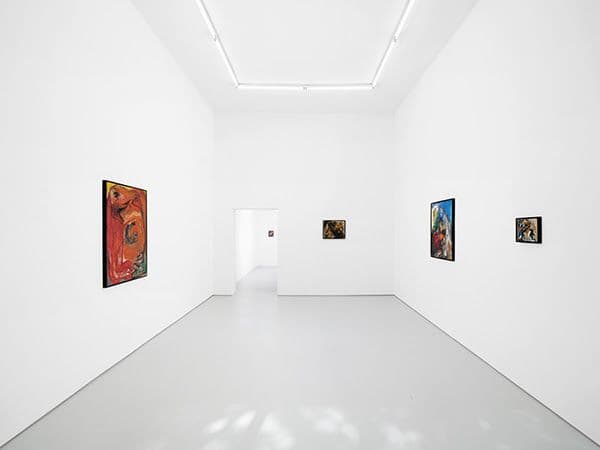
Marais, Paris
Jacqueline de Jong
Before Language
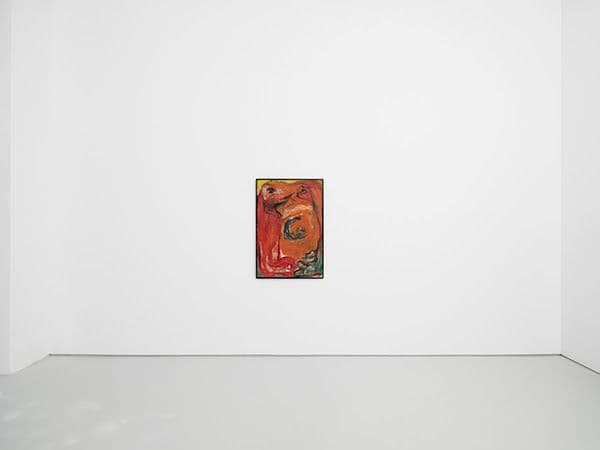
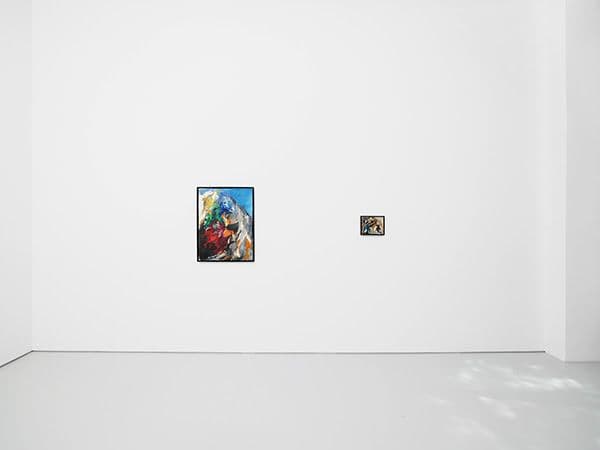
Galerie AllenGalerie Allen is pleased to present Before Language, an exhibition bringing together a group of paintings by Jacqueline de Jong produced between 1960 and 1964. These works belong to a formative moment in her practice, when painting appears to still be inventing its own grammar. The title Before Language also points to a place where painting precedes naming: before forms become bodies, characters, or narratives, they exist as gestures, tensions, and still-open signs. Figures appear only briefly before dissolving into stains, animals, faces, or undefined presences. Human and non-human forms coexist in a state of continuous transformation, suspended between tenderness, violence, humor, and hallucination. Marked very early by displacement and exile during the war, Jacqueline de Jong returned to the Netherlands without speaking Dutch fluently — a rupture that seems to echo the mutability running through her paintings. In the early 1960s, she gravitated around the circles of the Situationist International, particularly Asger Jorn, sharing their critique of spectacle, authority, and social conformity while resisting the movement's increasing dogmatism. In an avant-garde milieu still largely dominated by men, de Jong asserted a singular position early on: close to the Situationists without ever being absorbed by their orthodoxies, she developed an unruly painting practice, irreducible to any school or program. Rather than illustrating political theory, her paintings translate this atmosphere of refusal into physical and emotional form. In Le Consommateur Excité (1960–1963), a work presented in the exhibition, forms seem to emerge from a state of extreme tension without ever settling into clearly identifiable figures. Body, animal, mask, or grotesque apparition remain possible readings within a composition where impasto, drips, and sharp color contrasts produce an almost organic presence. Made at the moment when de Jong was developing some of her major works of the early 1960s, including Mr. Homme attaque Mr. Mutant (1962), the painting does not represent a stable subject, but rather a field traversed by contradictory forces: desire, violence, consumption, and dark humor. Faced with these paintings, the viewer is constantly placed in a state of uncertainty: what first appears to be a face may become an animal, a mask, a stain, or an apparition, without any single reading ever fully taking hold. This instability does not exclude humor; it also passes through caricature, grimace, and a form of aggressive comedy, where the grotesque becomes a way of undoing the seriousness of images and identities. In these early works, paint behaves less as representation than as a physical event. Thick accumulations of color, abrupt gestures, dripping forms, distorted faces, and grotesque creatures appear in compositions where bodies transform, collide, and merge. Desire and aggression, intimacy and theatricality, abstraction and figuration remain inseparable. For de Jong, identity never appears as a stable form: it is constructed and undone through the very movement of painting, between human, animal, mask, desiring body, and grotesque figure. Produced in a context marked by postwar reconstruction and the rise of consumer society, these paintings resist all forms of aesthetic, psychological, or social stabilization. Their force lies in their refusal of fixed categories and readable narratives. More than historical documents of the 1960s, they retain a contemporary intensity today, in the way they hold bodies, desires, and social roles in a state of permanent tension. The exhibition brings together a group of rarely shown paintings, from intimate formats of 1961 to larger and increasingly liberated compositions from 1963 and 1964, where color, gesture, and figuration reach an almost irreducible intensity. Jacqueline de Jong (b. 1939, Hengelo. Died 2024, Amsterdam, The Netherlands) was forced to flee Holland during World War II and her early life was marked by social upheaval. Her publishing, painting and sculptures have spanned over six decades, in which motifs of eroticism, desire, violence and humour recur with an irrepressible progression switching between different styles; from expressionist painting to new figuration and pop art and constantly reinventing herself while adhering to her pioneering personal vision. In the 1960s she became involved with the European avant-garde networks, most notably the Situationist International (SI) and Gruppe SPUR. When de Jong was excluded from the SI, she founded and edited The Situationist Times. Recognised as one of the most important and experimental journals of our time, the publication offered opportunity for collaboration between writers, poets and visual artists. As editor and publisher, she produced six issues between 1962 and 1967. In 1968 she marched with the students in Paris, printing artist posters in support of the movement.