
Giardini, Venice
Francis Alÿs
The Nature of the Game
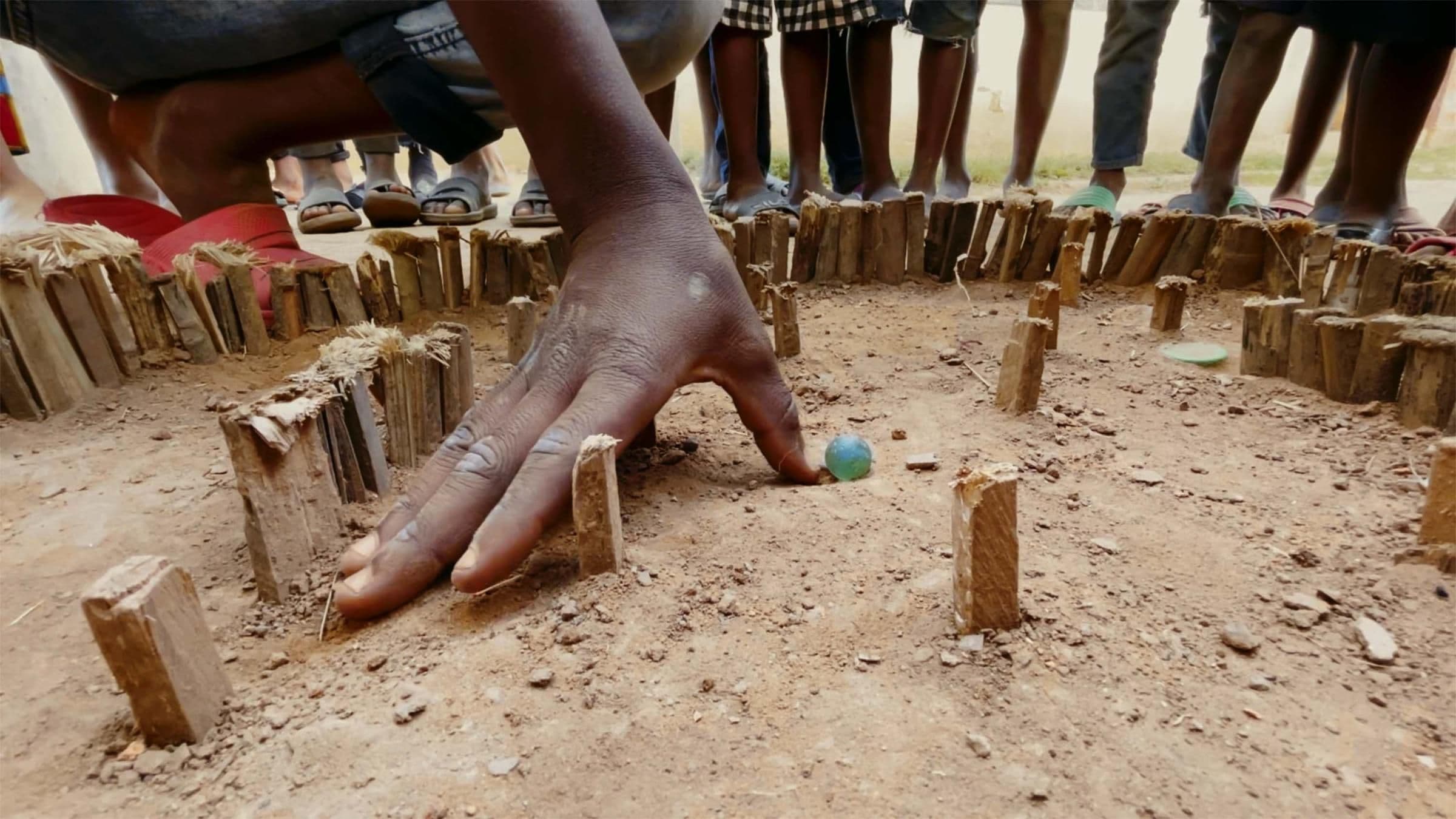
Belgian PavilionFor the 59th International Art Exhibition, La Biennale di Venezia, the Belgian Pavilion (Flemish Community) has invited curator Hilde Teerlinck and artist Francis Alÿs to develop an exhibition project. For the Belgian Pavilion, Alÿs will present The Nature of the Game, an exhibition featuring a selection of films and a series of paintings. Almost all of the films will be new productions. The selection was organized by Department Culture, Youth and Media of the Government of Flanders. The jury was composed of experts of the arts sector and consisted of Devrim Bayar (only first phase), Frank Benijts, Hicham Khalidi, Zeynep Kubat, Jozefien Van Beek, Sofie Van de Velde and Els Wuyts (only first phase) with Dirk De Wit as chairman and Stan Van Pelt as secretary. The exhibition will be presented at WIELS (Brussels) in 2023. — “A young boy runs and falls on the ground while his leg slides over the earth of the street and the tip of his foot touches an imaginary ball, he scores a goal! Action comparable to the likes of Messi! You can feel the joy on the dry and dusty streets. But even if the ball isn’t there, he is there…” Since 1999, during his many travels, Francis Alÿs’ camera has filmed children playing in the public space. It started with the video Children’s Game #1: Caracoles, showing a young boy kicking a bottle up a steep street, only to let it roll back to him and then kicking it up again. Playing is something natural, something that we discover and learn instinctively in our childhood. Like eating or sleeping, playing is an essential human need. It is necessary to take time, to spend time and to lose time in playing. Children’s play is to be understood as a creative relationship with the world in which they are living. Observing, investigating and documenting human behaviour in urban life is a constant in Alÿs’ work. His films record, in an ethnographical way, both the power of cultural tradition and the free and autonomous attitudes of children, even in the most conflicted of situations. Over the last decade, children’s play has gained a central position in Alÿs’ practice, its recording becoming a way to understand the patterns by which people live. Although some of the games can be related to a specific geographic or cultural tradition, most of them are played all over the world. And thus, gives work its universal character. For the exhibition in the Belgian Pavilion, Alÿs presents a selection of new short films shot since 2017 in Hong Kong, Democratic Republic of Congo, Belgium, Mexico, to name a few. Filming without interfering in the games, Alÿs reveals the hidden rules of playing, the ingenious interaction of the children with their environment, their deep complicity and their hopeful mood and joy. The installation in the Pavilion invites the visitor to walk through a labyrinth of screens as if they were in the middle of a global playground. The sound and image of the different films interact with each other, fragments forming together a whole, allegories translating the complexity of a sometimes harsh reality. A series of small paintings covering a period from 1994 to 2021 accompanies the video presentation providing the context in which some of the films were made. From Kabul to Ciudad Juárez, from Jerusalem to Shanghai, they unfold Alÿs’ distinct poetic sensibility towards social and political concerns. As anthropologist David MacDougall writes, “Taken together, these films reveal some wider truths: that many children’s games are specific to girls or boys, that most are competitive but also cooperative, and that children are adept at making do with little, adapting a wide range of environments and spaces for their own purposes. In this they create a world parallel to that of adults, one that overlaps with it but uses its physical resources quite differently.” However, children’s games tend to disappear. The rise in urban traffic, social medias and digital games and the parental fear of letting children play in the public space means that the tradition of playing outdoors becomes less common each day. This process might have experienced an acceleration due to the consequences of Covid-19 in the last few years, creating an urgent need to register them, now. The exhibition is accompanied by a book published by DCV Books. It is a facsimile edition of Alÿs' notebooks on children's games, something overall very visual. Anthropologist Michael T. Taussig, for whom fieldwork notebooks are an indispensable tool, argues that drawings in notebooks develop a life of their own, a life which is often fed by what can't be written down. —Hilde Teerlinck Francis Alÿs (Belgium, 1959) lives and works in Mexico City. Trained as an architect, Alÿs’ practice embraces multiple medias, from painting and drawing to video and animation. His works address ethnological and geopolitical concerns through the observation of and engagement with everyday life. He has most recently been involved in a series of new projects in Iraq culminating with the historical fiction Sandlines (2018–20). His Children’s Games series (1999–ongoing) is a recollection of scenes of children at play around the world. A dozen new games filmed in the Democratic Republic of Congo, Belgium, Canada and Hong Kong will be featured at the 59th Venice Biennale. Alÿs has exhibited in renowned museums worldwide and will represent Belgium at the 2022 Venice Biennale. Hilde Teerlinck (Belgium, 1966) lives and works in Barcelona. She is the CEO – General Director for the Han Nefkens Foundation, which supports young video artists worldwide through production grants. All projects are realised in close collaboration with international museums and art centers. Hilde Teerlinck was the director of FRAC Nord-Pas-de-Calais in Dunkirk, CRAC Alsace in Altkirch and the Center d'art contemporain in Perpignan, and Artistic Coordinator of the Pavilion Mies van der Rohe in Barcelona. She has also curated numerous international exhibitions and biennials, including the 2015 Lyon Biennale (contribution from Palais de Tokyo), the 2015 Beaufort Triennale (Belgian coast) and the 2018 and 2021 Kortrijk Triennial. Commissioner: Jan Jambon, Minister-president of the Government of Flanders and Flemish Minister for Foreign Affairs, Culture, ICT and Facility Management Curator: Hilde Teerlinck