
Culver, Los Angeles
Group Exhibition
Painting/Object
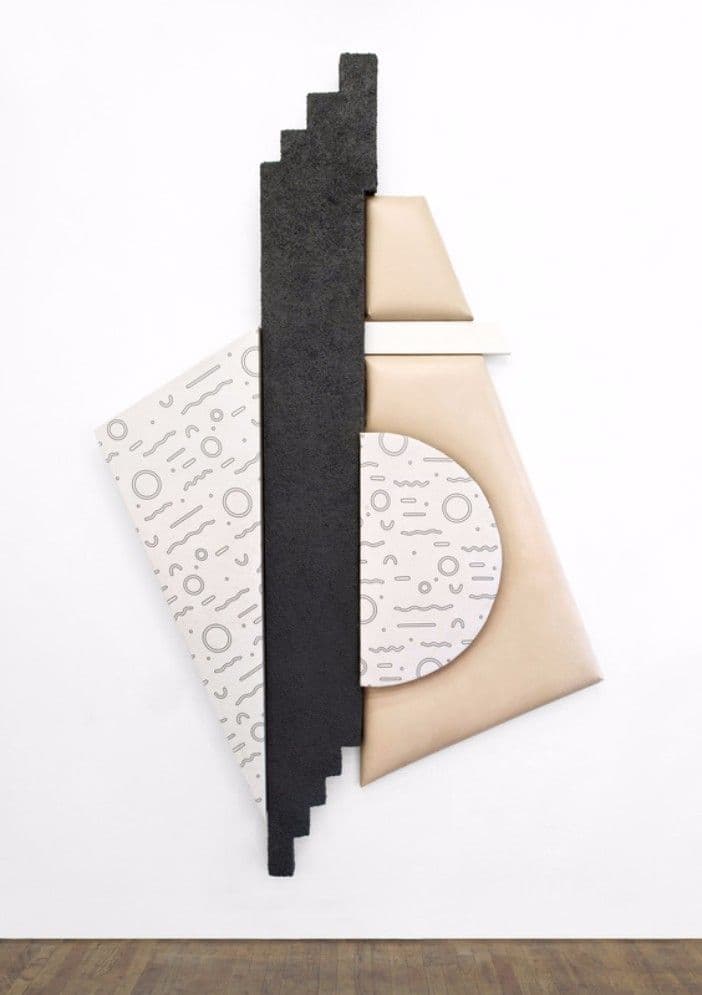
Library Street CollectiveMatthew King Leah Guadagnoli Calli Moore Felipe Pantone Beverly Fishman Jason Revok Robert William Moreland Johnny Abrahams Detroit-based Library Street Collective is pleased to announce Painting/Object, a group exhibition. Painting/Object is the third in Library Street Collective’s series of Los Angeles-based exhibitions. Painting/Object is an exhibition curated by Jason Revok, bringing together works that expand the boundaries and capabilities of painting as a visual language across form and materiality. Though varied in process and media, the works are substantial, abstract, and frequently function as both painting and sculpture. A 3-dimensional presence within the gallery space serves as the motif that ties the pieces into a cohesive whole. Part collage, part painting, the surfaces of Matthew King’s works are boldly painted with zigzag patterns referencing Op Art compositions and incorporating stripes, geometric blocks of color and images torn from newspapers and magazines. Referencing the minimalist powerhouses of art history with an aesthetic blend of Donald Judd and Frank Stella, King also nods to the collage artists of that era by incorporating appropriated images of American nostalgia; Goodyear, Evel Knievel, and the Great American Road Trip in sequenced smaller works. Physically constructed objects that insist on spatial presence, his paintings defy easy categorization. For King, the wall is a crucial defining element. “You can nail a chair to the wall,” he says, “and it will demand consideration that only a painting can. I’m interested in that space - placing objects in the room like a piece of furniture, but maintaining a dictative control on perspective.” Matthew King is based in Massachusetts. Leah Guadagnoli, along with Calli Moore, are the youngest artists presented in Painting/Object. Both are based in New York. Guadagnoli’s Memphis-like abstract paintings are composed of fabric, upholstery, paint, interior textures and furniture padding. Strongly influenced by interior spaces, her work takes inspiration from carpets, seating, walls of airports, hallways, waiting rooms and coach buses. She says, “My work considers how elements of indoor public spaces, the anti-aesthetic, and the suggestion of nostalgia can be aligned to challenge notions of taste, exclusivity, and social convention all the while refusing the contrivances of form and genre.” Calli Moore’s use of acrylic paint pushes the medium to function as much as a fibre and a modelling material as a film. Thick, layered, ropes of paint build on each other in multiple phases. The resulting webs, lattices, caverns, and protrusions give the work its depth and dimensionality. Born in Buenos Aires, Argentina, Filipe Pantone began his art career in southeast Spain with graffiti. His work fuses bold elements of graphic design with highly evolved geometric shapes to create an ultra-modern aesthetic. Straddling conventional graffiti, typography and abstraction, his work integrates punchy geometrics, color spectrums and optical illusions to create an aesthetic that is simultaneously ultra-modern and somehow reminiscent of an earlier digital era. Pantone lists Victor Vasarely, Carlos Cruz-Diez, Julio Le Parc, and Luis Tomasello as his major influences in their exploration of motion in art. Embracing abstraction, and drawing influence from kinetic and op art, his W3Dimensional pieces take inspiration from Teilhard de Chardin's 1950's theories, in particular 'Noosphere,' which was largely forgotten until the advent of cyberspace. The Internet, in its ever-growing exponential race of speed, pervasiveness, capacity, intelligence and durability, may well become the mechanical framework for the 'Noosphere', a sphere of thought that may bring about the evolution of human consciousness. Beverly Fishman’s art explores the relationship between color, form, and human identity in relation to both abstract and mechanical practices. Throughout her career, she has been interested in exploring abstraction and combining formal and material investigation with questions about the transformation of human beings through science and technology. For Fishman, contemporary painting remains a viable arena for protest and dismantling: a site where one can pursue a phenomenology of our contemporary medicalized and industrialized condition. Her medium and large-scale panel reliefs employ industrially applied discordant chemical pigments, which are polished to a reflective sheen when dry. This type of extremely reflective color is used because Fishman attempts to physically make the viewer sick; at the same time, the works appear candy-coated and liken the consumption of pills to the desire and ease of eating candy. A recurring motif in her work, capsules and tablets are employed as abstract modules through which constantly changing color and pattern combinations are created. Beverly Fishman is based in Michigan. Jason Revok is a Los Angeles-based artist noted for his complex assemblage works. Respected for decades of influential and pioneering work as a graffiti writer, Revok’s studio work explores deeply shared themes involving place and human experience using the very materials that make up the environment around him. Constructed of bits and pieces of found objects, Revok’s assemblage works function as urban artefacts, whereby their materiality articulates a sense of place. He states, “I am interested in the world itself that I have been submerged in for the last 25 years while painting and exploring the cities I have traveled to and lived in, not what it is I personally have been doing, but what I have been experiencing.” Los Angeles artist Robert William Moreland’s paintings/sculptures evidence an appreciation for historically romantic practices and materials. Beginning with extended planning and engineering of four to six inch maquettes, the artist works toward a compositional conclusion he deems worth realizing in large scale. From there, his process continues to include the hand-stretching of canvas using tacks. Though the tacks are mostly unseen, Moreland believes that the meticulous effort that goes into each piece becomes evident in the overall feeling and reception of a completed work. Using wood, canvas, tacks, paint and leather, he creates a finished sculpture meant to ground itself in its environment. He combines materials with the goal of achieving aesthetic synthesis while allowing their inherent characteristics to remain intact. The finished works do not produce distractions, but instead exist as dynamic objects of focus. Johnny Abrahams is interested in the way in which the illusion of movement within a still painting shakes the certainty of the viewer’s perception, in how the eye interacts with visual elements to send feedback to the mind. Keeping to a disciplined process of ruled and restricted composition within the space of a panel, he explores what can be done with line to the exclusion of all other design elements. The resultant work, with high-contrast figure-ground relationships, becomes vibratory, destabilizing the fixed gaze. In exploring the effects of their movement around the piece, the viewer’s subjectivity is highlighted. Johnny Abrahams is based in New York. Library Street Collective specializes in cutting edge contemporary fine art with a focus on emerging and established artists who have pushed the boundaries of traditional medium and exhibition space. Located in the heart of downtown Detroit, we present regular group and solo exhibitions while contributing to the artistic renaissance of the city's public, private, and heritage spaces. It is our mission to bring both world-renowned artists and exciting new work to a reimagined Detroit, as well as carry this sentiment as we expand our presence through exhibitions, special projects and art fairs nationally and internationally.