
Weho, Los Angeles
Group Exhibition
Sredstvo Kool (Medium Cool): Contemporary Video Art from Russia
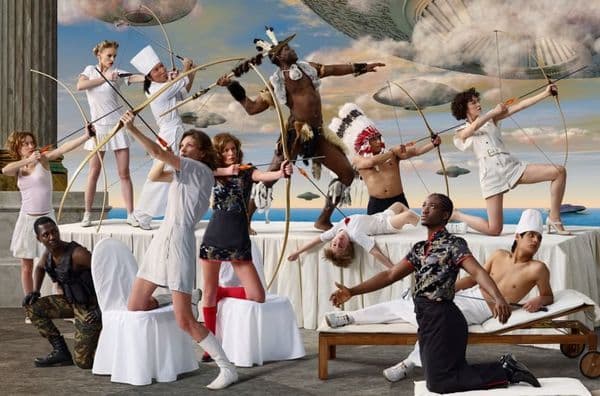
Young ProjectsAES+F, Sergey Bratkov, Vika Begalska, BlueSoup Group, Aristarkh Chernyshev, Chto Delat, Taisiya Krugovykh, Anastasia Vepreva Young Projects is pleased to present Sredstvo Kool (Medium Cool): Contemporary Video Art from Russia. The exhibition presents twelve contemporary video works — all of which being shown for the first time in Los Angeles — that represent an array of artists living in and around Moscow and St. Petersburg, Russia. When taken as a whole, these works present an overview of some of the more pressing issues, ideas and feelings shared by many of today’s Post-Soviet-era artists, including revolution, provocation, performance, actionism, militant feminism, anti-commercialism, historical memory and much more. In the words of curator Boris Groys, who has labeled many of these artists as ‘post-conceptual realists’, this current generation has been marked by the dissolution of the Soviet Union and the Cold War, which has engendered a fervent skepticism of Russian nationalism, the ‘status-quo’ of Western Capitalism, and the rising tide of Soviet nostalgia. As a result, one often finds reappraisals of Soviet histories embedded in their work, whether directly or indirectly. “Indeed,” he writes, “such a reappraisal seems unavoidable because contemporary Russian culture is a haunted place—haunted by specters of its communist past.” Stylistically, these artists employ an array of techniques to convey their subject matter—from the highly aestheticized, CG imagery of AES+F to the more confrontational, performative, style of Chto Delat. For the former, digital technologies allow the artists to create fantastical visual spaces that not only convey ‘a post-apocalyptic vision of a world where the mythologies of all cultures can be intermingled with the myths of contemporary media culture’ but one that directly engages art-historical painting traditions. But for others in the exhibition, the sheer urgency of the performative is often more germane to the message they want to convey. These artists have roots to Moscow actionism, the phenomenon of the early 90’s, which stood in close relation to the social and economic processes of the El’zin and post-El’zin periods. Actionism was a contextual reaction to the climate of the new Russian capitalism and commercialization: A ‘high time’ for ‘radicalisms’ of all kinds. And yet at the same time, much like the growth of video in the US in the 1980s, music and club culture ushered in a fervent anti-commercial, DiY punk-aesthetic, where “slickness” was to be avoided at all cost. The collective Chto Delat, for instance, which is made up of philosophers and poets, often creates situations and scenarios where individual members voice their attitudes theories and mores in a situationist environment (whether it’s a theater or street performance). The result is a kind of Zizek-style theoretical-collage that digs into an extraordinary array of ideas born out of the collective imagination. Or as Chto Delat writes: “Our work is about new experiments with collective authorship; the emancipatory and educational function of art; the spirit of collectivism; building a new type of relationship between movement and aesthetics, and so on. “ Other artists in the show, such as Begalska, Krugovykh, and Vepreva, employ similar strategies, but often through the lens of Feminist theory. They too use the vocabulary of didactic and/or performative actions (i.e. public lectures, classrooms, and even puppet shows) to challenge conservative, nationalist, religious, neoliberalist, and reformist ‘norms,” but often do so with a personal point of view. To quote writer Veronique Leblanc, “On the whole the artworks [of this generation] make up an inventory of symbolic actions, in varying degrees of strangeness, which manifest themselves as performative rituals. They convey an eclectic array of ideological affiliations and beliefs, all of which function to conceal various forms of violence… that is informed by the ongoing catastrophe to which we have become accustomed to via the media.”