
Marais, Paris
Tai Shani
Tai Shani
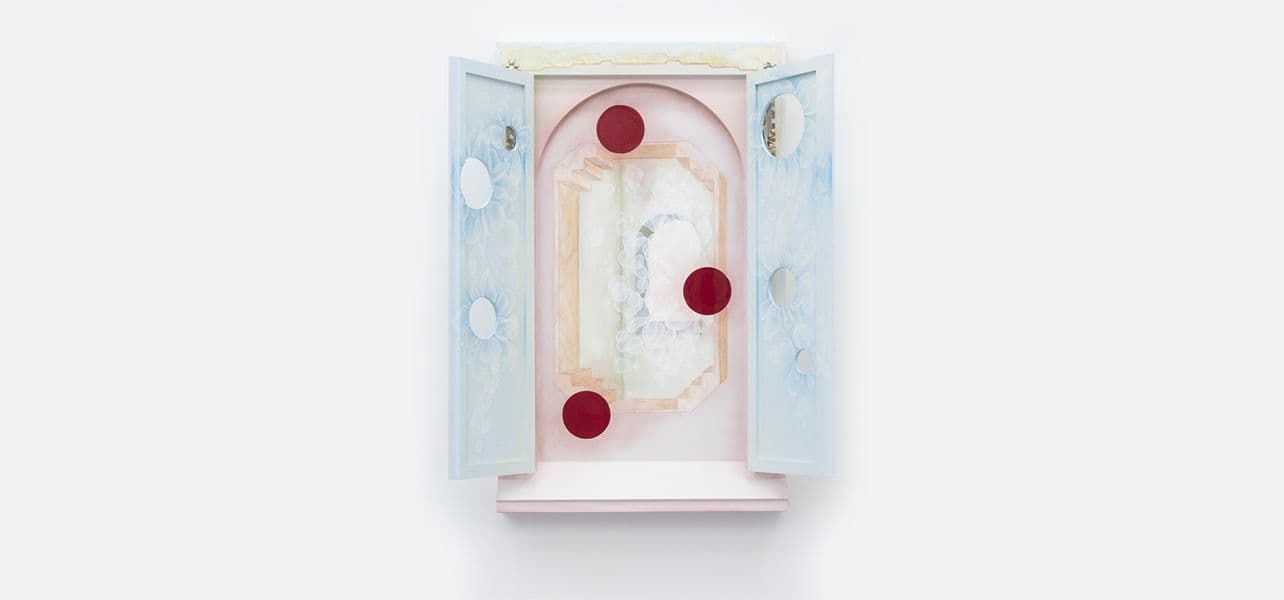
Suzanne TarasieveProject Room This exhibition marks the first solo presentation in France of the work of Tai Shani, a major figure in British contemporary art and co-recipient of the Turner Prize in 2019. Her practice, long developed on the fringes of traditional contemporary art channels, has nonetheless contributed to redefining the boundaries between fiction and reality, imagination and politics, influencing many artists emerging internationally today. Although modest in scale, this exhibition brings together several of the important characteristics of her work: a speculative spirit blending historical references and the imagination of new possibilities, a strong narrative and poetic dimension, a chimerical aesthetic combining baroque, pop, gothic, and religious elements, and a commitment to reinventing our relationships with history, the body, and community. The film that opens the exhibition serves both as a threshold and a key to entering Tai Shani's dense and stratified universe. This long, poetic and opaque monologue, lasting 19 minutes, presents itself as a cosmogonic matrix. It weaves different types of discourse —philosophical, geological, mythological, utopian, and dystopian—, which are later developed in the main exhibition space. The non-linear nature of its narration establishes a regime of fragmentation: meaning is not directly accessible and involves wandering through multiple ideas. The audience, placed behind the keyhole, must find the key to understanding the whole, which will necessarily be revealed in fragments. This fragmentation of language and meaning constitutes a direct parallel with the condition of the contemporary, which, as the angel in the film states, is undermined by an entanglement of "dark, terrible powers and their squalid bureaucracies and litigations of death." This observation has a material impact. The exhibition space is indeed organized around a series of sculptures representing different body parts—hand, heart, bust, circulatory or nervous systems—with a fragile aesthetic, as many signs of a dislocated whole that would need to be recomposed or repaired. The body becomes a metaphor for a social or planetary body. On the other hand, this fragmentation harbors a possibility: within the debris, unexpected collages can emerge, giving rise to new composite realities and chimerical subjectivities. Thus, Tai Shani tells us through her angel, our bodies, identities, human community, environment, and spirituality are all heirs to the fragmentation of the real, necessarily born from an assembly of organic and synthetic elements. This is conveyed in the sedimentation of aesthetic languages of the exhibition. Its vocabulary is composed of a rich mix of baroque and pop, gothic and religious, feminine and science fiction; each work is the result of a non-hierarchical cultural and symbolic collage, metaphors of a present made of disparate accumulations. From this chimerical material reality, Tai Shani attempts to invent a new way of telling and being-in the world, one that is more symbolic and more inhabited. Failing rationality is thus met with myth and fiction. This begins with the use of the poetic language, a flexible form *par excellence*, as opposed to the language of rationality. Here it becomes transformative: in the film, as the words unfold, the angel's body undergoes strange metamorphoses, as if speech acted directly on its flesh, reactivating a forgotten form of performativity of speech. The tone is set: the poetic language engages a material and symbolic reinvention of our experience. The chimerical and poetic disturbance inflects the very matrix of our relationship to reality; past, present, and future interpenetrate each other and constantly actualize. The construction of the image in the film is a strong metaphor of this: the viewer, placed behind a keyhole—image of the past—never directly accesses the present scene, embodied by the angel filmed from behind. The present is never fully comprehensible. It is only through a mirror, a figure of the future, that one perceives a deferred reflection of it. This play with temporalities places the film—as well as the rest of the exhibition—in a fertile tension between elegy and divination, between memorial and fictional dimensions. This dual temporal dynamic is expressed in the aesthetic of the relic: many pieces seem to come from an ancient cult, like *Love for the Living*, a reference to ancient canopic jars intended to preserve the viscera of the dead. This elegiac charge gives shape to a haunted universe, saturated with traces, remains, and ghosts. Here, it is a matter of questioning how our collective memory acts upon our present, particularly in its omissions. But this labour of memory is not aimed at restoring an old order—it is activated to bring about new speculative narratives. For example, the altarpiece, while explicitly adopting the iconographic codes of the Christian religious tradition, represents a succession of arches and openings that remain abstract—a beyond of possibilities. This religious language of the sculptures transforms the exhibition space into a temple, a refuge of imagination in the face of the violences of reality stated in the film—systemic violence against bodies, the earth, and dissident histories. A temple also because it carries within it the capacity to create community. By creating a chimerical liturgy, made of a fictional collective memory rendered material through ritual objects and a narrative, the exhibition simultaneously creates the community of chimeras it wishes for. The materialist and hallucinatory spirituality proposed by Shani addresses each of us, who can come to reflect and gather here. The titles of the works—*Heart, Commune, Love for the Living, The Passion*—also seem to whisper the possibility of a collective love, of an affective and symbolic bond capable of uniting us beyond our solitudes. Thus, the exhibition does not merely present a universe: it proposes another regime of meaning, another relationship to reality. By bringing together fragments, fictions, and ritual forms, Tai Shani constructs a space where speculation becomes a critical tool, a way to reclaim our narratives, our affects, and our imaginaries. In doing so, she opens the possibility of a collective memory in the making, nourished by echoes and inventions, where chimeras are no longer anomalies, but the conditions of a living thought.