
Marais, Paris
Daniel Boyd
Dream Time
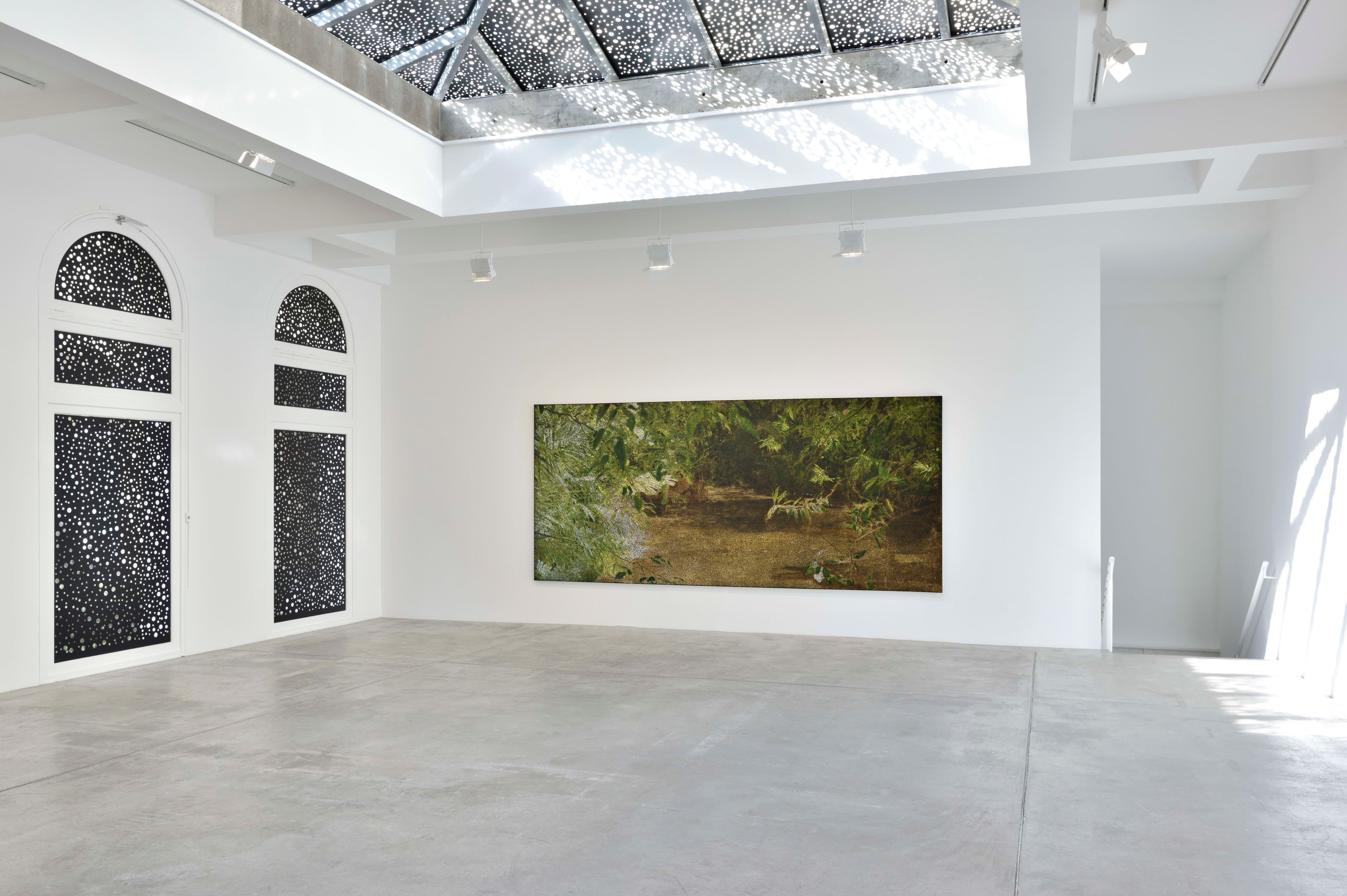
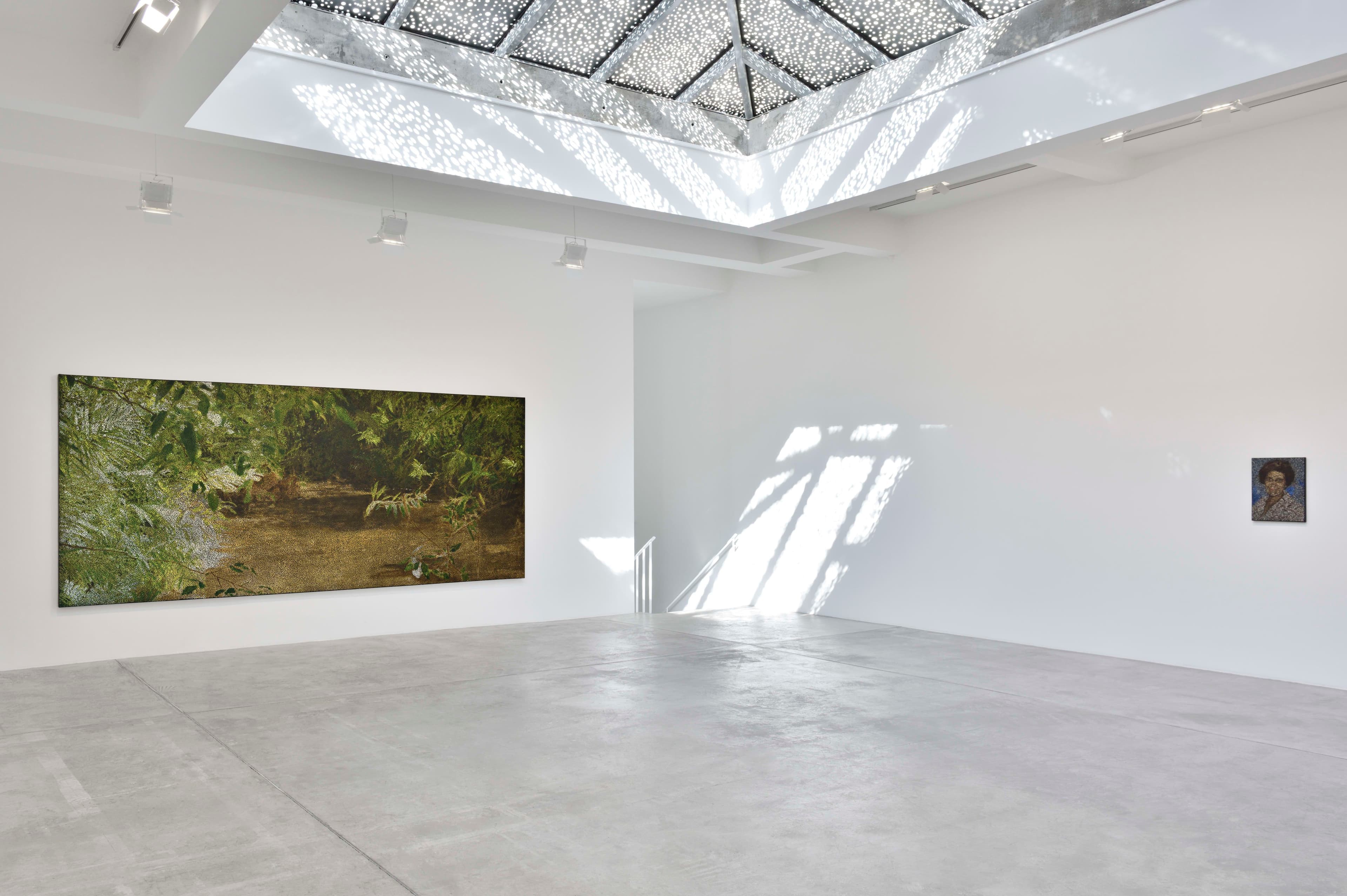
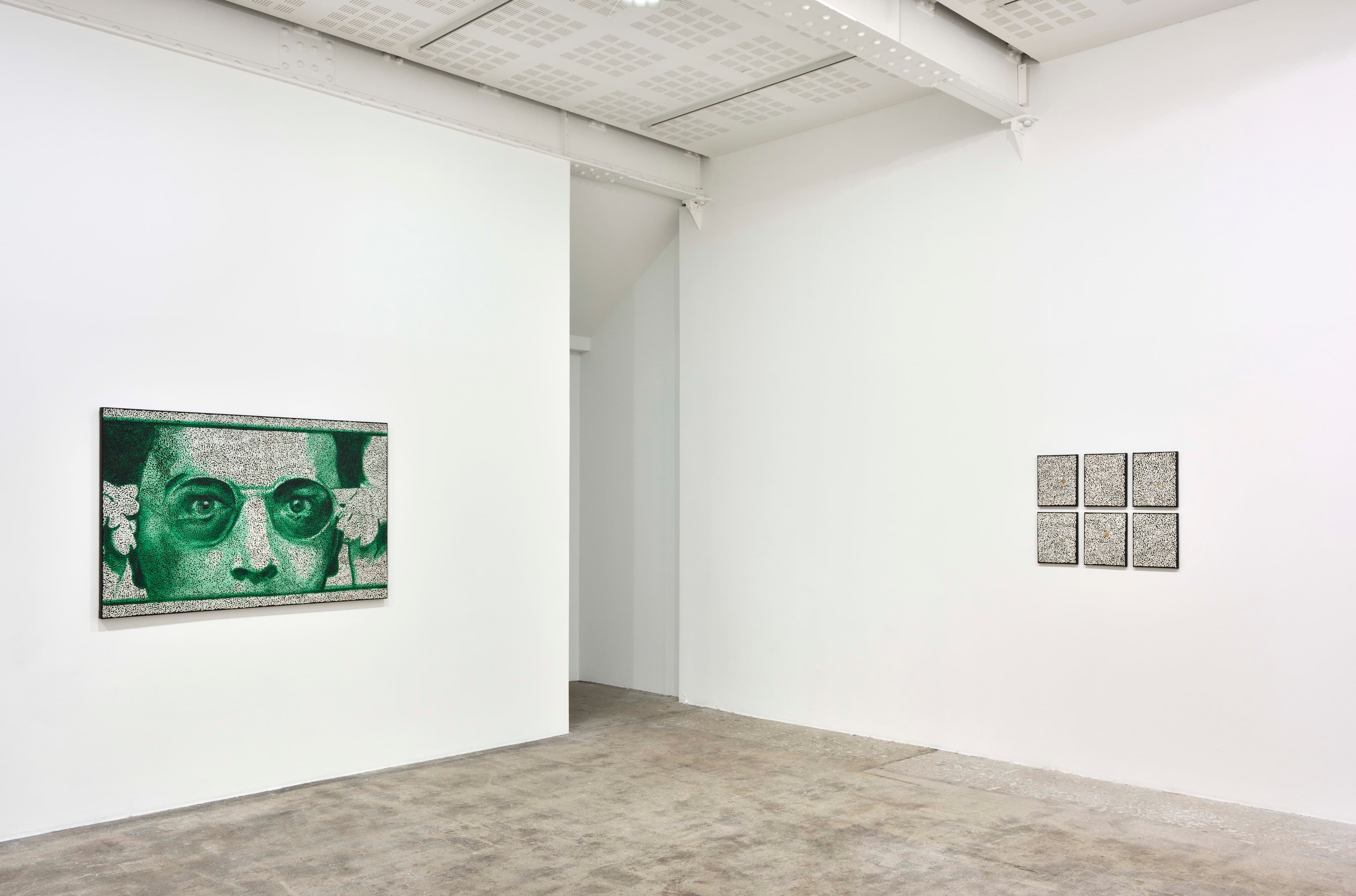
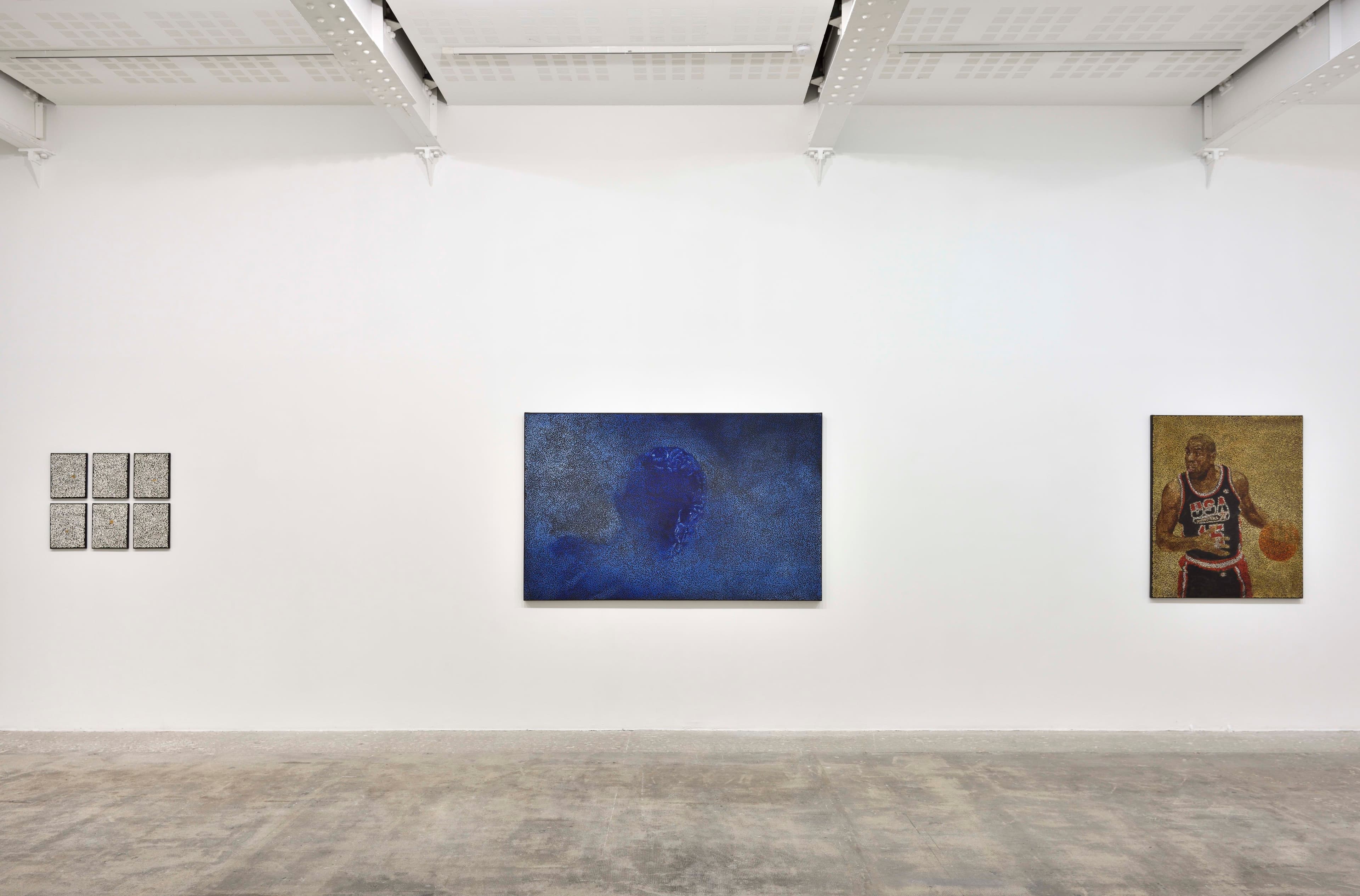
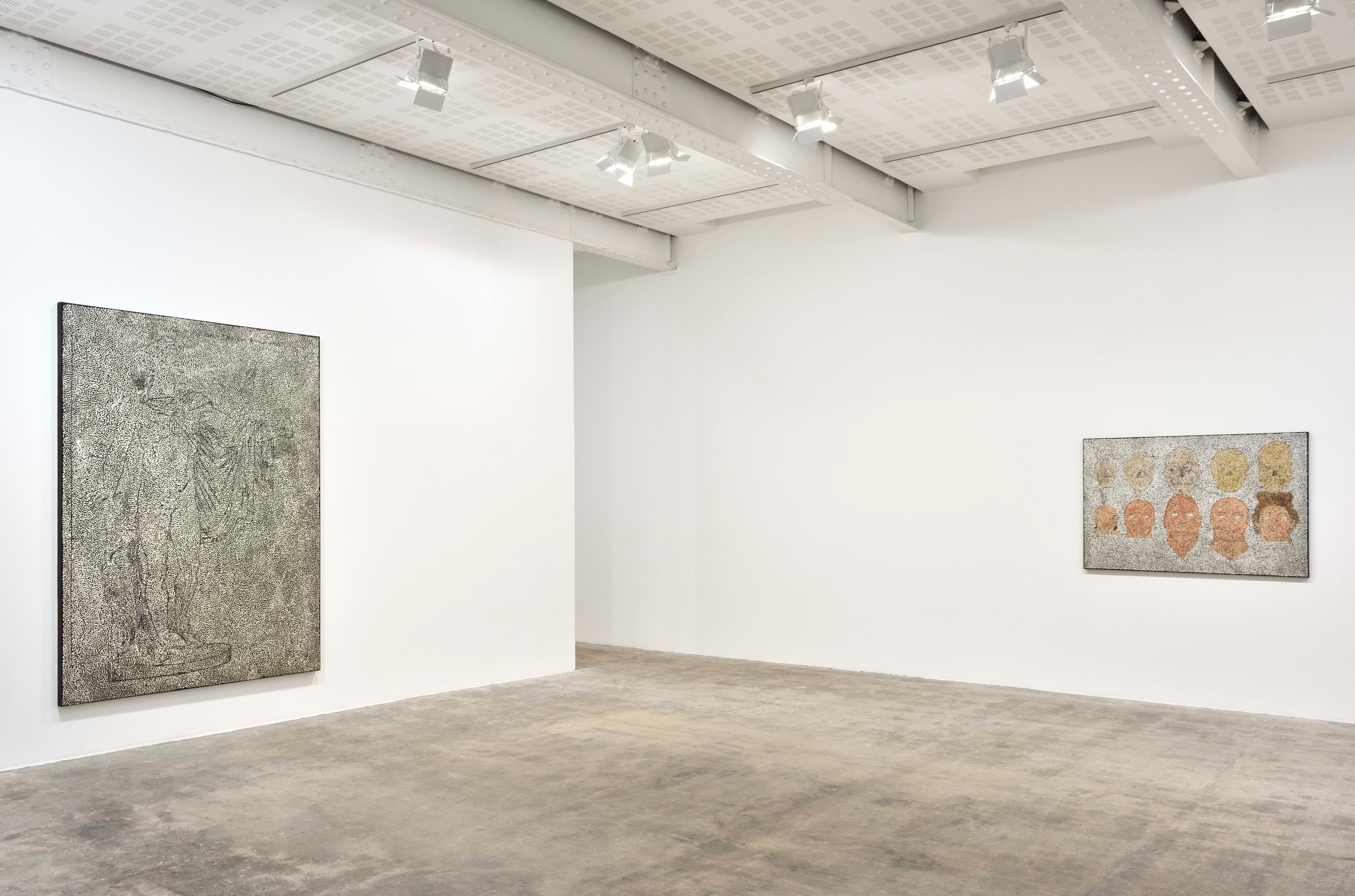
Marian Goodman[Scroll down for French version / Veuillez trouver ci-dessous la version française] Marian Goodman Gallery Paris is pleased to present Dream Time, Daniel Boyd's first solo exhibition in France, which includes a series of new paintings and an intervention in dialogue with the gallery's architecture. With his unique pictorial language, Daniel Boyd seeks to de-locate our visual perception from a single entry to one of multiplicity by directing our gaze toward narratives obscured by empire and oppressive cultural framework. Taking as his subject landscapes, historical representations and portraits linked to his own personal history, heretofore invisible, as well as iconic figures rarely depicted in the visual arts, Daniel Boyd continues to transmit and transpose his cultural and artistic traditions while expanding our collective imagination. The title of the exhibition responds to “dreamtime,” the term given by early European anthropologists to define what they understood to be the mythology behind the natural order of things for most Australian Aboriginal groups, proposing a reductive vision of their cultures, which are both highly diverse and interconnected by complex narrative networks. Boyd, who is of plural origins (descended from indigenous Australians and South Sea islanders), splits the term dreamtime into binary opposites (Dream Time), allowing the uncontrollable nature of a dream to be freed from the European linear and controlled perception of time. By way of poiesis, those who have been uprooted and culturally assimilated have arrived at a new constellation of narratives liberated from time and space, selecting stories addressed to new generations. Through each new series of paintings Boyd seeks to redress and overturn existing hierarchies of aesthetic forms and representations. In Untitled (TAOBIAM) (2024), for example, we recognize the almost imperceptible silhouette of the Apollo of Belvedere, one of the most famous sculptures of antiquity, described by the art historian Winckelmann as “the most excellent thing that nature, art and the mind combined to produce.” The image of the Greek god of harmony, beauty and light rubs shoulders with the portrait of the artist's grandmother in Untitled (NILYMY) (2023) and the natural landscape near the birthplace of one of her grandmothers in Untitled (WMHTA) (2024). Modern and contemporary figures from a wide variety of backgrounds are part of Daniel Boyd's Dream Time, such as the fictional Freddy Krueger, a horror movie icon known for murdering teenagers in their dreams in Untitled (NSD) (2024); and basketball player Magic Johnson, charismatic leader of the American Dream Team who made history by winning the gold medal at the 1992 Olympic Games in Untitled (NIIDT) (2024). In Untitled (LIYSLOAGPCD) (2024), the artist uses a photographic portrait of André Breton, leader of Surrealism, who placed the dream at the center of the movement's research, while continuing Modernism's cultural appropriation of non-European art forms. Boyd cites the idea of the “right to opacity” developed by Edouard Glissant as a conceptual inspiration that guides his formal practice. According to Glissant, the Martinique-born French writer, this concept is defined as the right of all people to preserve their psycho-cultural specificities, in opposition to the ideal of transparency promoted by the West, which throughout history has trivialized and sometimes denied the differences between peoples. Boyd's pointillist technique, unrelated to the dot painting of the indigenous artists of Australia's central desert region, aims to translate this thinking. Transparent convex dots randomly populate the surface of the canvases to interact with black paint that encircles the dots, setting the entire surface of the painting in motion. These dots, described by the artist as “lenses through which we can access distinct points of knowledge, experience or perspective,” allow each visitor to perceive the images differently, depending on their distance or position. The profusion of points, on the other hand, represents our collective vision. Finally, the well-guarded secrets behind the paintings’ process give them a magical dimension, shrouding them in mystery, as a metaphor for the right to opacity. Continuing this interplay of perception, the intervention on the gallery's first floor reveals a kind of twilight, and as in his 2023 installation in the atrium of Berlin's Gropius Bau, Boyd transforms the gallery's brightest space into a near-dark room after applying perforated black vinyl to the entire zenithal skylight and windows. The effect of furtive movement perceived in the paintings is then activated in the space as outside light and sunlight make their way through the vinyl, drawing a kind of starry sky in negative on the floor, not far from the presence of the moon in the exhibition in Untitled (YBBNTOE). Daniel Boyd was born in 1982 in Gimuy/Cairns, Queensland, north-east Australia. He lives and works in Sydney. He studied art at the School of Art & Design at the Australian National University in Canberra. His origins lie in several Australian First Nations and South Sea Islander groups such as Gudjal, Ghungalu, Wangerriburra, Wakka Wakka, Kuku Yalanji, Bundjalung, Yuggera and ni-Vanuatu. Boyd has been exhibiting since 2005. Recent solo exhibitions include Doan, at Pacific Place in Hong Kong, in collaboration with Art Basel Hong Kong (2024), Dreamland, at Marian Goodman Gallery in New York (2024) and Rainbow Serpent (Version), a joint project with the Gropius Bau in Berlin and the IMA, Institute of Modern Art in Brisbane (2023). His work was also the subject of a retrospective in 2022 at the Art Gallery of New South Wales in Australia. Boyd has taken part in numerous international exhibitions, including the 56th Venice Biennale (2015), curated by Okwui Enwezor, and the 20th Biennale of Sydney (2016). In 2017, he took part in Mondialité, at the invitation of curators Hans Ulrich Obrist and Asad Raza at the Boghossian Foundation in Brussels. He collaborated with Adjaye Associates on the creation of the George Street Plaza and Community Building in public space in Sydney (2022). In 2020 the Australian Institute of Architects awarded the memorial he designed, For Our Country (2019), the Canberra Medallion, the highest award for architecture in the Australian Capital Territory, it also won the national award for Small Project Architecture, the Nicholas Murcutt Award. Marian Goodman Gallery champions the work of artists who stand among the most influential of our time and represents over five generations of diverse thought and practice. The Gallery’s exhibition program, characterized by its caliber and rigor, provides international platforms for its artists to showcase their work, foster vital dialogues with new audiences, and advance their practices within nonprofit and institutional realms. Established in New York City in 1977, Marian Goodman Gallery gained prominence early in its trajectory for introducing the work of seminal European artists to American audiences. Today, through its exhibition spaces in New York, Los Angeles, and Paris, the Gallery maintains its global focus, representing over 50 artists working in the U.S. and internationally. ***** La Galerie Marian Goodman a le plaisir de présenter Dream Time, la première exposition personnelle en France de Daniel Boyd, comprenant de nouvelles peintures et une intervention réalisée en dialogue avec l’architecture de la galerie. Avec son langage pictural unique, Daniel Boyd cherche à démultiplier notre perception visuelle en orientant notre regard vers des récits occultés par plusieurs siècles d'impérialisme et d’oppression culturelle. En prenant pour sujet des paysages, des représentations historiques et des portraits liés à son histoire personnelle, jusqu'alors invisibles, ainsi que des figures emblématiques rarement représentées dans les arts visuels, Daniel Boyd continue de transmettre et de transposer ses traditions culturelles et artistiques tout en renouvelant notre imaginaire collectif. Le titre de l'exposition répond au « dreamtime » (temps du rêve), le terme donné par les premiers anthropologues européens pour définir ce qu'ils avaient compris de la mythologie sous-tendant l'ordre naturel des choses pour la plupart des groupes aborigènes australiens, proposant une vision réductrice de leurs cultures à la fois très diverses et interconnectées par de complexes réseaux narratifs. Boyd, qui a des origines plurielles (descendant d'autochtones australiens et d'insulaires des mers du Sud), propose une division du terme en oppositions binaires (Dream Time), permettant la nature incontrôlable du rêve de s’affranchir de la perception linéaire et encadrée du temps en Europe. Par le biais de la poièsis, ceux qui ont été déracinés et assimilés culturellement sont parvenus à une nouvelle constellation de récits libérés du temps et de l'espace, sélectionnant des histoires adressées aux nouvelles générations. À travers cette nouvelle série de peintures, Daniel Boyd cherche à renverser les hiérarchies existantes en matière de formes esthétiques et de représentations. Ainsi on reconnaît dans Untitled (TAOBIAM) (2024) la silhouette presque imperceptible de l’Apollon du Belvedère, l’une des sculptures les plus célèbres de l’Antiquité, décrite par l’historien de l’art Winckelmann comme « ce que la nature, l'art et l'esprit conjugués surent produire de plus excellent ». L’image du dieu grec de l'harmonie, de la beauté et de la lumière côtoie le portrait de l’aïeule de l’artiste représentée dans Untitled (NILYMY) (2023) ou encore le paysage naturel à proximité du lieu de naissance de l’une de ses arrière-grand-mères dans Creek (WMHTA) (2024). Plusieurs figures de l’époque moderne et contemporaine, issues d’horizons variés, participent au Dream Time de Daniel Boyd tels que le personnage fictionnel et icône du cinéma d’horreur Freddy Krueger, connu pour assassiner des adolescents dans leurs rêves dansUntitled (NSD) (2024) ou bien le basketteur Magic Johnson, leader charismatique de la Dream Team américaine qui marqua l’histoire en remportant la médaille d’or aux Jeux Olympiques de 1992 dans Untitled (NIIDT) (2024). Avec Untitled (LIYSLOAGPCD) (2024), l’artiste reprend un portrait photographique d’André Breton, chef de file du Surréalisme, ayant placé le rêve au centre de la recherche du mouvement tout en poursuivant l’appropriation par le Modernisme des formes artistiques extra-européennes. Daniel Boyd cite l’idée du « droit à l'opacité » développée par Edouard Glissant comme l’une des inspirations conceptuelles guidant sa pratique formelle. Selon l’écrivain français né en Martinique, ce droit se définit comme celui de tout un chacun de conserver ses spécificités psychoculturelles, s’opposant à l'idéal de transparence promu par l'Occident qui au cours de l’Histoire a banalisé et parfois nié les différences entre les peuples. C’est avec sa technique pointilliste, sans lien avec la dot painting des artistes autochtones de la région du désert central australien, que Daniel Boyd tente de traduire cette pensée. Les points convexes transparents occupent de manière aléatoire la surface des toiles et interagissent avec la peinture noire qui les entoure, mettant en mouvement toute la surface des tableaux. Ces points décrits par l’artiste comme des « lentilles à travers lesquelles nous pouvons accéder à des points distincts de connaissance, d'expérience ou de perspective » permettent à chaque visiteur de percevoir les images différemment selon la distance ou la position où il se trouve. La profusion des points représente, quant à elle, notre vision collective. Enfin, les secrets bien gardés du processus de fabrication des tableaux leur confèrent une dimension magique, les nimbant de mystère comme métaphore du droit à l'opacité. Dans la continuité de ce jeu de perceptions, l’intervention au rez-de-chaussée de la galerie révèle une sorte de crépuscule, et comme pour son installation dans l’atrium du Gropius Bau à Berlin en 2023, Daniel Boyd transforme l’espace la plus lumineux de la galerie en une pièce quasi obscure après avoir appliqué un vinyle noir perforé sur toute la verrière zénithale et les fenêtres. L’effet de mouvement furtif perçu dans les peintures est alors activé dans l’espace lorsque la lumière extérieure et les rayons du soleil se frayent un chemin à travers le vinyle, dessinant au sol une sorte de ciel étoilé en négatif, non loin dans l’exposition de la présence de la lune avec Untitled (YBBNTOE). Daniel Boyd est né en 1982 à Gimuy/Cairns, dans le Queensland, au nord-est de l'Australie. Il vit et travaille à Sydney. Il a étudié l’art à la School of Art & Design de l’Australian National University à Canberra. Ses origines sont issues de plusieurs groupes autochtones australiens et d’insulaires de la Mer du Sud tels que Kudjala, Ghungalu, Wangerriburra, Wakka Wakka, Gubbi Gubbi, Kuku Yalanji, Bundjalung, Yuggera et ni-Vanuatu. Daniel Boyd expose son travail depuis 2005, parmi ses expositions personnelles récentes on peut citer Doan, à Pacific Place à Hong Kong, en collaboration avec Art Basel Hong Kong (2024), Dreamland, à Marian Goodman Gallery de New York (2024) ou encore Rainbow Serpent (Version), un projet conjoint entre le Gropius Bau à Berlin et l'IMA, Institute of Modern Art à Brisbane (2023). Son travail a aussi fait l'objet d'une rétrospective en 2022 à l'Art Gallery of New South Wales en Australie. Daniel Boyd a participé à de nombreuses expositions internationales, telles que la 56e Biennale de Venise (2015), sous le commissariat d'Okwui Enwezor ou encore la 20e Biennale de Sydney (2016). En 2017, il a participé à Mondialité, sur l’invitation des commissaires Hans Ulrich Obrist et Asad Raza à la Fondation Boghossian à Bruxelles. Il a collaboré avec Adjaye Associates pour la création du George Street Plaza and Community Building dans l’espace public à Sydney (2022). En 2015 il a remporté le premier Young Artist Award, décerné par la Melbourne Art Foundation Awards for the Visual Arts, et plus récemment en 2022 il a été finaliste de l'Archibald Art Prize. En 2020, l'Institut australien des architectes a décerné au mémorial qu'il a conçu For our Country (2019), le médaillon de Canberra, la plus haute récompense pour l'architecture du Territoire de la capitale australienne. Il a également remporté pour ce projet le prix Nicholas Murcutt, Award for Small Project Architecture. Marian Goodman Gallery soutient le travail d'artistes qui comptent parmi les plus influents de notre époque, représentant plus de cinq générations de pensées et de pratiques diverses. Le programme d'exposition de la galerie, caractérisé par sa qualité et sa rigueur, offre aux artistes une plateforme internationale pour présenter leur travail, favoriser des dialogues vitaux avec de nouveaux publics et faire progresser leurs pratiques au sein d'organismes non lucratifs et institutionnels. Fondée à New York en 1977, Marian Goodman Gallery s'est fait connaître dès ses débuts en présentant au public américain le travail d'artistes européens de premier plan. Aujourd'hui, grâce à ses espaces d’exposition à New York, Los Angeles et Paris, la galerie maintient son orientation mondiale, représentant plus de 50 artistes travaillant aux États-Unis et à l'étranger.