
Downtown, Los Angeles
Terri Friedman
The Smell of Gasoline
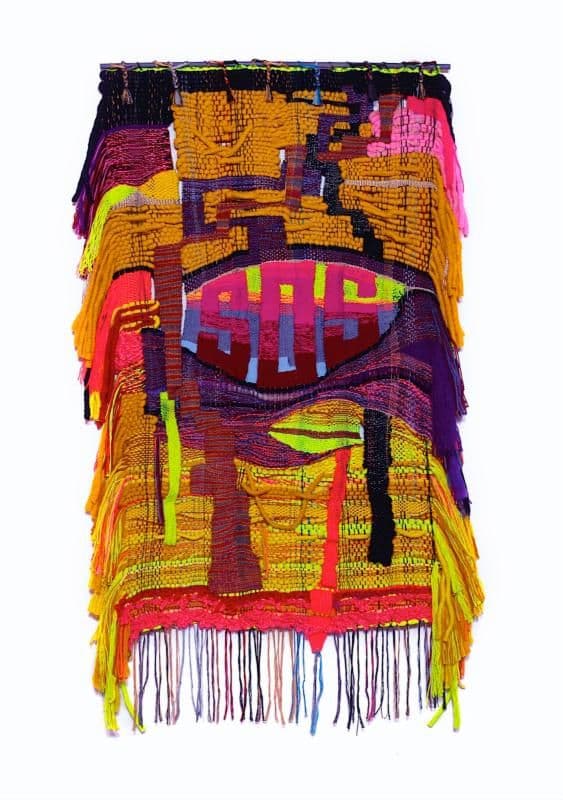
AcmeAcme is pleased to present The Smell of Gasoline, a solo exhibition of new woven works by Terri Friedman. With a background in painting and sculpture, Friedman is interested in pushing the material limits of painting, yet borrowing from different traditions. Friedman has been utilizing the loom to paint for the past five years. Terri Friedman lives and works in Northern California. She received her MFA from Claremont Graduate School in 1993 and her BA at Brown University in 1986. Her work has been exhibited nationally and internationally including her recent commissioned ART WALL at the Berkeley Art Museum and Pacific Film Archive, "The Way Things Go" at Yerba Buena Center for the Arts (curated by Rirkrit Tiravanija and Betti Sue Hertz), Orange County Museum of Art Biennial, Santa Monica Museum of Art, Geffen Contemporary, L.A.C.E., San Jose Museum of Art, pW139 Amsterdam, The Icebox Athens, c/o Gallery Oslo. Artist statement: "It's an odd fact that some people actually like the noxious aroma of gasoline. A highly flammable and colorless liquid. Most find it nasty. That seems to be the climate now in our country. Divisive, strained, and inflammatory. One match ignites a firestorm. Yarn is an unlikely agent to explore the human condition. What began as hopeful and optimistic work on my loom, slowly traveled through transition, loss, grief, disbelief (Wow, Oh no, Why), to cautionary signs (SOS, Wrong Way, Awake). My current body of work is a chronicle of the electric climate around me through a filter of tenuous optimism. Meditations on words and color. The atmosphere is radioactive and so are the woven panels. This has been a year of loss and grief for me personally and nationally. In addition to the toxic political environment, a friend died suddenly. Death, impermanence, and uncertainty are present. Though ultimately, I am interested in those places where lightness or brightness penetrate the darkness. These woven panels are personal and illusive protest banners-affirmations, just as inspired by contemporary Women Abstract painters, iconoclastic artists like Hundertwasser, as much as by artists like Sister Corita Kent, or fiber artists from the 60's and 70's like Magdalena Abakanowicz or weaver Hannah Ryggen. The process of weaving is unforgiving, mathematical, and imperfect. There is no painting over. It is like a digital printer, generated from the bottom to the top until an image is formed. Like many weavers, my process is not organic. After drawing, painting, picking palettes for warp and weft (the vertical and horizontal threads), measuring, laying them out on grid paper, I am ready to warp my loom. Though there is room for spontaneity, each warp thread and each section of the painted image is mapped out on paper before I begin. I like the very basic and straightforward technology of a loom. It is ageless. Weaving color. Yarn as paint. I have BOXES of yarns sorted by color and fiber. I welcome the tension between the natural fibers next to mass-produced artificial neon color yarn or even painted cotton piping. I am interested in the sickly sweet, awkward, uncertain, chromatic, theatrical, and ornate because it mirrors the unhinged world and fragile ecosystem we live in. The more I use these opposing fibers, textures, and palettes, the more it mirrors agitation. Because sometimes we just want to scream! Fear of color, chromophobia, is fear of race, sexuality, and life itself. Bright colors are often associated with children, homosexuality, sensuality, or drug culture. Psychedelia. Dazzle. Drag. Humor. Yet, color has the power to transcend. Color can mirror the insanity and unraveling we are feeling. Color is both confrontational and comforting. Rainbow Electric Acid zigzags weave through the panels. For years I have investigated abstract painting and color in my kinetic sculpture and installation as well as in my recent loom-based work. The yarn paintings are patchworks of words, color, and abstraction, and ultimately they are memorials of light coming through loss or even danger. 'Violent pretty': the woven panels tell stories about fragility, instability, and struggle." - Terri Friedman