West, London
Sarah Meyohas
Sarah Meyohas
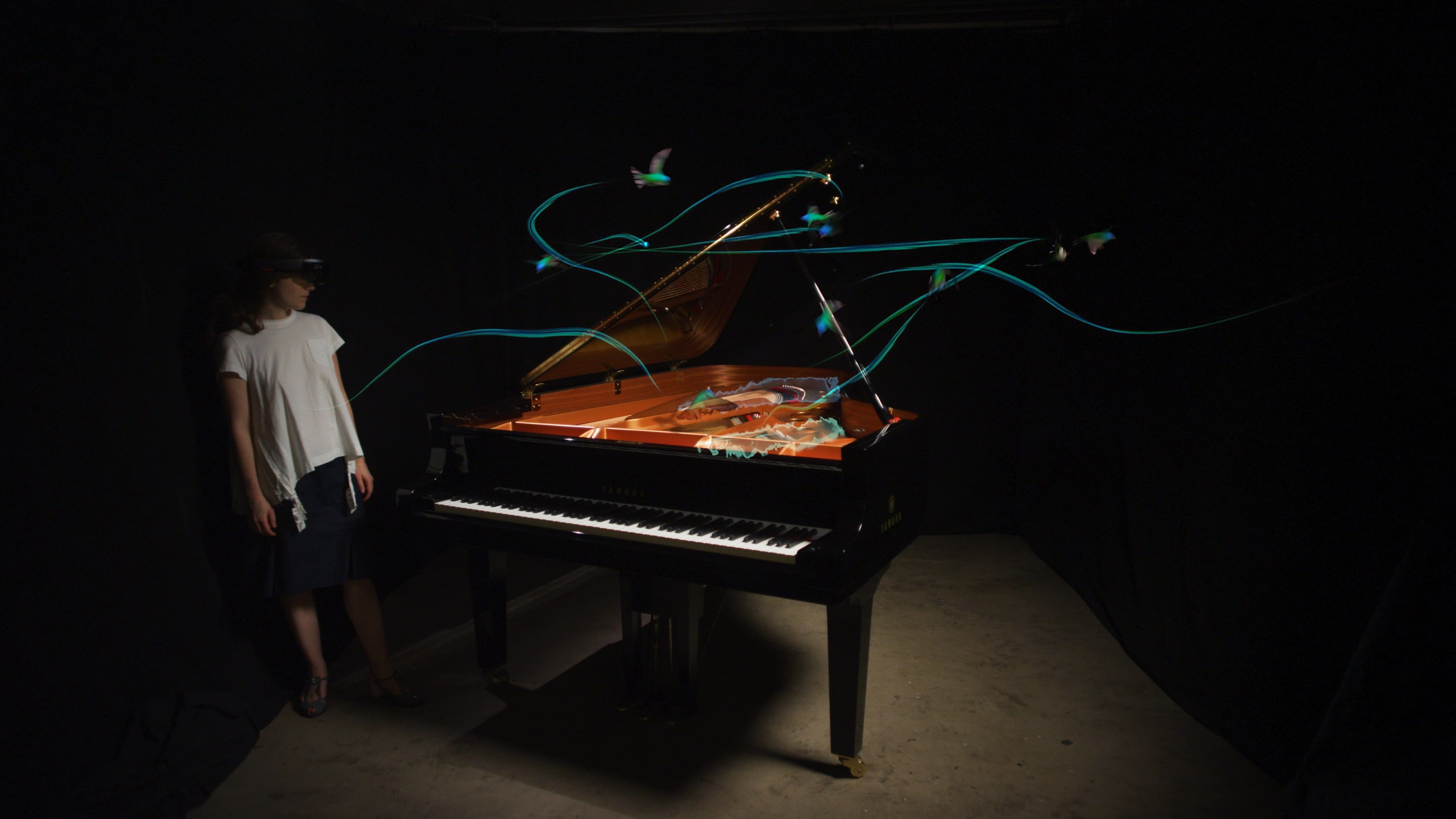
Nahmad ProjectsNahmad Projects is pleased to present an exhibition of new and seminal works by artist Sarah Meyohas. The exhibition is conceived in two general segments. One segment presents Meyohas’s cryptocurrency-NFT-hybrid project Bitchcoin and its relationship to two bodies of work, namely, large-scale photographs titled Speculations and a 30-min film presenting Meyohas’s multidisciplinary work Cloud of Petals. The second segment presents two interrelated works, Dawn Chorus, which has a sculptural presence featuring an immersive multi-sensory augmented-reality experience, and a series of holograms titled Interferences. In February 2015, Sarah Meyohas launched a social token, Bitchcoin, a cryptocurrency which could be exchanged in perpetuity for her work. Meyohas backed each original Bitchcoin with a five-inch by five-inch portion of her Speculations photographs. These works, created through the manipulation of physical reflective surfaces and water in a traditional photographic studio set-up, portrayed perspectival tunnels extending into infinity. Functioning as a visual and poetic interpretation of the blockchain technology itself, they held up a mirror to the alchemical ways in which value is created by the artistic gesture and embodied in art as a financial asset. This currency initially operated a fork of Bitcoin, during a month-long exhibition at Where Gallery in Brooklyn, New York, where a single node mined the token. Today Bitchcoin is recognised as one of the first NFTs to ever be minted, predating the launch of the Ethereum blockchain by five months. For the Cloud of Petals project, sixteen male workers gathered to photograph 100,000 rose petals, one by one, at the site of the former Bell Labs in New Jersey, where such innovations as the transistor, silicon solar cell, and numerous programming languages underwent critical developments. Meyohas conceived a real-life algorithm which dictated that human hands must individually open the flower, pick the petal, place it under the lens, press the shutter, and upload the image to a server. The workers set aside one petal per rose that they considered the most beautiful and put it in a press—preserving it as a physical artefact. The 30-min film documenting this highly ritualised, collective performative process is on view in the exhibition. In early 2021, fractionalised collecting and various use cases of decentralised finance in the art world that Bitchcoin had predicted came to pass. In response, Bitchcoin underwent a metaphoric transformation through its linkage to Cloud of Petals. Each of the 3,291 petals that had been stored on archival cardstock were minted as ERC-1155 tokens on the Ethereum blockchain. The petals are the documentation of the performance; materially limited and unique, they are the “proof-of-work” of the project itself alluding to the “proof-of-work” mechanism that is the predominant correlate of transactions on a blockchain. If one chooses to redeem their Bitchcoin for a physical relic, their coin will be destroyed, or “burned,” highlighting the symbiotic relationship between token and the traditional practice of currency backing. Each Bitchcoin token has a number on the back — the number of the worker, and the number of the petal selected. This number links each token to its unique petal. The tokens were first offered in an auction with Phillips in May 2021. To date, the volume of Bitchcoin transactions has exceeded 4.5 million USD. Bitchcoin, now referred to as a proto-NFT, proposed three ideas that are gaining widespread attention and application: using blockchain to track ownership of artwork, public fractional ownership of artwork, and the blockchain itself as a medium. As Tim Schneider of Artnet observed, “Blockchain-based work probably first surfaced in art-world consciousness in the form of Sarah Meyohas’s Bitchcoin.” [1] "Long before Beeple’s digital collage fetched tens of millions of dollars at auction,” wrote Bourree Lam of Wall Street Journal, “Meyohas was experimenting with using the blockchain technology behind Bitcoin to make art.”[2] The second segment of the exhibition presents two interrelated works, the augmented-reality work Dawn Chorus and a series of traditional holograms titled Interferences. The subject matter of the holograms is simply plant matter; yet, these are highly textural close-ups that invoke sensations of viscera. Meyohas is investigating the phenomenology of sensory perception that is unique to each individual viewer depending on what they bring to the experience and their physical movements in real space and time—a journey that begins visually and subtly evolves into an embodied multi-sensory experience of orifices, spikes, and gelatinous textures. Holographic experimentation began in the 1940s and the technique was recognised as a unique invention in 1971 when the Hungarian-British physicist Dennis Gabor was awarded the Nobel Prize in Physics. A hologram is essentially a photograph of an interference pattern (that is, the pattern that results from the superimposition of two waves), which, when suitably illuminated, produces a three-dimensional image. Meyohas sees her holograms as lenses through which nature is glimpsed at. Glass is an ancient material that is ubiquitous in our contemporary technologies and the built environment. In these holograms, glass returns to us embodying interference patterns. Juxtaposing the holograms, an older technology that uses an ancient material, with Microsoft’s cutting-edge augmented-reality headset, HoloLens in Dawn Chorus, Meyohas points to different ways in which glass and interference patterns of invisible and intangible yet very real physical phenomena such as sound waves, light waves, radio waves, and so on, can be used to shape our sensory experience of the world. Given so much talk of the Metaverse these days, the work asks us to stand at the frontier of future technology with HoloLens, by means of which we can participate in an enchanted world of birds at play, and consider its not-so-distant cousin, the early-20th-century invention, the hologram, which as a medium is not so common due to the tremendous technical complexity of its construction. In Dawn Chorus, birds in playful flight are the agents of the genesis of music. They land on the piano initiating a chain reaction of audible phenomena. In pre-historic times, the inspiration for human-produced music must have been the sounds of nature, especially those of wildlife. Birds are intrinsically related to music, so much so that we have come to call their communication “bird song,” and their seemingly choral singing at dawn the “dawn chorus.” By virtue of the way their feathers reflect light, some birds also manifest what is called “structural colour,” which refers to the most vivid colours in nature. Unlike pigments, which produce colour by absorption of specific wavelengths of light, structural colour involves the reflection of light within a material. In Dawn Chorus, while the birds are the protagonists of a magnificent opera of sound and colour, the piano is the stand-in for the fountain, a mythological trope (e.g. the fountain of youth, the fountain of life, etc.). The composition of the soundtrack that emanates from the speakers is itself a composite made up of several elements: recordings of “electromagnetic dawn chorus,” a phenomenon that refers to radio waves being converted at dawn with the use of proper radio equipment to sounds that resemble birds’ dawn chorus by coincidence; the flute, the instrument most akin to bird song; actual dawn chorus; and, the sound of the piano playing two distinct scripts. The first composition is developed algorithmically and is statistically similar to sections from whole-tone scale compositions, or compositions in “augmented scale”, that is, built from notes with intervals of a whole note, poetically rhyming with the “augmented reality” offered by HoloLens. Examples that come to mind are the work of composer and ornithologist Olivier Messiaen and Franz Liszt’s Water Games at Villa d’Este, upon hearing which, it is not hard to imagine birds of paradise at ecstatic play in the countless fountains of the Villa. The second script was specifically commissioned for Dawn Chorus from a contemporary French composer named David François Moreau. Dawn Chorus invites the gallery visitor to experience the superimposition of not only different kinds of human and artificial intelligence, but also the innate intelligence of the natural world, through a cyborgesque constellation of hardware and software. Sarah Meyohas (b. 1991, New York) is a conceptual artist and pioneer in the field of crypto art. Her work has been exhibited worldwide, including solo shows at 303 Gallery, New York and Red Bull Arts, New York. Meyohas is also a venture partner at Spark Capital. In 2015, Meyohas created Bitchcoin, a cryptocurrency backed by her physical artwork. Predating the launch of Ethereum, Bitchcoin is the first tokenisation of art on a blockchain, effectively a “proto-NFT.” Today, Meyohas continues to investigate emerging technologies with familiar emblems of biological life: soaring birds, created using augmented-reality software, flock in unison with the frenetic variations of the stock market; rose petals, aggregately identical but individually unique, comprise the dataset for their AI-created equivalents. Meyohas’s practice provides an intelligible visual language to articulate the systems and complex operations that increasingly govern our world. 1 - Tim Schneider, “Cryptocurrencies, Explained: Why Artists Are Already Leaving Bitcoin Behind for Something Bigger”, artnet News, February 6, 2018, online 2 - Bourree Lam, “Meet Wall Street’s Crypto Artist”, The Wall Street Journal, May 22, 2021, online