
Marais, Paris
Dean Monogenis
The Other Way
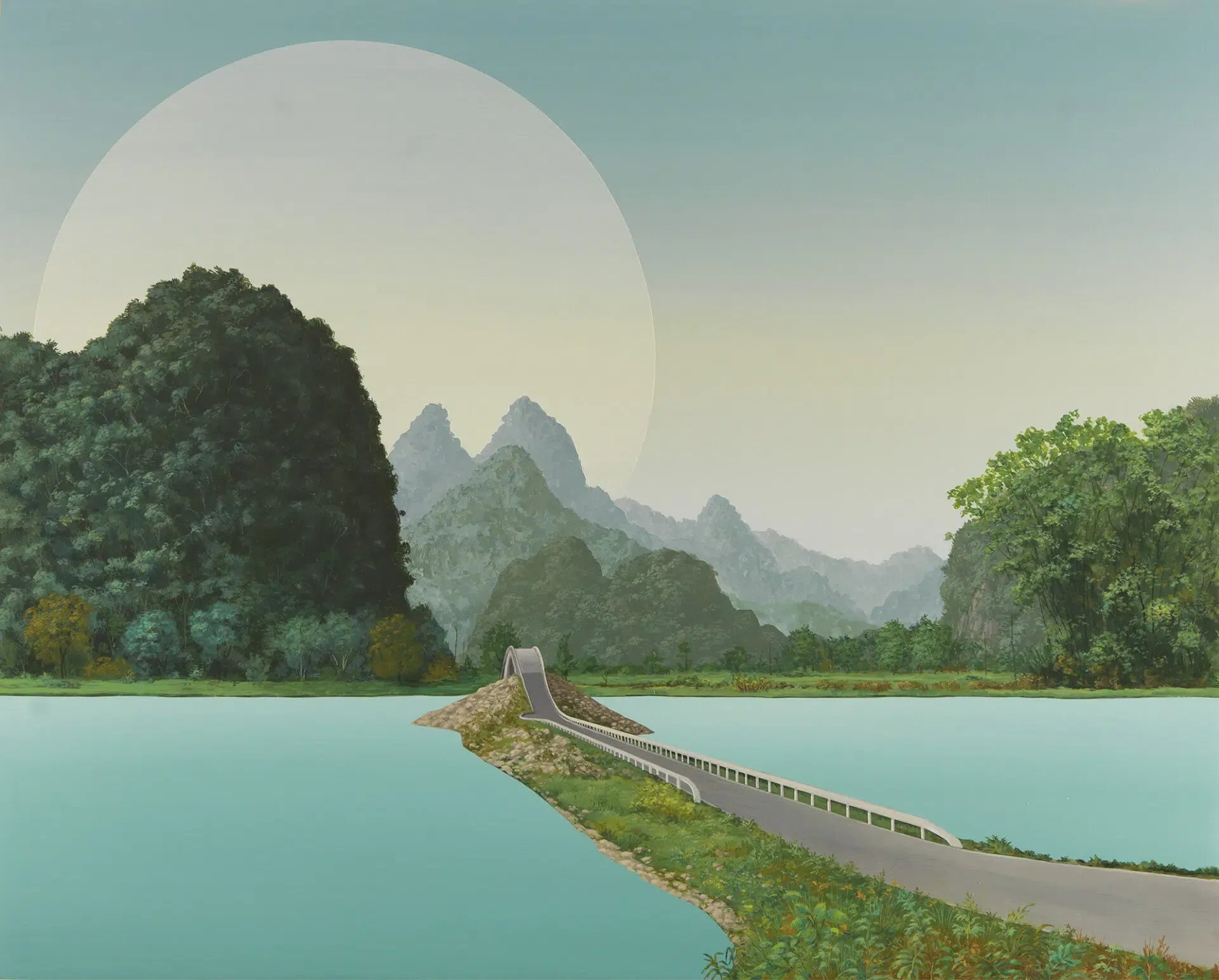
Xippas[Scroll down for French version / Veuillez trouver ci-dessous la version française] Xippas is pleased to present the third solo exhibition of American painter Dean Monogenis in its Paris space. The exhibition brings together a selection of new paintings created over the past year and opens with the presentation of the artist's new monograph Higher Ground, on the occasion of the opening reception. 'As soon as humans appear, everything begins to change.' This phrase, uttered by one of the protagonists of Andrei Tarkovsky's film Stalker, could be applied to the painted landscapes of Dean Monogenis. Large mountain panoramas bordered by clear lakes whose hypnotic shimmer is treated with a condensation of colored bands that introduce, into the immensity of nature, an artificial geometric composition. The artist plays with the resurgence of a Donald Judd-style colorful minimalism in the depths of classical landscapes, responding to the Albertian perspective. The infiltration of this cohabitation of styles questions the status of the image: reality or simulation, mental construction? Disturbance sets in. The window opened by the painter becomes a zone of 'fictional reality' to be explored. Indeed, if everything on the surface seems to adhere to a realism 'of the already seen,' the gaze tirelessly loses itself in the mystery of the unknown. And the sparing integration of human presence, suggested only by a few architectural elements – modernist houses perched on the side of a rocky peak or campers' tents pitched at the water's edge – reinforces the illustration of the solitary pilgrimage. But these familiar clues also have the power to imperceptibly change our view of nature. If the sublime snow-capped mountains embody our desire to escape into wild environments, they also raise the question of the impact of man on this idyllic postcard. Doesn't the work The Ability to Forget (2024), with its explicit title, evoke this feeling of losing something precious, even vital? A tiny pyramidal structure overlooks a large river dam while gazing in placid wonder at the innocent beauty of the water flowing from the mountain. How has the hand of man changed the contours of the landscapes? A return to nature, desired by the environmental struggle for rediscovering an ideal life, unpolluted and unindustrialized, is it possible? 'If we look more closely, these scenes are also a reference to our temporality and the uncertainty of what we will find in this perfect place,' the artist emphasizes. This quest is driven by a fascination with the figure of the adventurer, whose silhouette remains unseen yet is embodied by winding paths, improbably traced and cast forth to conquer dense, steep massifs, which are poetically embodied in the work Aventurine (2024). More than mere side roads, these are above all initiatory paths, shrouded in mystery, in sunsets with Californian colors. If Ritual (2023) evokes the vibrant palettes of David Hockney, Idle on the Precipice (2023) immerses us in a deep orange glow. The artist says his passion for architecture — structures he likens to sentinels perched atop dizzying peaks — was born in 2001, following the fall of the Twin Towers on September 11: 'This event was so shocking that it immediately changed everything around me. It made me see architecture for the first time.' However, in this new series, architecture is a little less present. No more buildings under construction, no cranes towering overhead. The ideal takes precedence over the tangible. And the images transform into an allegory of nostalgic beauty, marked by a foretold disappearance. This is exemplified in the work The Calling (2024), where an immense snow-streaked mountain stands beneath an enormous moon. The call of nature, of course, like a prayer, is a religious invocation. Here, the narrative gives way to the spiritual. The artist's mountain, while it refers to the world of Hollywood fiction through its uncanny resemblance to the Paramount Channel logo, is nonetheless an evocation of the writer René Daumal's Mount Analogue, a novel the painter cites in his personal library. A mystical mountain, a sacred refuge. Dean Monogenis, like his silent architectures, stands on the dizzying path between the exterior journey and the interior path. And here, alongside the artist, we step into travel narratives elevated by literature and cinema. The painter would be like Caspar David Friedrich's Wanderer Above the Sea of Fog. 'This series seeks to depict an ideal or utopia, while acknowledging that romantic visions of a natural paradise like Arcadia are inevitably shaped by contemporary reality. There is still adventure and the human need to travel and explore. I want this and I want to create paintings about it. But precisely because it's 2025, I have to include elements that suggest the limits of this dream,' he explains. The mountain motif thus serves as a renewed approach to landscape painting, reflecting contemporary concerns—spiritual, political, and ecological—while delicately balancing themes of rebirth and eschatological beliefs. 'Landscape painting is and always has been a means of transportation. And we need it. We need to feel that we can travel, even briefly, or virtually, simply by sitting and looking at an image.' Thus, Dean Monogenis meticulously invents the contemporary 'capriccio.' Born in 1973 in New York, USA, Dean Monogenis lives and works in Brooklyn, USA. His oeuvre was part of numerous institutional shows: CAC Meymac (France), McNay Art Museum (Saint Antonio), Pavillon de l’Arsenal (Paris), Musée d’art moderne de Saint- Etienne Métropole (Saint-Etienne), Schneider Museum of Art (Ashland), Santa Monica Museum of Art, Bronx Museum of Art (New York), Mykonos Biennale (Mykonos), Angels Gate Cultural Centre (San Pedro), Pace University (New York), Federal Reserve Board (Washington), Hunterdon Art Museum (Clinton, New Jersey), Neuberger Museum (NY), Herter Gallery, (University of Massachusetts, Amherts), Makor-Steinhardt Center (New York), Macedonian Cultural Society (New York), Brooklyn Museum of Art (Brooklyn, New York). In 2013, Dean Monogenis has received «Artist in the Market Place (AIM)» award, attributed by Bronx Museum of the Arts (Bronx, NY, USA) and in 2014 he was invited to conceive outdoor sculptures for the museum. In 2013 and 2016 he was granted residency in CCA Andratx, Mallorca, Spain. ***** La galerie Xippas a le plaisir de présenter la troisième exposition personnelle du peintre américain Dean Monogenis dans son espace parisien. L’exposition réunira un ensemble de nouveaux tableaux réalisés au cours de cette dernière année et s’ouvrira par la présentation de la nouvelle monographie de l’artiste Higher Ground, à l’occasion du vernissage. Zone de réalité fictionnelle « Dès que les humains apparaissent, tout commence à changer ». Cette phrase, énoncée par un des protagonistes du film Stalker d’Andreï Tarkovsky, pourrait s’appliquer aux paysages peints de Dean Monogenis. De grands panoramas montagneux bordés de lacs limpides dont le miroitement hypnotique est traité avec un condensé de bandes colorées qui introduisent, dans l’immensité de la nature, une composition géométrique artificielle. L’artiste joue avec la résurgence d’un minimalisme coloré à la Donald Judd au creux de paysages classiques, répondant à la perspective albertienne. L’infiltration de cette cohabitation de styles interroge le statut de l’image : réalité ou simulation, construction mentale ? Le trouble s’installe. La fenêtre ouverte par le peintre devient une zone de « réalité fictionnelle » à explorer. En effet, si tout en apparence semble coller à un réalisme « du déjà vu », le regard se perd inlassablement dans le mystère de l’inconnu. Et l’intégration parcimonieuse de la présence humaine, uniquement suggérée par quelques éléments d’architecture – maisons modernistes perchées sur le flanc d’un pic rocheux ou tentes de campeurs plantées au bord de l’eau – renforce l’illustration du pèlerinage solitaire. Mais ces indices familiers ont aussi le pouvoir de changer imperceptiblement notre regard sur la nature. Si les sublimes monts enneigés incarnent notre désir d’évasion dans des environnements sauvages, ils posent aussi la question de l’impact de l’homme sur cette carte postale idyllique. L’œuvre The Ability to forget (2024), au titre explicite, n’évoque-t-elle pas ce sentiment de perte d’une chose précieuse, vitale même ? Une minuscule architecture pyramidale surplombe un grand barrage fluvial tout en regardant dans une contemplation placide et émerveillée la beauté innocente de l’eau écoulée de la montagne. Comment la main de l’homme a-t-elle changé les contours des paysages? Un retour à la nature, souhaité par le combat écologiste pour retrouver un idéal de vie non pollué et non industrialisé, est-il possible ? « Si l’on regarde de plus près, ces scènes sont aussi une référence à notre temporalité et à l’incertitude de ce que nous trouverons dans cet endroit parfait » souligne l’artiste. Cette quête passe par une fascination pour la figure de l’aventurier, dont on ne voit pourtant jamais la silhouette mais qui est incarné par des chemins sinueux aux tracés improbables jetés à l’assaut de massifs denses et abruptes, ce qu’évoque avec poésie l’œuvre Aventurine (2024). Plus que des chemins de traverse, il s’agit surtout de chemins initiatiques baignés de mystère dans des soleils couchant aux couleurs californiennes. Si l’on pense à David Hockney dans le magnifique Ritual (2023), on se délecte de l’atmosphère orangée de Idle on the precipice (2023). L’artiste le dit, sa passion pour l’architecture – qu’il accroche comme des sentinelles à des sommets vertigineux – est née en 2001, après la chute des Tours Jumelles dans l’attentat du 11 septembre : « Cet événement a été tellement choquant qu’il a immédiatement changé tout ce qui m’entourait. Cela m’a fait voir l’architecture pour la première fois ». Cependant, dans cette nouvelle série, l’architecture est un peu moins présente. Plus de bâtiments en construction sous des grues. L’idéal prend le pas sur le concret. Et les images se muent en allégorie d’une beauté nostalgique, marquée par une disparition annoncée. En témoigne son œuvre The Calling (2024) habitée par un immense mont strié de neige auréolé d’’une énorme lune. L’appel de la nature bien sûr, comme une prière, une invocation religieuse. Nous quittons ici le narratif pour entrer dans le spirituel. La montagne de l’artiste, si elle fait référence à l’univers de la fiction hollywoodienne par sa troublante ressemblance avec le logo de la Paramount Channel, n’en est pas moins une évocation du Mont Analogue de l’écrivain René Daumal, récit que le peintre cite dans sa bibliothèque intime. Montagne magique, sanctuaire. Dean Monogenis, à l’instar de ses architectures silencieuses, se tient sur le chemin vertigineux, entre le voyage en extérieur et le voyage intérieur. Et c’est ici que nous entrons, avec l’artiste, dans les récits de voyage sublimés par la littérature et le cinéma. Le peintre serait comme le Voyageur contemplant la mer de nuages de Caspar David Friedrich. « Cette série a pour intention de décrire un type d’idéal ou d’utopie, mais avec la compréhension implicite que les notions romantiques d’une utopie naturelle comme l’Arcadie, de nos jours, sont soumises à notre réalité. Il y a encore de l’aventure et le besoin humain de voyager et d’explorer. Je veux cela et je veux créer des peintures à ce sujet. Mais précisément parce que nous sommes en 2025, je dois inclure des éléments qui suggèrent les limites de ce rêve » explique-t-il. Le motif de la montagne sert ainsi une nouvelle peinture de paysage à l’aune de nos questionnements contemporains, qu’ils soient spirituels, politiques ou écologiques, se tenant sur le fil de l’idée de renaissance et des croyances eschatologiques. « La peinture de paysage est et a toujours été un moyen de transport. Et nous en avons besoin. Nous avons besoin de ressentir que nous pouvons voyager, même brièvement, ou virtuellement, simplement en nous asseyant et en regardant une image ». Ainsi, Dean Monogenis invente avec science le « capriccio » contemporain. —Julie Chaizemartin, Journaliste et critique d’art Né en 1973 à New York, États-Unis, Dean Monogenis vit et travaille à Brooklyn, États-Unis. Son œuvre a fait partie de nombreuses expositions institutionnelle : CAC Meymac (France), McNay Art Museum(Saint Antonio), Pavillon de l’Arsenal (Paris), Musée d’art moderne de Saint-Etienne Métropole (Saint-Etienne), Schneider Museum of Art (Ashland), Santa Monica Museum of Art, Bronx Museum of Art (New York), Biennale de Mykonos (Mykonos), Angels Gate Cultural Centre (San Pedro), Pace University (New York), Federal Reserve Board (Washington), Hunterdon Art Museum (Clinton, New Jersey), Neuberger Museum (NY), Herter Gallery, (University of Massachusetts, Amherts), Makor-Steinhardt Center (New York), Macedonian Cultural Society (New York), Brooklyn Museum of Art (Brooklyn, New York) En 2013, Dean Monogenis a reçu le prix “ Artist in the Market Place (AIM) ”, attribué par le Bronx Museum of the Arts (Bronx, NY, États-Unis) et en 2014 il a été invité à concevoir dessculptures extérieures pour le musée. En 2013 et 2016, il a bénéficié d’une résidence auCCA Andratx, Majorque, Espagne.