
Marais, Paris
Trevor Yeung
Redundant Lovers
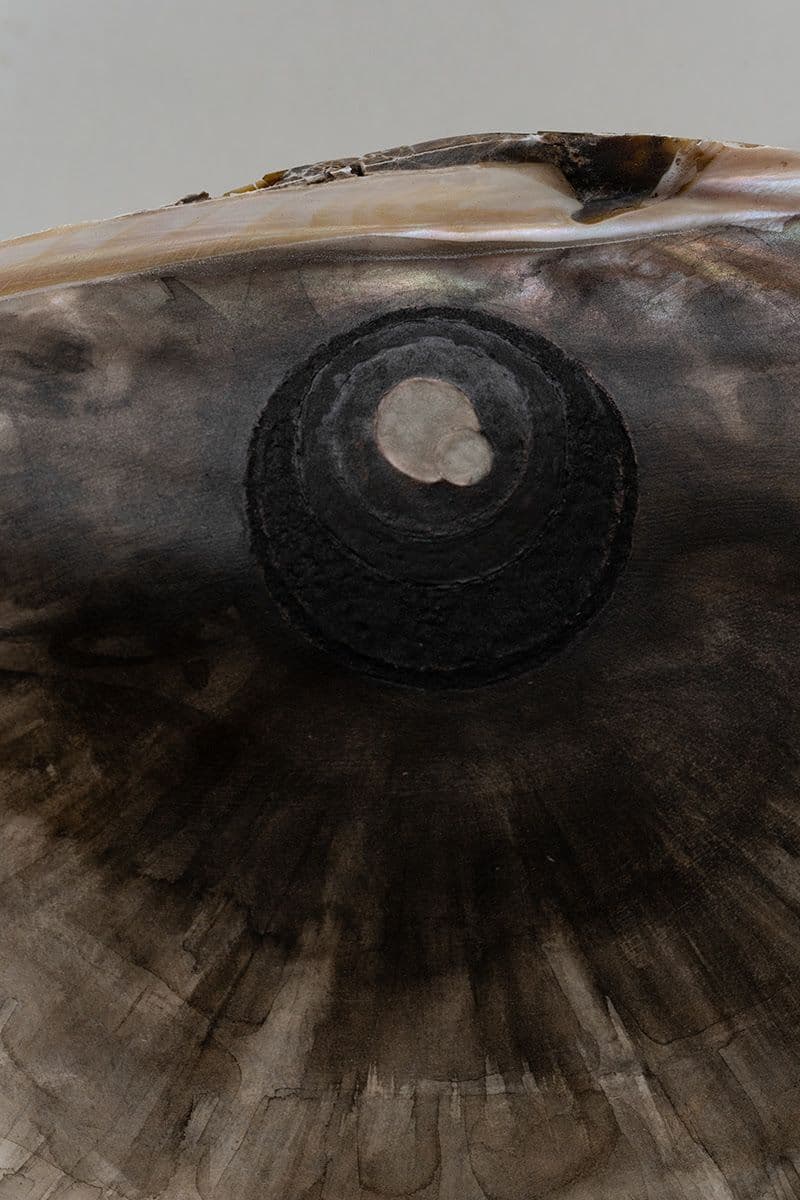
Galerie AllenGalerie Allen is pleased to present Redundant Lovers a solo exhibition by Trevor Yeung. How many times have you been a lonely mollusk, missing the other half of your shell? An empty aquarium that colourful fish have long left? Or just a shy, awkward rock looking for friends, afraid to leave the shadow of a friendly tree? I certainly have—and found great comfort in Trevor’s quiet sculptural narratives. He hides emotions in plants, animals and minerals, telling stories of challenged self esteem, uneasy attempts at communication, unrequited love, and the enduring hope to be made complete. His new body of work, Redundant Lovers (2025) is made of painted mussel shells, carefully displayed on the wall—awkwardly large, almost unnatural. These oversized shells are a byproduct of Southeast China’s freshwater pearling industry, which produces the overwhelming majority of the world’s pearls. The work uses ink painting and mineral pigments, cherished because, unlike watercolors and oils that change over time, they last forever. In place of the precious material that perhaps inhabited the mollusk, Trevor paints circles inside the hollow shell, which he calls “remains of hope and lower expectations.” Trevor is particularly fascinated by shells: minerals produced by animals, layers protecting soft and fragile insides, they remain long after the living body has died and decomposed. His works often blur the lines between animal, mineral and plant life. In his series Cacti (2019), he placed taxidermied spiked blowfish in flower pots, painting them green with mineral pigments to mimic the appearance of a cactus and mess with regular classifications. Redundant Lovers also evokes some early sculptures like Three to Tango (2015), a fabulous threesome of marine animals fixated forever in their dance under a glass case. He evoked a display typical of Chinese antique shops to show how love and relationships are idealised and fetishised, represented by a single moment of embrace or intercourse. Trevor’s painted mollusks refer directly to Japanese golden shells (kai-awase), hand-painted shells that were part of an elaborate court game cherished by Japanese aristocracy. Players had to find the matching half of their meticulously-crafted shell, often an arduous task in sets of hundreds of tokens. In Trevor’s interpretation of the kai-awase game, however, the giant shells have no match. After the two parts of the marine animal are broken apart to remove pearls, killing the animal, they are tossed to be sold in bulk. Discarded in a huge mass of leftovers, they are forever destined to remain alone. —Lucas Morin The idea for the series of works in Redundant Lovers came to Trevor Yeung after he stumbled upon some vintage Japanese hand-painted clamshells in a flea market. Drawn to their faded but still exquisite craftsmanship, Yeung wanted to buy one to keep, only to find that the whole set of around twenty must be bought together. Such clamshells are in fact play pieces in an ancient Japanese court game called kai-awase. Dating back to the late Heian period (794 to 1185), kai-awase is a matching game wherein players try to identify two halves of the same clamshell in a game set that could consist of up to 360 pairs. In the game’s original iteration, plain shells were used, and players had to match a chosen ‘deal’ shell (dashigai) with a ‘base’ shell (jigai) laid out on the ground purely based on natural contours and patterns. [1] As the game evolved, the two halves of a bivalve were decorated with the same image on the inside for the ease of confirming a match. With added decoration, kai-awase became luxury objects by the late 15th century. Paintings in mineral pigments with gold and silver gilding were the main decoration, and the images often depicted scenes from The Tale of Genji, a literary masterpiece from the 11th century about fictional romantic escapades of the Heian court. During the 16th and 17th centuries, kai-awase sets also became the most important bridal gift in marriages of the nobility because not only were these aesthetic objects a status symbol of wealth and power, the singular match between a pair of shells was also thought to symbolise monogamous union. [2] Redundant Lovers takes kai-awase as a point of departure to explore the opposite of an inherent match. The shells on view are imperfect halves thrown away after commercial pearl extraction. Using mineral pigments, Yeung simulates the pearls that were once lodged inside the bivalves. Unlike the throwaway shells, though, mineral pigments are known for exceptional longevity. Among the pigments used, malachite is the oldest known green pigment, first manufactured by the Egyptians from about 4000 BC and still survives today in tomb paintings. [3] Closely related to malachite is azurite, also a greenish-blue pigment containing basic copper carbonate. The most precious blue, however, is ultramarine made from ground lapis lazuli. Traded along the ancient Silk Road from its native Afghanistan, ultramarine can be found in Chinese Buddhist grottos of the Dunhuang region in depictions of the Buddha’s hair, robes, halo, and other celestial adornments dating as early as the Northern Wei dynasty (386-535). In the West, lapis was imported into Europe much later in the 14th and 15th centuries. [4] The arduous manufacturing of ultramarine made it even more valuable than gold. Due to its preciousness, ultramarine was reserved for depictions of the noble or sacred across cultures. The lasting vibrancy of mineral pigments offers a poignant contrast to the themes of solitude, loss, and imperfection in Redundant Lovers. —Joyce Hei-ting Wong 1 - Tomoko Sakomura, “Japanese Games of Memory, Matching, and Identification,” in Asian Games: The Art of Contest, ed. Colin Mackenzie and Irving Finkel (New York: Asia Society, 2004), 255. 2 - Yamazaki Tatsufumi, “A Golden Opportunity: Reviving the lost art of kai-awase and kai-oke production”, NGV Magazine, September – October 2021, 36-7. 3 - J.R. Barnetta, Sarah Miller, and Emma Pearce, “Colour and art: A brief history of pigments,” Optics & Laser Technology 38 (2006): 446-47. 4 - Ibid, 449.