
Lower East Side, New York
Group Exhibition
Who's Afraid of Still Life?
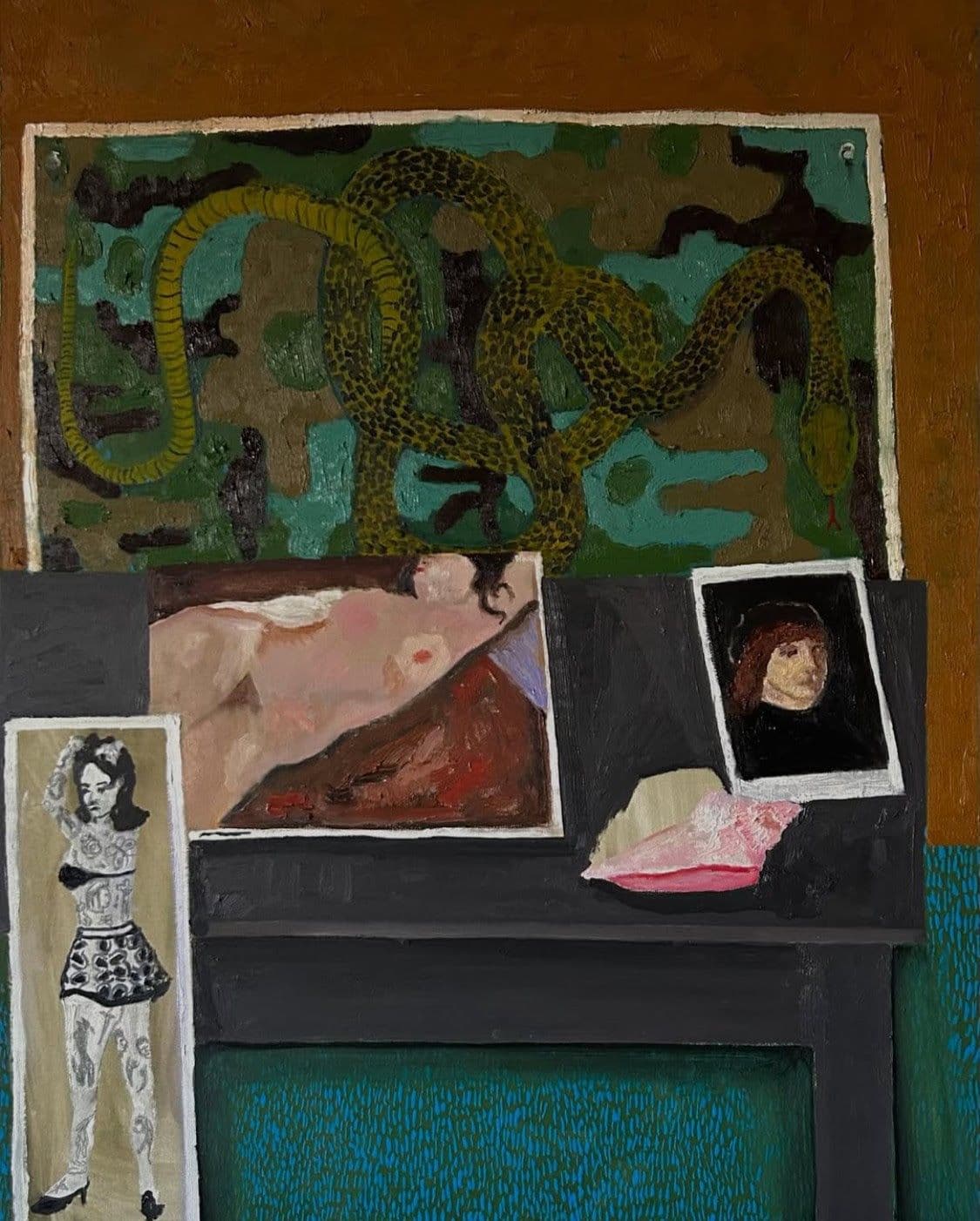
JJ MurphyMaureen Dougherty, Kyle Gallup, Allison Gildersleeve, Catherine Kehoe, Ryan Kish, Tracy Miller, Mark Milroy, John Mitchell, Jesse Morsberger, Nora Riggs, Trevor Winkfield JJ Murphy Gallery is pleased to present Who’s Afraid of Still Life?, a group exhibition of recent still life paintings curated by Nancy Mladenoff. Édouard Manet famously observed, “Bring a brioche, I want to see you paint one: still life is the touchstone of painting.” Despite its very long history, the still life—the arrangement of objects in space—is often considered a lesser genre. Yet all of us can think of extraordinary examples of still lifes throughout art history: works by Cézanne, Matisse, Giorgio Morandi, or Pablo Picasso's "Green Still Life" (1914). This show argues that the still life is very much alive today by presenting the work of eleven contemporary painters who explore the rich possibilities of a genre that has never gone away. Allison Gildersleeve’s “Half Past Two” (2025) features pairs of scissors in a jar, a flower in a glass, and two sketchbooks with paintbrushes. Two still lifes in the exhibition contain a single object. In some sense, the paintings of Maureen Dougherty and Jesse Morsberger reflect the interests and preoccupations of different generations. Morsberger focuses on a can of Red Bull energy drink set against a purple-and-black background, while Dougherty paints a high-heeled woman's shoe that is composed of an assortment of stripes and colors. Ryan Kish’s painterly still lifes are more traditional in their elegant simplicity. They feature a green onion and shallot on ceramic plates. Tracy Miller flattens pictorial space in depicting a chocolate-covered donut set on a doily against colorful abstract shapes. Catherine Kehoe’s “News Blackout” (2025) abstracts her still life enough so that the viewer struggles to decipher exactly what is being represented, such as leaves and possibly fruit. Trevor Winkfield depicts a goblet and vase, but he pushes the element of abstraction to the point where the objects transform and become part of an intricate pattern or design in which the vase becomes a mechanical-like figure. Mark Milroy flattens space in depicting a nightstand, a camouflage snake poster, three small images, including one of a Courbet nude, and a seashell. In Kyle Gallup’s “Other Side of the Mirror” (2024), a silver tray rests on an old-fashioned dresser with a mirror that reflects the bedroom, creating an image within an image. Nora Riggs's “Still Life with Fries” (2025) offers an overhead perspective. Her still life includes French fries, an open packet of ketchup, a plastic bag of grapes, and other elements that add a surreal dimension, such as a Greek head vase or cup. John Mitchell uses careful framing to juxtapose a scene on a TV screen from "All About Eve" (1950) and a postcard from a Paris exhibition of Vincent Van Gogh. As human beings, we have an intimate relationship with everyday objects, which we often imbue with a sense of personal meaning. The importance of still lifes, as this show hopefully makes clear, is that, through heightened perception, they help us to understand and appreciate the world in which we live. John Cage suggested that music is all around us if we could only hear it. The same might be said of still lifes; they surround us if we could only see them.