
Galleries, Basel
Kendell Geers
The Oculist Witness
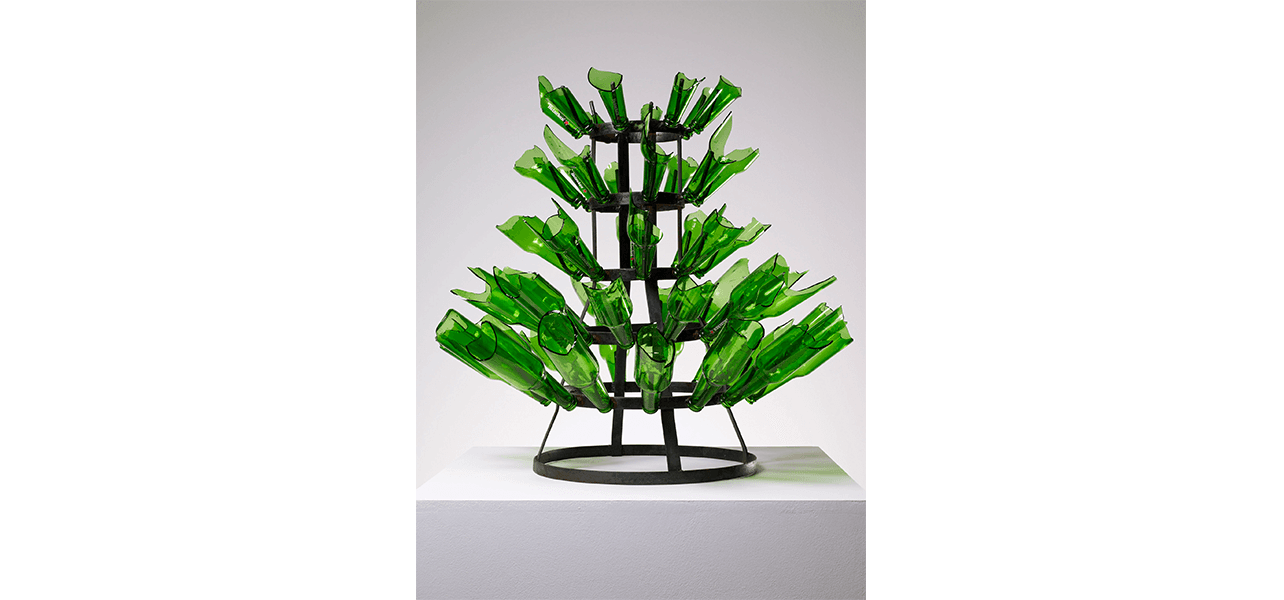
WildeKendell Geers, a pivotal figure in contemporary African art, has carved a niche for himself on the international stage with his incisive and unapologetically bold works. His first exhibition with Wilde and in Basel, The Oculist Witness, is a testament to his profound engagement with the legacies of history, art, and activism. Born in the throes of apartheid South Africa, Geers's journey from a working-class family to an artist in exile shapes his unique artistic language, one that defies simple categorization and speaks to the complexities of identity and resistance. His work, rooted in a deep and complex engagement with his identity as a white African, interrogates the intersections of minimalism, conceptual art, and activism. Through his art, Geers stretches and transforms the fabric of perception, weaving together semantics, puns, and innuendos into a tapestry that challenges and provokes. His art is a dance in the shadows of Plato's Cave, where reality is inverted, and doubt and perception intermingle in a shamanic ritual of understanding. At the heart of The Oculist Witness lies an innovative and thought-provoking venture: the exhibition is conceived around the book Duchamp's Endgame, authored by Kendell Geers. This book is not just a catalog or supplementary material but serves as the conceptual and thematic core of the entire exhibition. In Duchamp's Endgame, Geers embarks on a scholarly yet deeply personal journey to decode the enigmatic activities of Marcel Duchamp in Munich in 1912, revealing insights that challenge and expand our understanding of Duchamp's contributions to modern art. The book proposes a revolutionary perspective on Duchamp, suggesting that the true essence of his work has been obscured by conventional art historical narratives. Geers, through meticulous research and artistic intuition, uncovers the intricate play of influences and ideas that shaped Duchamp's oeuvre, particularly the pivotal work Tu m’ (1918). By doing so, Geers invites readers and viewers alike to discard preconceived notions about Duchamp and engage with his art in a more direct, unmediated manner. Duchamp's Endgame thus acts as a gateway into the exhibition, guiding the audience through Geers's intellectual and artistic landscape. It frames the show as an extension of the book's arguments, with each artwork serving as a visual and conceptual counterpart to the themes explored within its pages. The exhibition, through this symbiosis with the book, becomes a dynamic space where the legacy of Duchamp is reexamined and reinterpreted through Geers's lens. Throughout his long career as an artist, Kendell Geers has engaged with the legacy of Duchamp on multiple levels. Perhaps the most profound was to shift the term found object to lost object because the former entirely erases and denies the history of the object prior to being “found” by an artist. In contrast, the term lost object invites the viewer to consider when why and how an object gets lost and how that context informs the object re-contextualised as a work of art. Geers’s most famous lost object is a broken Heineken bottleneck that he titled Self Portrait (1995). The domestic beer bottle is transformed into a weapon of destruction and the label that reads “Imported from Holland - The Superior Quality” is a cutting commentary on how the colonial process was directed by corporate interests. The central work of the exhibition is an art historical masterpiece called Stripped Bare (2009). The sculpture is a 3-meter high wall of bulletproof glass, shattered by the impact of 7 bullets fired at close range. The scale and structure of the work are exact quotes from Marcel Duchamp’s The Bride Stripped Bare by Her Bachelors, Even (1915 to 1923), which can be found in the Tate Collection. Even though the sculpture was made 15 years ago, it is as pertinent today as ever, a chilling reminder of the fragile human condition and the fine line where art and politics find themselves in an uncomfortable interrogation of the other’s limits. Stripped Bare was also included in Ruffneck Constructivists curated by Kara Walker for the Philadelphia ICA in 2014. Where Stripped Bare is larger than life, Tears of Eros (2009) is an almost invisible small glass phial that takes its form from Duchamp‘s 1913 work Air de Paris, a 50cc glass phial of air. Once again, Geers shifts the signifier along the tense border between art and politics, by filling his 50cc glass phial with teargas. The title uses black humor to generate a play on words that pays homage to the English title of Georges Bataille's 1961 book “Les Larmes d'Éros” which explored the complex relationship between violence and the sacred. Rack (2009) refers to the Medieval torture instrument as well as Duchamp’s iconic work Bottlerack (1914). Geers has transformed a vintage bottlerack from the same period into a device that interrogates history by adding broken Heineken bottles to each of the lost object’s pins, both restoring and denying its original functionality. Duchamp’s Endgame will be published by Wilde in partnership with Fonds Mercator and Yale University Press. During Art Basel 2024, it will be available exclusively through Wilde.