
Charlottenburg, Berlin
Tom Holmes
Razor Blade Candy
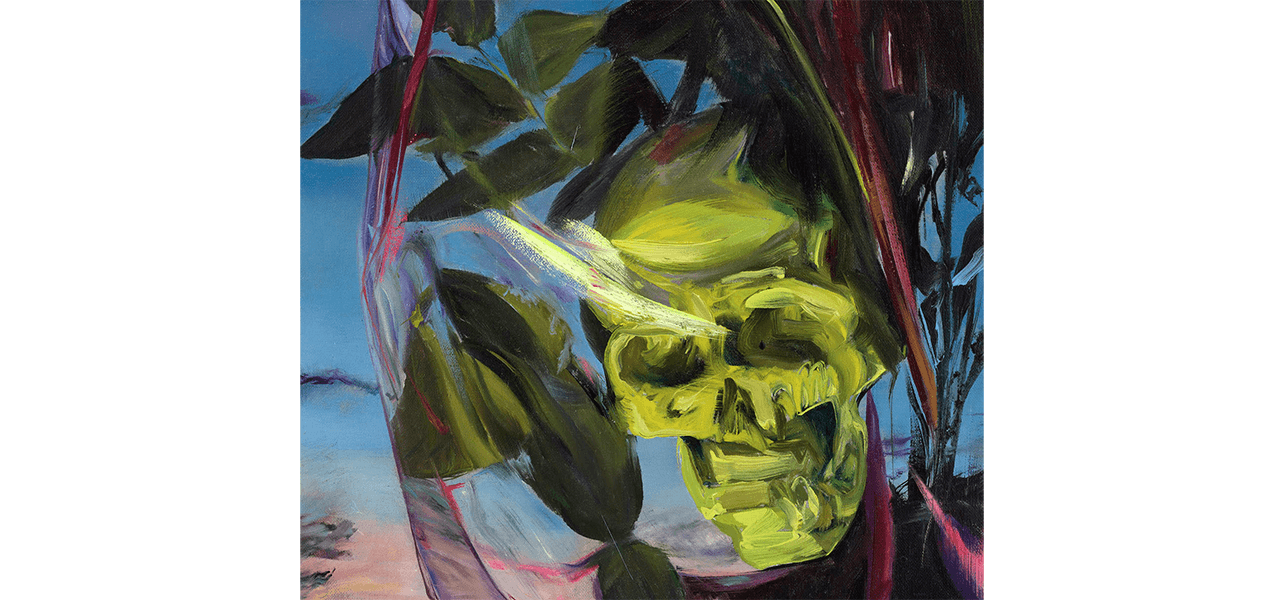
EfremidisEfremidis is happy to present the solo exhibition Razor Blade Candy by Tom Holmes. In Tom Holmes’ new show Razor Blade Candy, their investigations into the gothic underbelly of American culture results in a series of psychedelic and fantastically expressionist paintings. Employing virtuosic brush work, the paintings have a photographic quality, capturing children and objects in moments of exuberance and celebration, while there remains a sense of something latent and darker. The works mark a new stage in Holmes’ painting practice, where image making meets a funereal excavation of American death, depravity and hope. Widely recognized as a sculptor and deployer of ready-mades, Holmes’ recent exhibitions have seen their interests in the automatism of both art making and life-living find their way onto the canvas. This will be Holmes' first solo show in Europe since their exhibition Temporary Monument at Kunsthalle Bern in 2013. The exhibition is accompanied by a written interview between Tom Holmes and the curator and writer Dominic Eichler. Dominic Eichler: When I first saw your suite of paintings for your exhibition at Efremidis, I was struck by the depictions of children in inexpensive Halloween costume, some who look like they are hollering. They created ambivalence in me, even some discomfort, much like when I see parents over-share images of the autonomous beings they are entrusted to nurture. Who are these children? Why and how did you paint them? Tom Holmes: Yeah, ya just can’t make a portrait without the portent stickiness of selfies. Kids are so often the surrogate selfie for a performative parenting on social media. There’ve been no shortage of bat-shit libertarian myths floated in the last few years. Markedly, in a wave of populist histrionics, we’ve seen crunchy moms unexpectedly aligned with the far right & get quite loud touting irrational conspiracies. My favorite, Pizzagate, where a conspiratorial Deep-state is alleged to be running a paedophilia ring out of a DC pizza joint. So perhaps I began with the simple idea that kids might make a potent metaphor because whining “What about the children” was so often being amped to justify a neurotic Mama-bear’s fear, lack of control, alienation. There was also a palpable sense of self-censorship. I could hear those internalized restrictive voices saying “What’s that Kween doing picturing children? Who’s that white boy think he is depicting an ethnic other?” (Did my internalized voice just mis-gender me? – the nerve.) So I chose to lean into the subject precisely because it all felt a bit unmentionable. That long-standing common myth that the homosexual is a threat to children I find particularly irksome. It’s worth noting that these images of children are complete inventions, fiction. They aren’t painted from life or even a photo of a real kid. Of course, all the works were completed before Lensa AI came out, but I’ve really put up no resistance to that sort of rubbery uncanny Pop aesthetic. By the nature of their construction, the works can’t be called realist, although I’m banking on their empathic potential – that the human is most interested in, concerned with, other humans. DE: Your work also got me thinking about the art history, possibly because of the style and the use of oil paints and raw linen canvas. For a millennium, childhood in painting meant the infant Jesus, cheeky cherubs and the dressed-up prodigy of rulers and elites. Some impressionists loved middle-class children and children with their mothers, though I can’t recall one depicting a caring patriarch off hand. In photography from the 19th century on, we have documents of children at work, poverty-stricken, sick in bed. But if we stay with painting, it seems like children rarely feature in the canon 20th century modern art. This seems to be true even if the idea of drawing like a child was a popular dictum for the Avantgarde. (Of course, there are exceptions, in Social Realism for example and Picasso springs to mind.) I am conscious too that mid-century Feminists were acutely aware of this blind spot. Do you think it is because, as I read somewhere, that children are difficult to paint because they won’t sit still, or is there cultural politics at work? Or is it about the art market – because pictures of other people’s children aren’t considered good sellers? TH: The works in this show are as much images of light as they are their primary subject, but what is there to really say about paint application? I’m happy to divulge what postcards, books, were laying around while I made the work. I’ve been looking, in the last couple years, at a great deal of Symbolists’s work. There is often a decided quietude, introspective, gauzy aspect in works like Odilon Redon’s portraits and still lives. Félicien Rops can be so loopy and seductive. Some later characters like Morris Graves, Anton Kolig were also on my mind. Some odd ball paintings like Friedrich von Amerling’s portrait Emperor Franz I (1832), loomed large. There’s a nod to the Bildungsroman and a very German cult of self-discovery. And Oh, George Minne’s Kneeling Youth (1898) is a raison d’être. I mean, I’ve painted three screaming children dressed up as the Fates/ Valkyries among plastic still lives, so it might not be at all obvious I was drawing from such hushed ‘ol art work examples. A show of mine back in 2019 included a number of painted images of the makeshift memorials left at the site of schools shootings. It wasn’t a Victorian morbidity, or Social Realism that I was after so much as the disconnect in civic depictions of grief. That oddly infantilizing sentiment that assumes some disruptive force in the natural order of things – the child taken before its time. DE: I saw that many of your earlier works use found objects in sculptural assemblages? What changed in your thinking and why? TH: Oh Christ, nothing so cowardly as stylistic monotony. Does the work look so different? I contain multitudes! I’ve been such a reluctant painter. I just started oil painting a few years ago. Turns out it’s not so hard. As a studio practice, the autonomy, liberty, of painting is remarkably prudent. There was also a sense that the raw object I was reclaiming for its metaphoric potential didn’t induce a contemplative space as effectively as a picture of the thing – it just didn’t. The thinness of off-the-shelf objects needed a bit of remove to enter that space – the space of platonic form. The readymade is always central in the work – I just don’t see a strategy away from it. As I was painting the children, it occurred to me that the subjects were veering awfully close to the allegorical. Work really will arrive just outside one’s agency sometimes. I’ve no real allegiance to painting. It’s what I seek out in the museum experience, but if tomorrow this work demands a different medium/mode, digital projection, jazz dancing, I’ll surrender to the needs of the work. I’m often surprised that the work doesn’t look as abstract as I know it to be. Within the studio practice, there’s no real difference in representation and abstraction, the historic differentiations are all horseshit. All painting is abstract painting. DE: I have always been drawn to ‘unfinished’ paintings. A striking one in Berlin is Adolph Menzel’s Speech of Frederick the Great to his generals before the battle of Leuthen 1757 (1859–1861). There is a huge energy in his brushiness too. I suppose it is because of how they place the viewer in the shoes of the painter with palette in hand, in making decisions, in process, perhaps failing or giving up. I suppose it was the abstract artists again if mid-century modernism that really made raw canvas do half the work. The fragmentary leaves space or a field for the imaginary. What attracts you to this pictorial device? TH: I do find that Menzel painting quite arresting. In no short part because there is a pronounced vulnerability in its making, its end. There was a month, a day, a moment when the artist chose to abandon the work. A moment where the ember went out. And there left, is the naked ghost of Frederick the Fae, nothing left to say. Paintings that do that, show their skeleton, materiality, offer an invitation to their formation. A picture grows up. A picture can arrive in a single moment, but seeing is and isn’t instant. DE: One of the unanticipated phenomena in contemporary art of the last decade is the incredible abundance of figurative painting circulating. I am not sure that discourse has caught up with this. Writing anything about the specificity of a painting requires an appreciation of aesthetic nuance, not just the ‘right’ subject. You joked to me as we were about to start this interview that you wanted to jump on this bandwagon now precisely because it is waning. Figurative painting of the last century was very much tied to social politics. On this point, is your use of working-class US cultural signifiers a programmatic decision on your part? Is it important who is represented? TH: Listen, am I the only one that thinks Berlin shows an inordinate amount of mediocre scatter-floor-installations? It feels like, Oh here’s a politically-overdetermined, land-fill- bound, faux-raw, faux-anti-aesthetic, faux-anti-commercial installation, where you walk on seashells to feel bad about the environment, or walk over dirty clothes to feel bad about refugees. Oh look, at the far end of the empty space there’s a video wall of nothing, happening slowly. Jesus H Y’all, a reliance on the false authority of minimalism, is numb-nuts dumb, but throw-away art – that truly sux. This country, this town, doesn’t need to produce another philosopher. Ya needs to produce a fuckin comedian. Nobody talked more shit about recent figurative painting than me, but of course I hadn’t really made a figurative painting much less shown any. Turns out they are an interesting challenge. It bemuses me to show such figurative, pictorial, work. It amuses me to show paintings in Berlin, at all. Really there is no telling what the work wants to end up being. In a perverse, perhaps defeatist way, I rather love showing work in a genre so quickly going out of fashion (if it ever were, in Berlin.) New York, at least, has paraded out, in the last five, ten, years some rather provincial dogoodery. The rub is, it ain’t done that much good. I assure you all the gatekeepers look the same. So, it begs the question who’s the real beneficiary? Doesn’t seem to be the artist. They are being used as disposably as fashion models. My position begins to feel like this: representation matters that much less every time ya hear the phrase (said in bratty Millennial voice) “Representation Matters!” (I might apply this to any theoretical social democracy, but for our purpose let’s say just within the context of a progressive lefty Art World). The thin brittle surface layer of politics is so fucking homogenous that I’m forced to listen to much deeper layers beneath what is being said. I’m now listening for those deeper layers of intention, tone, tenor, desire, repression, convention, volition! (I’m gonna throw fate & destiny in there just to take it right to the edge of one’s agency.) The drive to homogeny within a contemporary discourse cannot be trusted – it’s as fruitless as old-world etiquette. If it isn’t being driven by Love is it just masking so much civic inequity? Hold on, was “Figurative painting of the last century so very much tied to social politics?” Hun, I’m not sure that’s true. Sure, 70’s Black Arts Movement, Socialist Realism, but beyond that the early & mid-century examples feel rather apolitical, no? The Brits always seem to think a painting is missing something if it doesn’t have a figure, but what were the social politics of Bacon, Freud, Auerbach? Hedonistic shenanigans? They got my vote. DE: I’m feeling wary about the hubris entailed in the notion of the ‘contemporary’. It seems to me most of the things that matter to us in life and art have long tangled roots, and that’s the reason for my evocation of art history in these questions, exculpation, and both deconstruction and synthesis seem to me to be crucial. Are the paintings of objects such as the mirror, or the stacked objects about the construction of a subject? TH: Right. I’m proposing that the nature of any given object/image is illusory. One, of the one-hundred-and-one, mechanisms of metaphor is the object gets to remain the object while the subject gets slippery as fuck. There’s the Duchampian gag at an elementary level (i.e. The Eggo frozen waffle brand Leggo My EggoTM becomes the bodhisattva’s instruction to let go of my ego) Then at an increasingly more complex stratum there is my rather elusive list of concepts that need better metaphors. Um, well I do have more to say about metaphor, but perhaps it’s best I don’t say too much. Metaphor looses its punch without succinctness. DE: The show’s title Razor Blade Candy refers to an urban myth that resonates with perverse malice, and plays to a genre of American noir that is ubiquitous in mass culture and also to be found in Pop and post-Pop art – for example in the work of Andy Warhol and Cady Noland. What attracts you to this malevolence? And to what end? Why do you feel comfortable with dark Pop? What is your attraction to the gothic underbelly of the American dream? TH: No, no it’s not that dark-sided. Actually, it’s all rather wholesome. I do hope the humor of the title isn’t lost. It’s a strawman argument. There is no predator, never was. What is the oppressor, the ruffian, the state, the despot, to the tyranny of one’s own mind? There is a half-atrophied fear-fed primate brain that entertains itself with a falsified sense of threat to its survival. A great waste of civic imagination. America is a fucked project. The game’s been so rigged nobody in the know can imagine a state solution to any civic ill, but there are still enough pockets of anarchist refuge to exercise community care at a much smaller level. These are, by their nature, separatist communities, self-defined. But, an American dystopia isn’t a primary subject of my work. I’m really after something akin to hallucinating via the visual, sensational noise to glimpse the mechanism unfolding. I use to like to say “Cady Noland is God”. You never hear from her and she’s rumored to still use a fax machine.”