
Marais, Paris
Léopold Rabus
Léopold Rabus
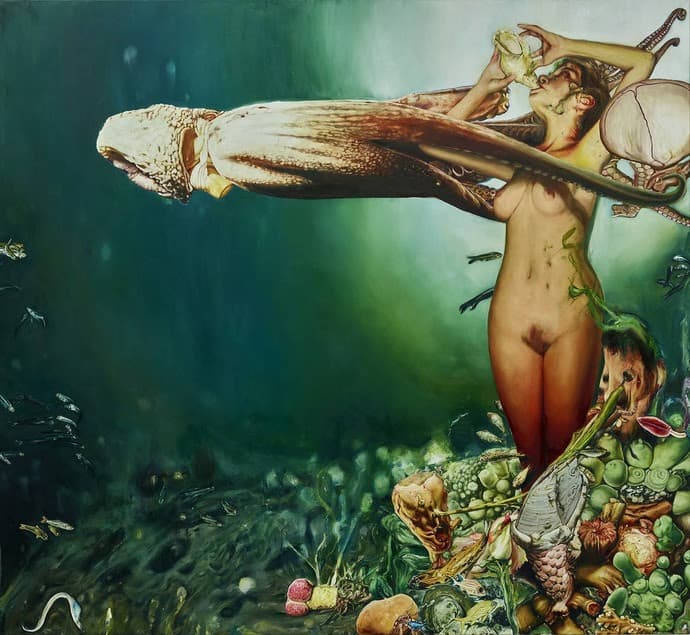
Suzanne TarasieveProject Room How can we inhabit the world in harmony with all living beings? It is around this question that Léopold Rabus brings together for the first time, in the gallery’s Project Room, two series of oil paintings that explore the relationships between the body, the gaze, and their environment. Through these works, the artist captures a transition from an organic world to more stripped-down landscapes in which living forms transform, fragment, and persist in new ways. The first series was inspired by a trip to Corsica, and in particular by the discovery of the iconic sculpture Venus à la conque, created by sculptor Gabriel Diana in the early 2000s and located in the center of Bastia. Rabus explores the seabed as a place of birth and creation. The foam brings forth a Venus within a teeming ecosystem, in which fish, vegetation, and organic fragments intermingle. In one of the paintings, a monumental octopus spreads its tentacles horizontally, partially covering the figure and clouding our perception, without ever obscuring her presence. The seabed thus ceases to be a mere backdrop and becomes an active environment— a space of movement, contamination, and transformation. A palette dominated by deep greens and aquatic tones envelops the scene in an atmosphere that is both alluring and unsettling. Léopold Rabus does not merely revisit the figure of Venus; he offers a contemporary reinterpretation, in which birth is no longer a pure and idealized moment, but a complex corporeal phenomenon, in which the body and its environment are closely intertwined. While this first series immerses Venus in an organic world in constant flux, the second offers an earthly echo. Varied landscapes—twilight valleys ablaze, nocturnal woodlands tinged with romance, vast mountain horizons—replace the ocean depths with a mineral and vegetal expanse, marking the transition from a teeming milieu to a more barren environment. The motif of the eye is central and recurring in this new context. Whether isolated or in clusters, it appears in these landscapes as a fragment detached from the body. This presence brings to mind pigs’ journey to the slaughterhouse: their eyes are removed before they die, introducing a raw and tangible reality. But these eyes do not merely evoke the disappearance of the living: they raise a more enigmatic question, that of the animal’s gaze on the world we inhabit together. It is from this perspective that the artist references Rainer Maria Rilke’s Eighth Duino Elegy. Rilke depicts the animal as liberated from time and open to an immediate perception of the world to which humans have no access; these eyes thus seem to bear the mark of an experience lived without distance or detachment. A question remains unanswered: what have these eyes seen? Rabus introduces a kind of poetry into the depiction of these initially repulsive eyes. He sublimates them by treating them as still lifes: painted in a figurative style, then placed within almost instinctive landscapes, they acquire an ambiguous presence, both unsettling and meditative.