
Marais, Paris
Yoan Mudry
Don't Feed the Cat
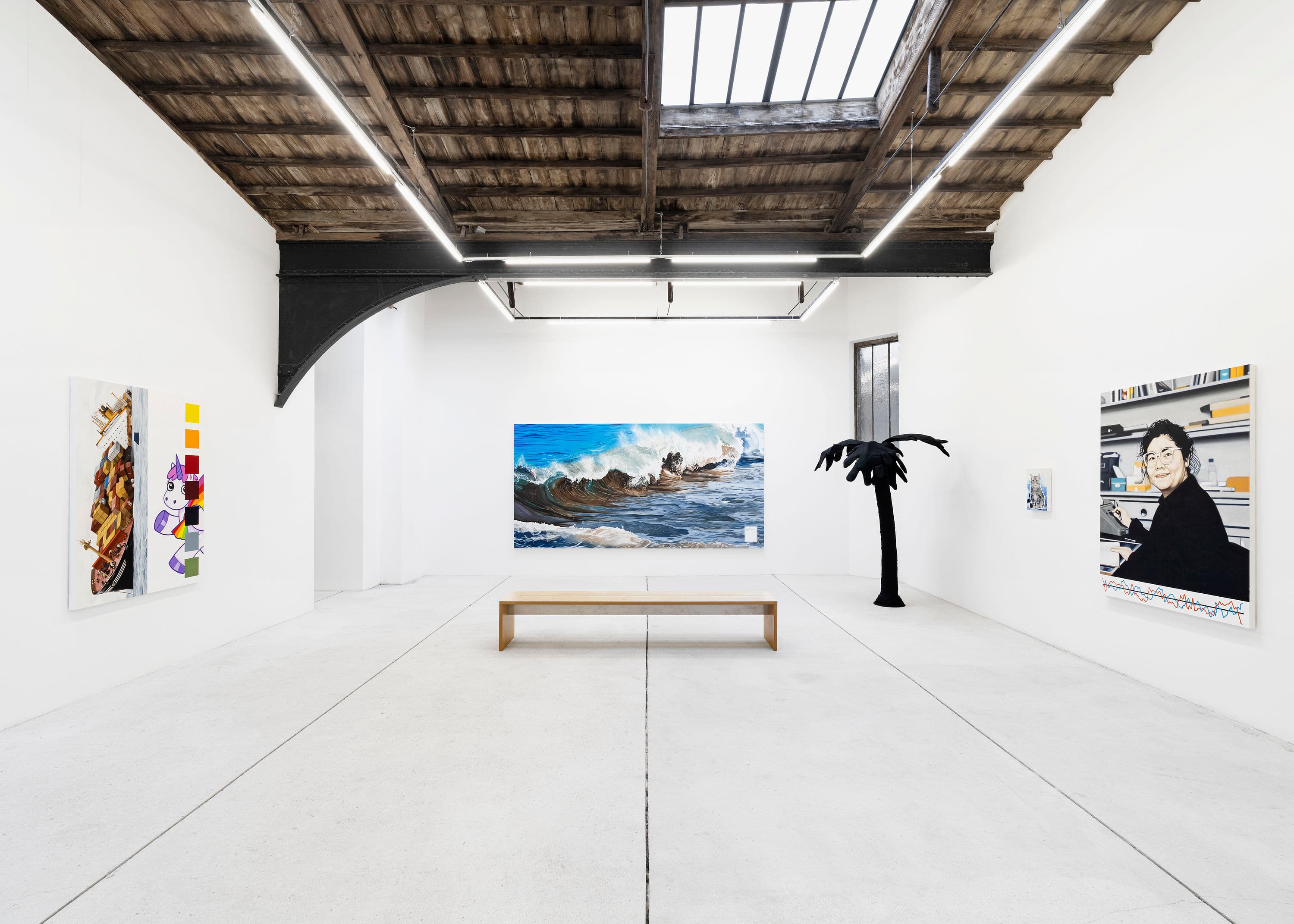
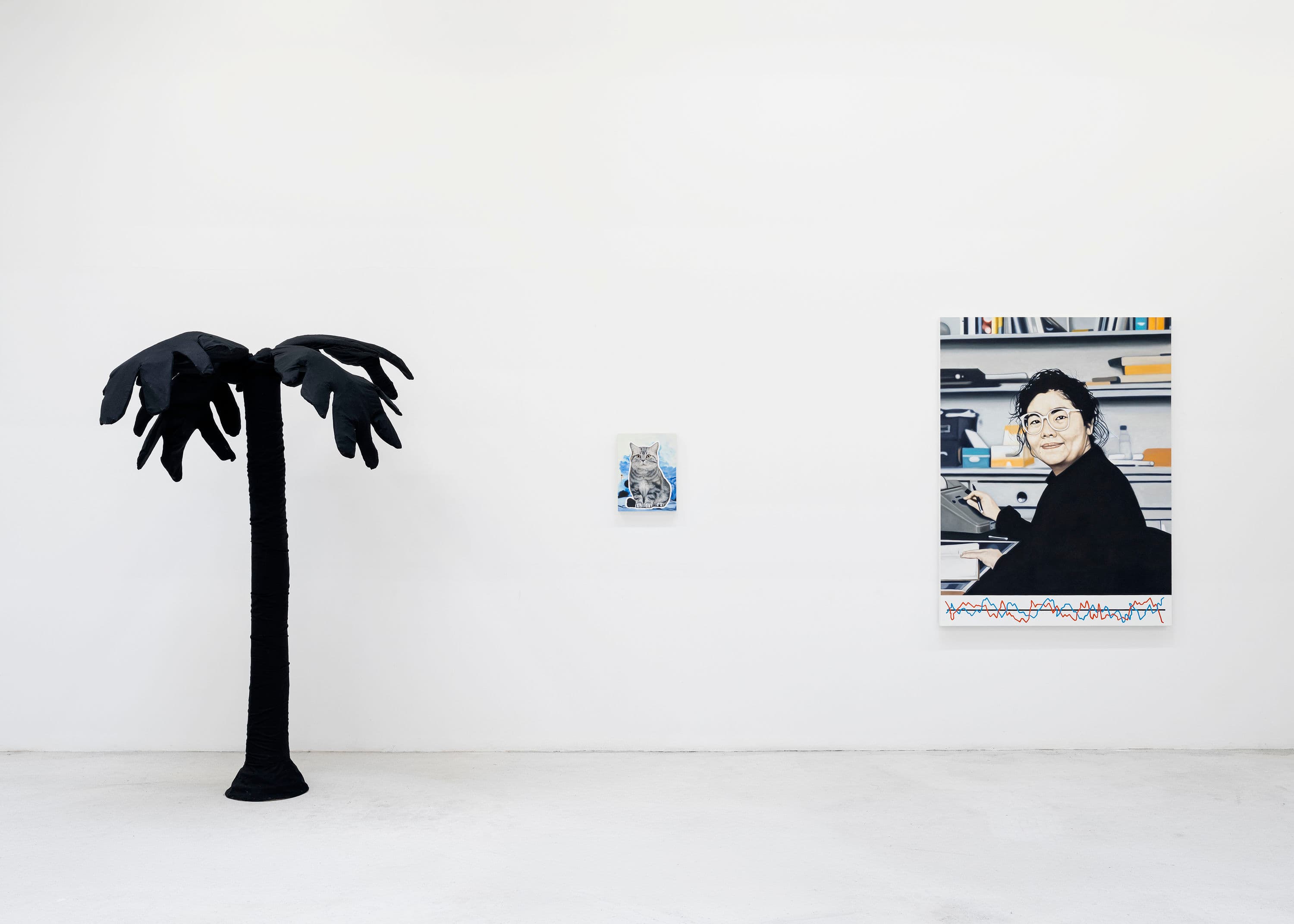
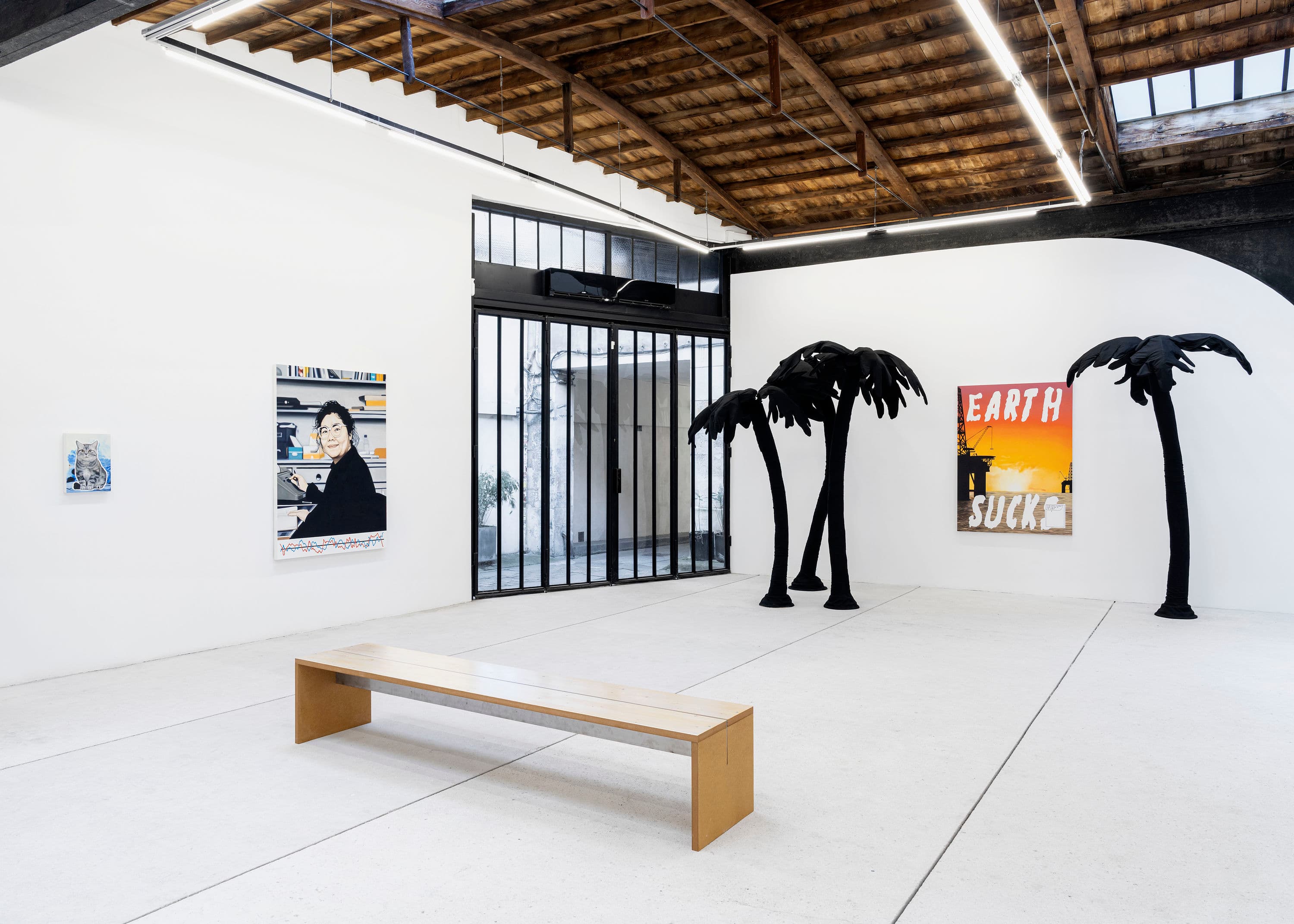
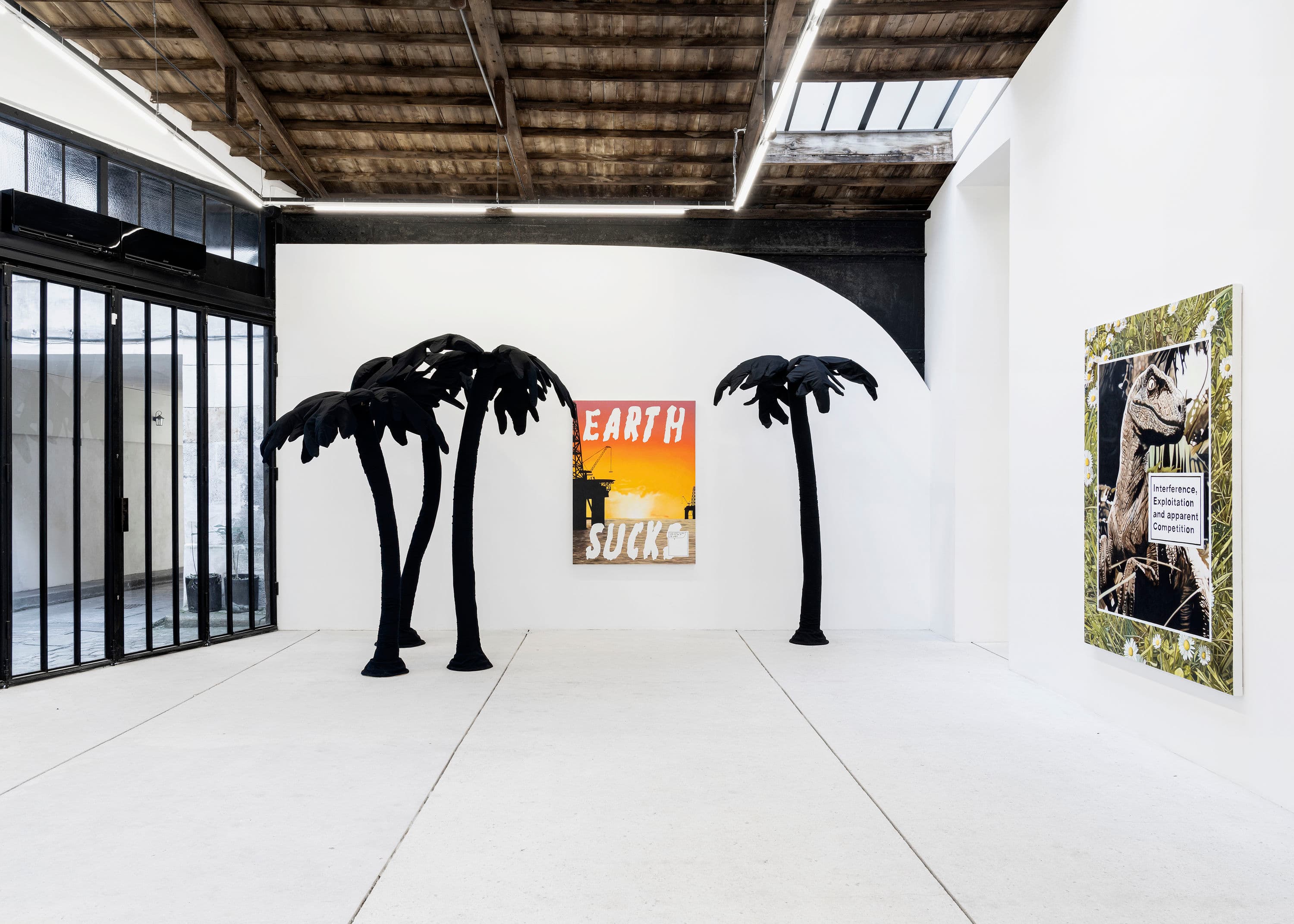
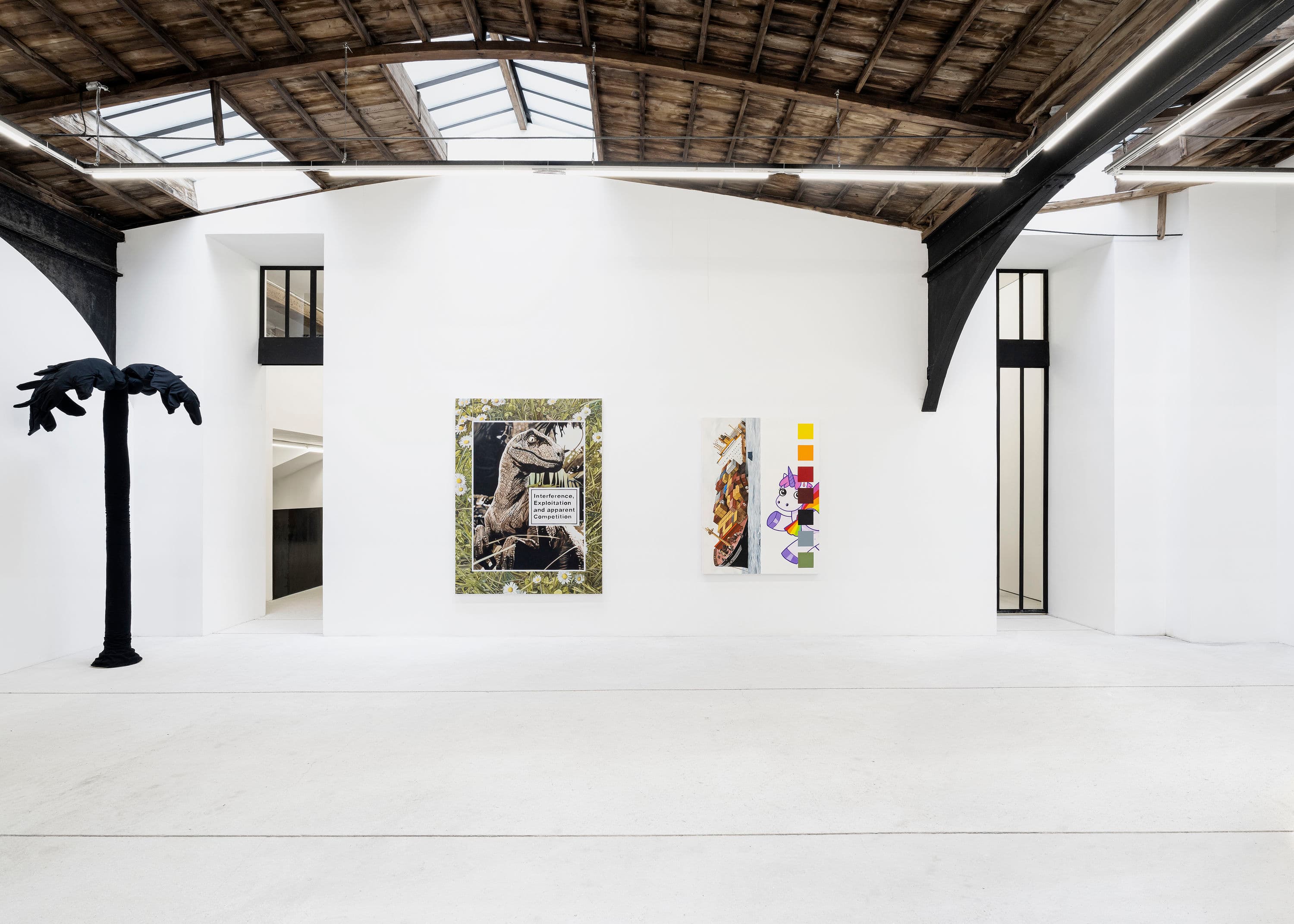
Frank Elbaz“Don’t expect too much from the end of the world.” This somewhat vague injunction to distrust, discreetly formulated, almost whispered by one of the paintings in the exhibition, is at first rather enigmatic. It could constitute a kind of millenarian equivalent of “Don’t put all your eggs in one basket.” Why not even serve as a popular saying for the Age of Collapse (spoiler: it’s ours)? But everything becomes clearer when it is interpreted within the specific context of Western pop visual culture: it may well be that the end of the world produces no beautiful representation, no grandiose scene, no admirable spectacle. In short, nothing comparable to those photogenic images of apocalypse with which we have been increasingly saturated since July 1945. While the question of what will replace our old visual grammar of catastrophe remains open, Yoan Mudry’s exhibition offers answers in the form of palm trees that have no business indoors, an oil platform installed in the open sea, and species struck by extinction. Here, he very explicitly thematizes the issue of collapse, drawing on figures that are not limited to the representation of a brutal cataclysm but are instead characterized by durations ranging from the very long to the very rapid. Since 2010, Yoan Mudry has worked through the appropriation of images and texts found largely online. He develops collages in Photoshop, producing several versions until he arrives at a composition that satisfies him and in which the images “come together.” There is no rule: the composition may rely on a formal analogy or on an unexpected association. This pop methodology emerged in England in the late 1940s among artists shaken by the destruction of the war (and its images), who conducted their experiments using content borrowed from mass culture, largely imported from the United States. In Mudry’s work, the nature of the sources has evolved, but the principle remains the same: mixing anonymous visual languages in order to create different levels of accessibility, inviting everyone into the loop to collectively explore the technological landscape of the time. He is interested in the visual mechanisms of advertising and marketing, as well as in the new forms of algorithmic manipulation that characterize digital capitalism. The seductiveness of images and the capture of attention are thus, for him, both a subject and a method—humor, cartoons, the bright, colorful palette of screens, technological sublimity, sunsets, or trompe-l’œil all functioning as traps designed to draw viewers in. Yoan Mudry spends weeks in one-on-one encounters with his images. The painting stage that follows the collage can even last for months. This operation of transposing the screen into oil on canvas obviously requires great technical mastery. It also situates his work within the post-conceptual tradition of the Pictures Generation, along with its set of questions: why paint instead of print? Why paint oneself rather than delegate? Does reiterating visual codes (in this case those of advertising, web cultures, or mainstream cinema) make it possible to critique them? And where does the line lie between critique and complicity? By way of an answer, one might emphasize that Yoan Mudry’s prolonged face-to-face engagement with images today attests to the possibility of sustained attention, and offers an alternative to the automated production of images. “What I try to do with painting,” he explains simply, “is to move closer to the figure of the craftsman.” Significantly, the work that cost the artist the most is also the one through which he most clearly affirms, to date, his relationship to painting. The wave that occupies a large wall of the gallery is both his first incursion into a monumental format and an allegory of the long history of this medium—a history shaped by successive generations of painters who have grappled with the difficult task of representing this boiling, foaming, liquid surface, for the sheer pleasure of it. —Jill Gasparina Born in Lausanne in 1990, Yoan Mudry is a multidisciplinary artist currently living and working in Geneva. A graduate of the Geneva School of Art and Design (HEAD) in 2014, Mudry develops a reflection on image saturation, information overload, and the proliferation of narrative flows that permeate our daily lives. He responds to these phenomena by intersecting, recomposing, and layering different sources—images and texts primarily drawn from the internet, as well as comics, cartoons, and references to art history—within a diverse body of work that manifests mainly through painting, but also through sculpture, performance, video, and installation. Yoan Mudry has recently presented solo exhibitions at Union Pacific, London (2023), and at Kunsthalle Basel (2021). His work has also been featured in numerous group exhibitions, notably at FMAC Geneva (2024), Kunsthalle Zürich (2023), Kunsthalle Bern (2021), and the Istituto Svizzero in Rome (2021). In 2025, he was awarded one of the City of Geneva Grants.