
Westside, Los Angeles
Alice Könitz
Pistachio Concern
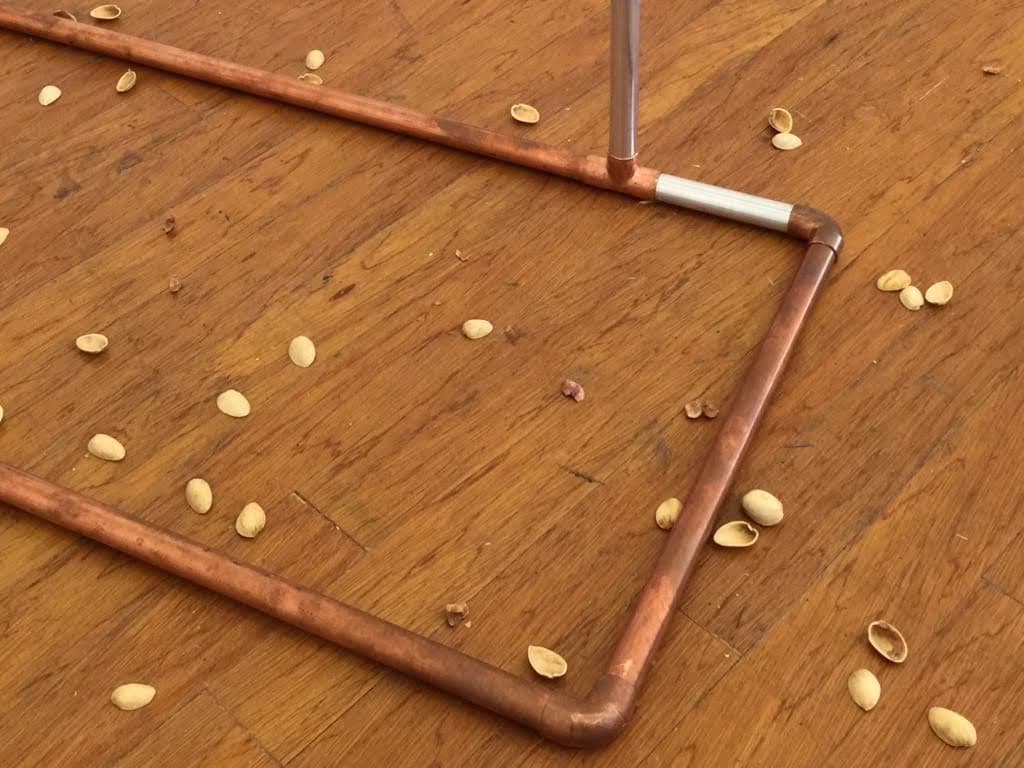
DXIX ProjectsDXIX Projects is pleased to present Pistachio Concern, a solo exhibition by artist Alice Könitz. As part of DXIX Projects’ previous group exhibition, Home Depot, curated by Won Ju Lim and Jan Tumlir, Könitz created a site-specific sculpture realized from loosely interwoven copper & aluminum pipes which eventually penetrate through an interior wall of the gallery into a small back room–offering a plate of pistachios from one end of the conduit structure, while dispensing perfume from the other. As a continued exploration of the dialogue Könitz has initiated with the architectural space, DXIX has invited the artist to extend and expand this singular work into a solo project resulting in Pistachio Concern: an exhibition utilizing this initial sculpture as a source of instigation, amplifying a dialogue with a new body of work. At the entrance of the exhibition space, Könitz has installed a revolving door adapted to the tall and narrow proportions of the existing doorframe. Once squeezing through the turnstile into the exhibition space we confront a cigarette vending machine and the mentioned pistachio & perfume dispenser. Some resonances between the pieces are apparent. The vending machine and revolving door are based on rotating mechanisms. One is transporting the viewer, while the other, in a similar way, is transporting a cigarette from the inside of the box to the outside. Each of these pieces “offer” something–an entry, a cigarette, a pistachio, a dash of perfume–each available to the viewer through the simple actions of stepping through, rotating, grabbing or squeezing. Finally, on the wall overseeing the scene, we find a drawing of the French Singer Mireille Mathieu. This portrait reinforces a central point of reference within this body of work as it suggests a specific place and a time in Könitz' memory recalling the encounter with Mireille Mathieu's image on a record cover at her childhood friend's apartment from a time before she started elementary school. In addition to memory, Könitz' work often engages with spatial experience and architecture. The works in this show allow a playful reconsideration of the domestic space in which the exhibition is located, inhabiting the architecture with naturalness as they furnish the space like functional artifacts, appliance devices, and/or architectural devices, yet with a sense of awkwardness as they remain in context as temporary anomalies. The pieces revolve around specific twists in the aesthetics of contemplation, functionality and usability. If the usual art experience is articulated around contemplation (subject observes and analyzes an object) this is now being replaced by an experience simultaneously articulating around contemplation and function. These works are built on a logic of function that seems para-functional or pseudo-functional, and creates a very singular relational experience with the viewer, who in this particular case we may also call user, or even better, “viewer-user”. However, this functionality is disjointed (para) and artificial (pseudo) in the sense that is not inserted into the mélange of the everyday ordinary experience where similar artifacts may pass unnoticed as they are used and perform their unique yet “normal” functions. Könitz' works in this exhibition are precariously built in a synthetic DYI style (probably unable to perform in the long term) and gently staged (displayed in an art exhibition context while still allowed to perform their function). They are neither designed to perform and endure efficiently in real life conditions, nor created exclusively for contemplation. This is a singular articulation of the logics of contemplation and function that ultimately allows for a fictionalization of the experience that creates a high degree of self-consciousness in both the artifacts and the viewer-user. In this moment of awareness, the “ordinary” shows its aesthetic potential while what we normally refer to as the “art-object” unveils its mundane qualities, playing a game of constant mythification and demythification. Alice Könitz is a Los Angeles based artist. She received MFAs from the Kunstakademie in Düsseldorf and from Cal Arts in Valencia. Her work negotiates hypothetical language and physical space. It has been included in Made in LA at the Hammer Museum in Los Angeles (2014), The Fifth Wall at the Armory Center for the Arts, Pasadena (2014), Whitney Biennial (2008), CB08 at High Desert Test Sites, California Biennial (2008); Half Square Half Crazy, Villa Arson, Nice, France(2007); Laying Bricks, Wallspace Gallery, NY (2007); Blockbuster Summer, Taxter and Spengemann, New York (2007); Aspects, Forms, and Figures, Bellwether (2007) New Ghost Entertainment Entitled, Kunsthaus Dresden (2006), Bring the War Home, Elizabeth Dee Gallery(2006), Celine and Julie Go Boating, Anna Hellwing Gallery (2005); International Paper, UCLA Hammer Museum (2003); Play it As it Lays, London Institute, London, 2002; Tirana Biennial, Albania, (2001) Könitz had solo exhibitions at Commonwealth and Council, Los Angeles, (2016); Dr Gundula's Office, at Galerie Nächst St. Stephan, Rosemarie Schwarzwälder, LOGIN, Vienna (2015); The Wall House Mystery, Wall House, Groningen, The Netherlands, (2012); Resort/A Station for Display at LAXART, Los Angeles (2009); Stay Calm, Walk Home, and Induce Low Stress at Susanne Vielmetter Berlin Projects, Berlin (2008); Public Sculpture at Susanne Vielmetter Los Angeles Projects (2006), University Art Museum Long Beach (2004), boom-editions Shane Campbell, Chicago, IL, (2004) Könitz is also the founder of The Los Angeles Museum of Art (LAMOA), an experimental exhibition space that the artist describes as a “platform for an organic institution that lives through participation.” In 2014, The Los Angeles Museum of Art was included in the Hammer Museum's biennial Made in LA 2014, winning the Mohn Award.