
Marais, Paris
Group Exhibition
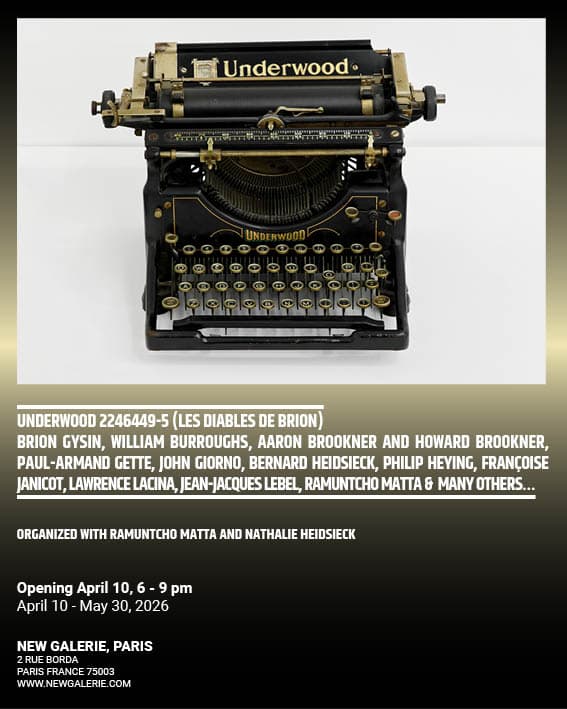
Underwood 2246449-5 (Les Diables de Brion)
New GalerieAaron Brookner and Howard Brookner, William Burroughs, Paul-Armand Gette, John Giorno, Brion Gysin, Bernard Heidsieck, Philip Heying, Françoise Janicot, Lawrence Lacina, Jean-Jacques Lebel, Ramuntcho Matta "I was born during the days of the Beat Hotel, and I grew up in a house (that of my parents, Bernard Heidsieck and Françoise Janicot) whose doors were always open to the American writers of the Beat Generation. I haven’t just inherited a place steeped in history where avant-garde movements crossed paths for over half a century; I live alongside the spirits of some of them. I was born during the days of the Beat Hotel, and I grew up in a house (that of my parents, Bernard Heidsieck and Françoise Janicot) whose doors were always open to the American writers of the Beat Generation. I haven’t just inherited a place steeped in history where avant-garde movements crossed paths for over half a century; I live alongside the spirits of some of them. In the room I now occupy again, there is a wall full of their books, within easy reach. In the room where I work, there is a rare portrait of Burroughs smiling at my mother, who took the photo. One evening, he had told her that she reminded him of his wife Joan (whom he killed in Mexico while playing William Tell). There is a portrait of my father as a young man taken by Ian Sommerville (Burroughs’s handsome young lover) who, as the only scientist at the Beat Hotel, created the Dream Machine with Gysin; one such machine, cobbled together in the living room with my mother, often spun on the record player. There is a poem by John Giorno, their common lover, printed on a large chocolate bar (which needs to be put in the fridge when the temperature gets too high) and something to roll joints with, left there as ever, forever. There is a work by Gysin in the mantelpiece above the fireplace mirror (where he would sometimes catch a glimpse of his devils following him everywhere). There is also, among many other things, a small box of Ilford film containing a little of his ashes. There’s James, sitting majestically in an armchair— the cat my mother named after James Grauerholz, Burroughs’ final companion. There are countless photos, records, cassettes, magnetic tapes, films, and files overflowing with documents, which I had to catalog as a teenager and then move or restore following disasters of all kinds; I took charge of them, often reading letters that were not addressed to me. They’ve all passed away, but there isn’t a single room in this apartment on Quai Bourbon that doesn’t bear traces of their presence. I’m steeped in their memory. I loved them all—some more than others, of course—but I feel marked for life, a life they’ve partly shaped. I often feel that my life simply flows from theirs. I miss them. And in these times, that longing only grows stronger. Brion’s presence within these walls goes back as far as I can remember. I can still hear him telling spellbinding stories the moment he stepped through the door. His extraordinary voice, with its undefinable accent, will never fade, for it was so often recorded. When he left Tangier for good in 1973, he moved into my mother’s studio for a few months, on the same landing. And it was here that he met Lawrence Lacina, a young American who first entered the house on the arm of an elderly aunt on the day of a First Communion, giving me Chantefleurs and Chantefables, Desnos’s children’s poems, which are still here. When I later began to travel, it was to his home that I went to seek unimaginable advice. Like a magician, he would pull from a wooden box a file containing hundreds of business cards sorted by country and city—the ones that would come in handy: “Buy this or that and bring it from me to so-and-so (in Cairo, Abydos, Aleppo, Sanaa…). And doors would open." —Nathalie H. de Saint Phalle "Hello Hello Those were the words Brion Gysin used to greet me ever since I was fifteen. I’ve always loved having imaginary yet very real brothers. There was Lou Reed, David Bowie, and Bob Dylan. Whenever one of their records came out, something wonderful entered my life: their worlds, both imaginary and very real. I never would have imagined that one day I’d meet their uncle. Because yes, Brion Gysin is a sort of forefather to all these inspiring older brothers. Without him, there would have been no Lou, no David, no Bob... as they came to be. Nor even the Rolling Stones, for it was indeed Brion Gysin who introduced Brian Jones to the magical worlds. There would be no William Burroughs, for it was indeed following his encounter with Brion that he became who he is to this day. Nor would there be Basquiat or Keith Haring.... Brion Gysin had a great gift: he was a mind opener. He opened you up to yourself. The New Galerie invites you to encounter his essence through his work, his way of being, and through all those who mattered to him." —Ramuntcho Matta