
Chinatown, New York
Blake Rayne
Reserves
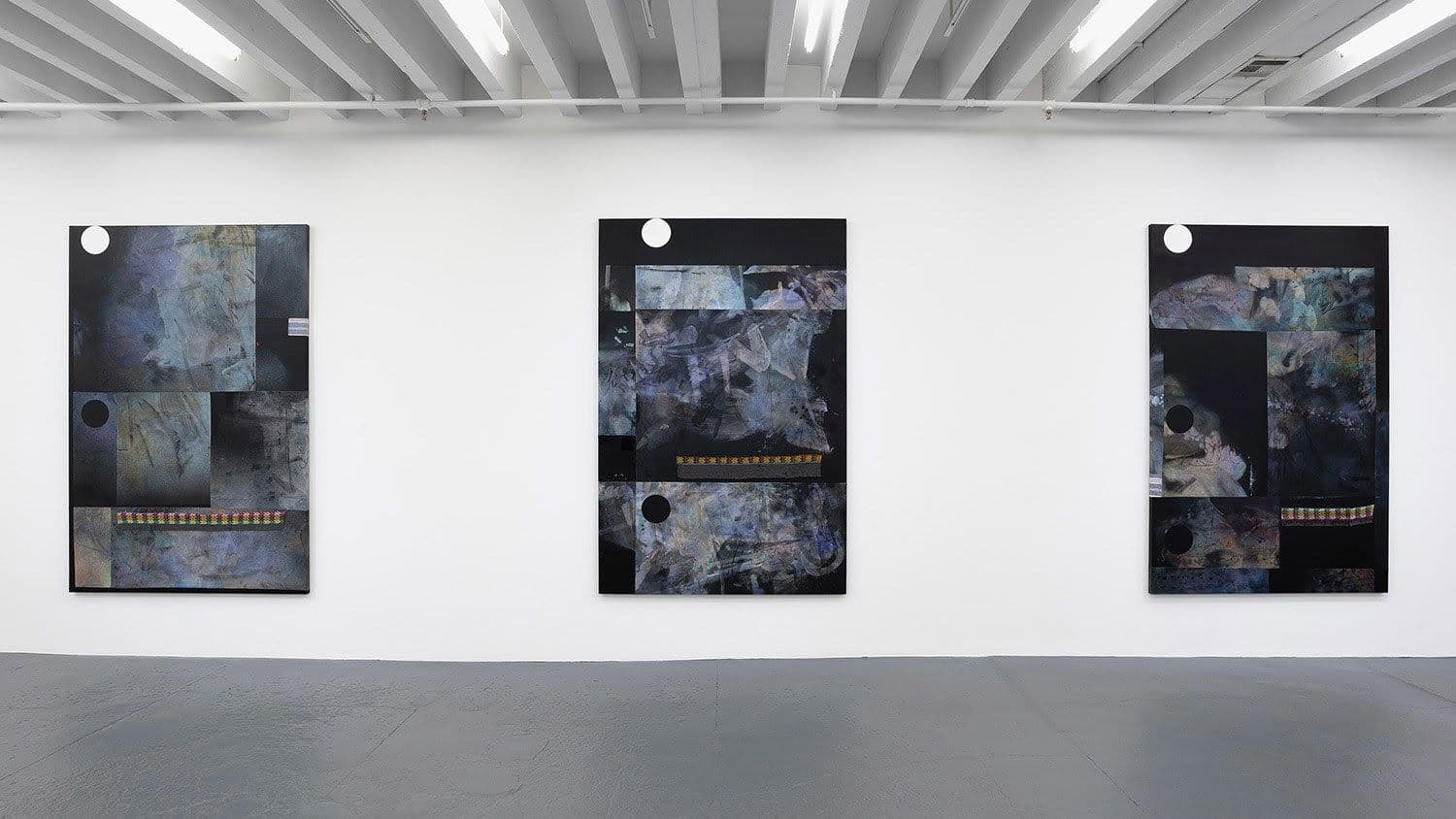
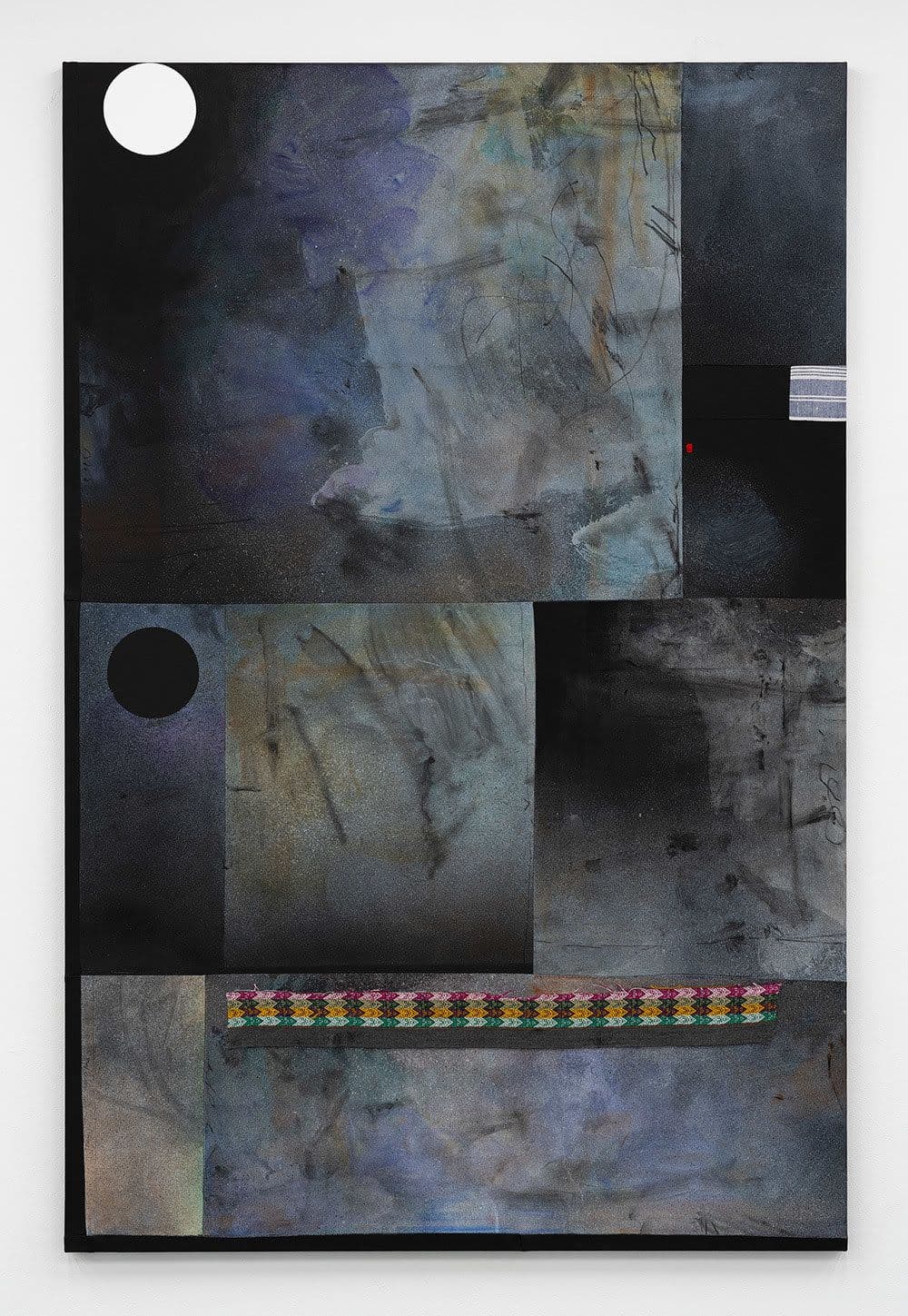
Miguel AbreuMiguel Abreu Gallery is pleased to present Reserves, the eighth one-person exhibition by Blake Rayne at the gallery. Comprised of a series of new paintings, the works begin in black, not as color but as a certain state of darkness, a working condition. From this ground, the artist develops a set of recurring operators that draw into play a painting’s usual supports, its seams, joins, and traces, along with the rituals and protocols that inform their registration and distribution. These operators – Drift, Seam, Forensic, Relay, Witness, Traversal, and Chip – are not a fixed syntax but a set of repeated acts. They re-tool painting to function with context and convention as material and keep the procedures that shape the works active and visible. Drift names the paintings’ unsettled ground, a field of gradient and trace where color hovers without resolving into hue. It operates as a reserve of energy and attention: scuffs, mists, and notations that persist within the work rather than precede it. ‘Drift’ keeps the painting’s latency visible, the moment when surface and process begin to thicken into each other. Seam names the visible joins in the montage. Strips of fabric are cut and sewn edge to edge, at least one horizontal and one vertical line running across the surface. They not only produce joins, but brick-like patterns and grids. Each join folds the fabric’s margin inward, an inversion that brings the outside into the work’s interior. At the same time, the seam binds while still dividing; its cut remains legible. Forensic refers to the printed fabric sewn along one edge of the work, often a blue-and-white stripe recalling a ledger or barcode. As an embedded foreign body, it integrates evidence of another scene of production. The forensic strip is both ornament and record, a public trace reminding the viewer that painting never works alone. Relay is the circular white spot painted near the upper left edge of each canvas. Touching the top border, it acts as a registration or transfer device across the set. The Relay converts the painting’s boundary into a passage and embodies the artist’s broader interest in images that don’t just show but do. Witness is a fragment of gleaned cloth glued on top of the canvas, placed near but never over a seam. Its credibility lies in adjacency. The Witness testifies by relation rather than integration, carrying its prior use as a faint trace of time and contact. Traversal is a mark that crosses a seam. A sprayed line, tick, or fragment passes over a join so that division itself remains active. Each crossing folds separation back into relation, revealing how continuity is built from a constellation of cuts. Chip is the smallest mark, a single brushstroke of unmixed paint, often red. Each painting contains one. The Chip operates as count and incision, a minimal decision that anchors the field. Variation across reds keeps it procedural rather than emblematic, a difference sustained within a rule. With these operators, the paintings convert the background procedures of making — stitching, testing, registering — into palpable thought. Reserves points to the moment when material process and pictorial elements exchange roles. By folding administrative acts into the act of painting itself, Rayne re-tools abstraction as an economy of attention and endurance. The work holds something back so that another form of seeing might emerge. Blake Rayne (b. 1969, Lewes, Delaware) lives and works in New York. He attended the California Institute of the Arts, received a fellowship from the American Academy in Berlin (2010), and has taught at Columbia University’s School of Visual Arts (2003-09). In 2016-17, Cabin of the Accused, the first survey exhibition of Rayne’s work, was held at the Blaffer Art Museum in Houston, Texas. Recent solo exhibitions include Archives I: Blake Rayne, Emanuela Campoli, Paris (2024); Bad Maps, Galeria Nuno Centeno, Porto (2023); Blake Rayne, 1301PE, Los Angeles (2022); and Dog Ears, Miguel Abreu Gallery (2020–21). His work was included in L’Atelier du Sud, Fondation Vincent van Gogh, Arles (2023–24); Collected by Thea Westreich and Ethan Wagner, Whitney Museum of American Art, New York (2016); Chat Jet: Painting <Beyond> the Medium, Künstlerhaus, Graz (2013); Nikolas Gambaroff, Michael Krebber, R. H. Quaytman, Blake Rayne, Bergen Kunsthall, Norway (2010), and in numerous other group exhibitions, including at The Kitchen, SculptureCenter, Artists Space, Gladstone Gallery, Reena Spaulings, Greene Naftali, and American Fine Arts, all in New York, and at Gagosian Gallery, Paris. Rayne's work is held in the collections of the Museum of Modern Art, New York; the Whitney Museum of American Art, New York; San Francisco Museum of Modern Art; FRAC – Fonds Regional d'Art Contemporain Poitou-Charentes, France; Pinault Collection; the Portland Museum of Art; and the Institute of Contemporary Art, Miami, among others. Tense and Spaced Out: Polar Nights, Glacial Chaos, and the Ecology of Misery, a monograph on Rayne’s work, with texts by John Kelsey, David Lewis, Jaleh Mansoor, Laura Owens, Sean Paul, and Javier Sánchez Martínez, was published in 2017 by Sequence Press/Blaffer Art Museum/Sternberg Press.