
Galleries, Miami
Chris Jin Kim
Triggered
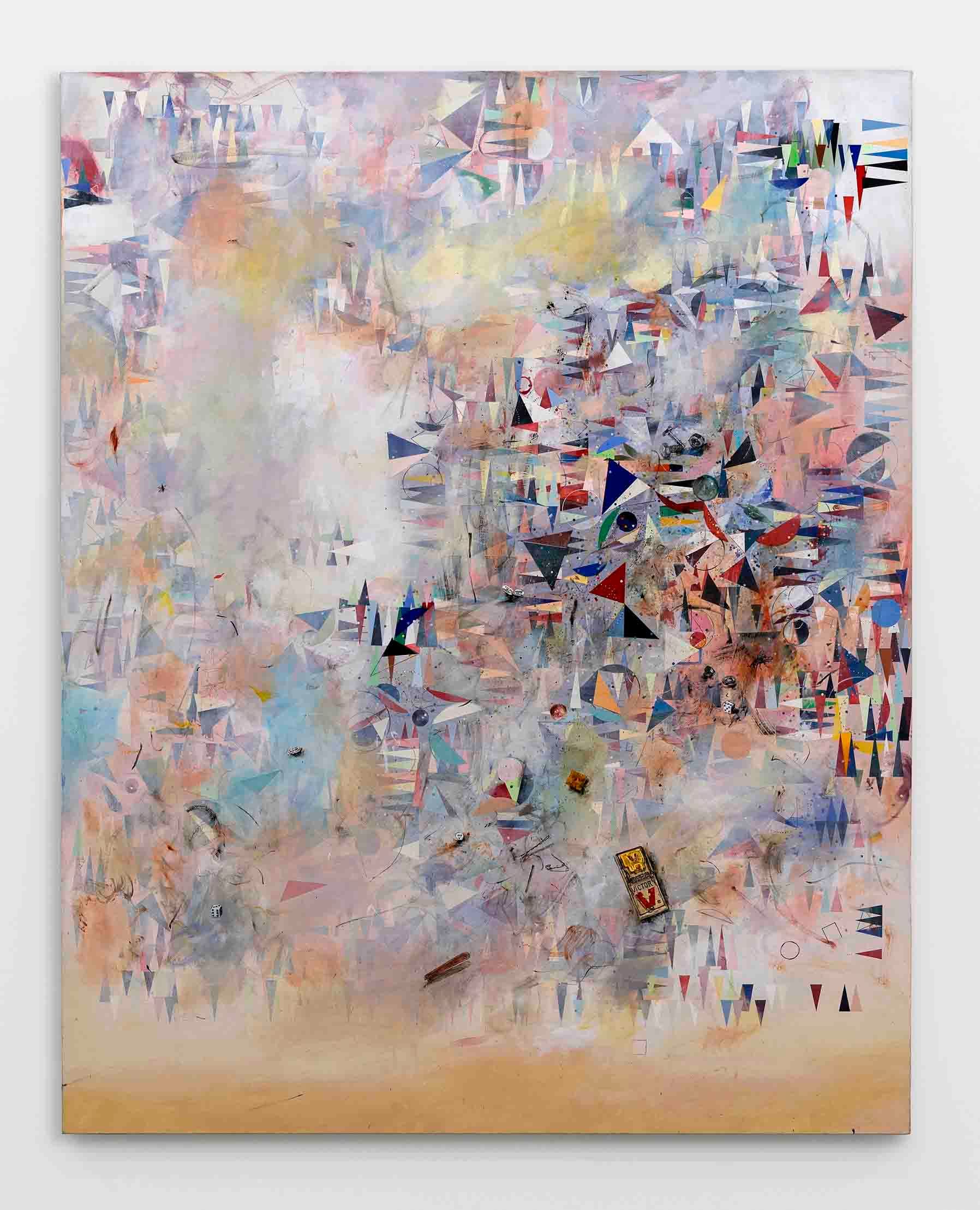
Bill BradyThe twelve works by Chris Jin Kim in this, her first-ever show, reveal a remarkable and evolving talent, a painter who is developing her own style and approach in acrylic paintings that repay both distant and close looking. Kim’s abstract works oscillate between chaos and control, with her signature solidly colored and small pennant forms providing anchors amidst a haze of atmospheric paint, slashes of color, pointillist dots, and floating forms. The pictures are wonderful to behold. Here and there are remarkable details, moments of painted trompe l’oeil (“fool the eye”) magic that the artist terms “triggers”: a Heinz ketchup packet, Fisher-Price figurine, small plastic soldiers, razor blades, a “Get out of jail free” card from Monopoly, scissors, an allen wrench and screw, a crumpled Splenda package. The detritus of mundane existence, these remarkably observed, and adroitly painted still-life elements cast light on both the gestation of the picture and a way of teasing out a possible story from these otherwise abstract compositions. They are not simply performances of rare realist skill, but combine with the morass of light and color and patterning of pennants to convey states of mind and suggested narratives. Remarkably, these eleven individual canvases and one large triptych represent all the completed pictures Kim has ever produced. The artist was born in 1986 in Oakland, CA, to a Korean American family. She attended Catholic schools where she took an Advanced Placement class in Studio Art, demonstrating an early affinity for drawing, an appreciation of cartoons, and general interest in animation but not as a career. Kim attended Parsons School of Design in New York and took some classes at UC Berkeley, graduating in 2009. Since that time, she has worked in Los Angeles and now back in New York in the fashion industry and magazine publishing, but only took up painting four years ago, in 2017. In that same year she began regularly going to museums. It took her some time, working in various apartments, to complete her first pictures. They are dated 2020 and are the smaller format works in this show at 60 by 48 inches. Arrested Development (2020) bears a push and pull quality: the signature flatly colored pennants fade into and emerge from scumbled areas of gesso and color or lie brightly in the foreground. Their placement is irregular, but their orientations hew to the four compass points. Sometimes they are in groups, sometimes alone. These are distinctive from the multiple circles and variously shaped triangles throughout the image. In the lower right is a trompe l’oeil Victor mousetrap, its signature red “V” blending with the various chevrons across the scene. The hard geometric abstraction of Wassily Kandinsky comes to mind, as well as the thinned and abstracted coloration of Arshile Gorky’s backgrounds or Mark Rothko’s early “Multiforms,” the bold coloration of Ellsworth Kelly, and the drawn disorder of Cy Twombly. But Kim also has spoken of the impact of Jean-Michel Basquiat’s work, its loudness, its raw quality, as something to emulate. Father Like Son (2020) features a darkened upper quadrant, planetary circular forms, grouped pennants, and twisting and careening triangles, like snowflakes drifting down through the haze towards the brightened lower part of the canvas. Here is the male Fisher-Price figurine, in a sailor’s cap, armless, with a string tied around his neck that bears a tinge of malice. A hapless Icarus plunging down to earth. The “trigger” elements in these works float through the compositions like Dorothy’s visions of her family and the Wicked Witch seen out her bedroom window of her storm-tossed farmhouse in the opening tornado sequence in The Wizard of Oz (see that floating Campbell’s Soup can in the riotous Caníbal of 2021). They similarly serve as psychological markers, and reflect Kim’s interest in true-life podcasts such as This is Actually Happening, which she listens to as she works, and whose tales of lived trauma and human experience creep into the works. The stories, often painful, put Kim on edge and give her the charge to paint. They are pointed, like the pennants. Thus “trigger” refers to the podcast narrators who churn up memories from their own lives, Kim’s empathetic response and channeled emotions elicited by the stories, and the effect of the trompe l’oeil elements on viewers, who bring to them their own memories. This has resulted in newer works both beautiful and powerful such as Excision (2021) with its layered build-up of form at the right and into the center and then a dramatic and unexpectedly serene vertical strip of buttery yellow along the left edge; the picture is like a satellite of view of metropolitan Cairo with the jarring void of desert to its west. The simultaneously fiery and heart-breaking Arson, Our Son (2021) bears a Twombly-like smoldering furnace of a cloud of black and red at left, drips of painterly confusion at the bottom, and speckled throughout trompe l’oeil triggers: small candles that spell out a fragmentary “Happy Birthday,” miniature Lego astronauts. Nostalgic markers of brighter days. In this more recent work, such as the grand triptych Born with the Safety Off (2020-21), the progression of tones from light to dark from left to right across 12 feet of canvas, gives the sense of a narrative arc. In the third panel a floating Magic 8 Ball, a oracular toy dating back to 1946, bears a possibly grim message: “Not Likely.” Absent is the blue triangle that normally backs these cryptic pronouncements in the toy’s porthole viewer. But of course, the colored triangle is Kim’s motif, and it fills these canvases, those grounding strokes of saturated colors aligned to the north, south, east, and west, directional markers in an uncertain world. —Jason Rosenfeld Jason Rosenfeld, Ph.D., is Professor of Art History, Marymount Manhattan College, New York, and Senior Writer and Editor-at-Large at The Brooklyn Rail.