
East Village, New York
Hafsa Nouman
Facsimile
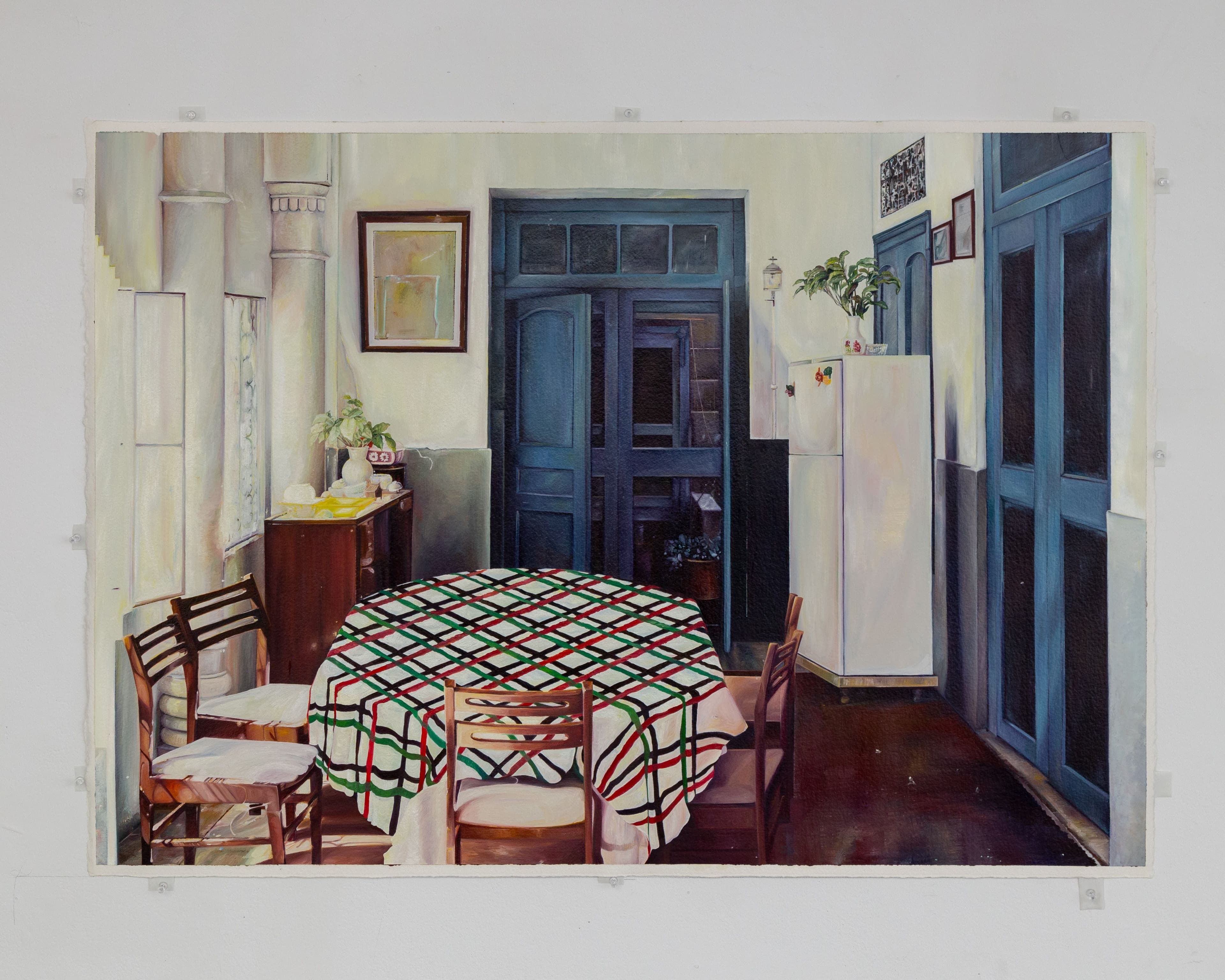
Palo GalleryPalo Gallery (New York, NY) is pleased to present the opening of Hafsa Nouman’s solo exhibition Facsimile. The exhibition takes its name from the dastarkhwaan, a traditional floor-spread used across Central and South Asia for communal eating. Derived from Persian, the term refers both to the cloth itself and to the larger social act of gathering around food. Spread across the ground, the dastarkhwaan creates a shared space of hospitality, cleanliness, and collective presence. In Nouman’s central artwork, the dastarkhwaan is approached not merely as a domestic object, but as a spatial and social structure. Unlike the architecture of the dining table, which provides preset hierarchies and assigned positions, the dastarkhwaan expands horizontally: elastic in capacity and able to accommodate whoever arrives. “The work is a 13 x 7 ft acrylic painting on canvas functioning as a facsimile of the tablecloth from my maternal grandmother Bibi’s house in Gujranwala, Pakistan: a gingham pattern composed of black, red, green, and white. Until the age of six, before the demolition of the house, every summer meal was eaten on the dastarkhwaan spread across the floor of Bibi’s lounge. We, the children, gathered on the ground while the elders sat nearby at the dining table. The work returns to this memory not as nostalgia, but as a way of tracing how acts of eating also produce forms of relation, hierarchy, intimacy, and belonging.” —Hafsa Nouman Over time, the dastarkhwaan gradually disappeared from many urban middle-class homes, increasingly associated with a perceived lack of refinement. As dining tables came to signify upward mobility, propriety, and modernity, floor-based communal eating became folded into classed ideas of etiquette and respectability. Revisiting the dastarkhwaan at a larger scale, Nouman reflects on the quiet disappearance of vernacular forms of gathering and on the cultural and political values embedded within domestic habits and objects. The exhibition also includes a series of fruit paintings depicting species indigenous to specific regions once shaped by colonial occupation, including olive, pomegranate, and sugarcane. These fruits function simultaneously as agricultural forms, cultural memory, and political signifiers, accumulating layered associations around resistance, displacement, labor, and survival. Rather than operating as fixed symbols, they appear as unstable images whose meanings shift across historical and geopolitical contexts. Throughout the exhibition, painting becomes a site where memory, ecology, and representation are translated into facsimiles, surfaces that preserve traces of what can no longer be encountered directly. Hafsa Nouman (b. 1998, Lahore) is a Pakistani visual artist based in New Haven, Connecticut. Her practice engages memory, ecology, and decolonial inquiry through painting and installation. Having lived within economies shaped by IMF-led reform and neoliberal extraction, she approaches decolonisation as a mirage, a horizon structured by desire, always visible yet endlessly deferred. Nouman’s works exist both as an image and a withheld object, structurally present yet visually inaccessible. Through reflective surfaces that glimmer and oscillate, she complicates flatness and destabilises the act of looking. The viewer is positioned not as a passive observer, but as an implicated witness, confronted with the conditions that govern visibility, preservation, and loss.