
SoHo, New York
Yoshimitsu Ishihara
Fill Up Quietly, Forever
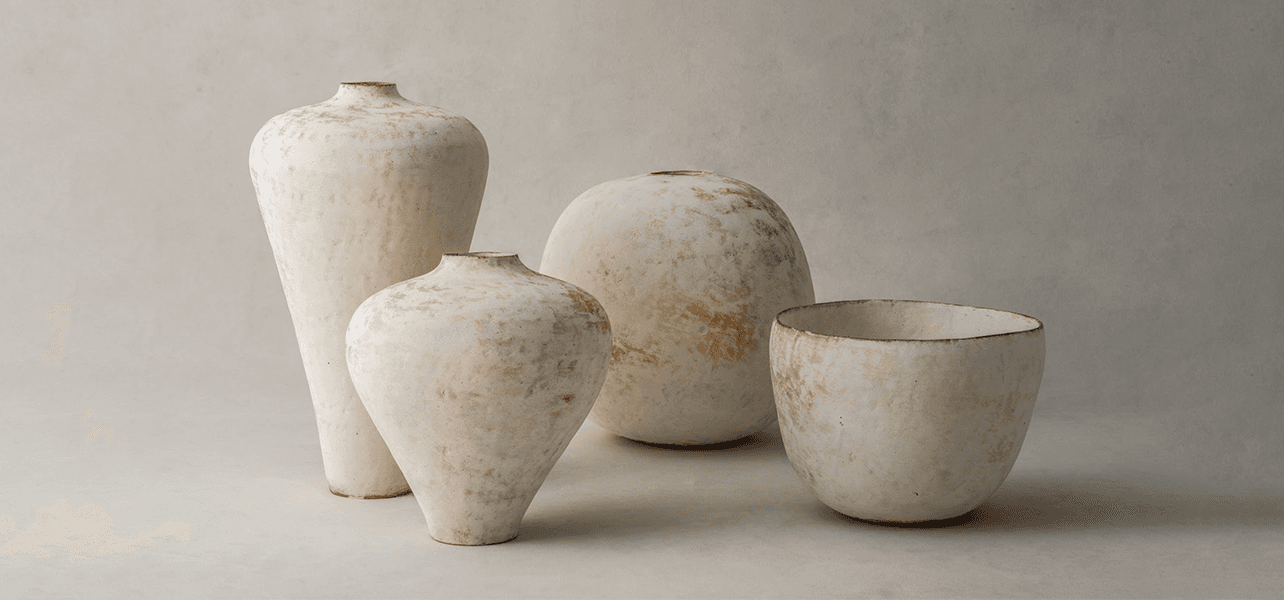
Guild GalleryGuild Gallery is pleased to present the first U.S. solo exhibition of Yoshimitsu Ishihara (b. 1971, Osaka, Japan), a Japanese ceramicist who shapes, fires, and finishes his pieces entirely by hand using natural materials and ancient techniques. Though Ishihara’s pieces bear simple names—such as "Bowl," "Jar," or "Vessel"—the objects themselves are anything but: deeply sculptural, richly textured ceramics, born of an intimate communion with clay and fire. The sense of slow accretion that marks this collection of work reflects Ishihara’s quiet determination to evolve and grow day by day, in concert with the natural world around him. For this exhibition, Ishihara has made his largest works to date, working at a new scale that moves beyond the functional to the sculptural. After previously focusing on tableware and other diminutive forms, Ishihara has begun to craft vessels that assume recognizable shapes—jars, bowls, vases—in expanded sizes, with painterly patterning born from his innovative soil and clay combinations and his boundary-pushing wood-firing techniques. Though some aspects of his practice have changed since he began forging ceramics two decades ago, his commitment to slow craft remains the same: from start to finish, it takes Ishihara six months to create each batch of new vessels. He views his evolution as an artist as akin to the natural rhythms of the environment around him: constantly advancing, with an inextricable connection to what has come before. From his small, remote studio at the base of a mountain in Fukuoka, on Japan’s westernmost island of Kyushu, Ishihara begins by preparing his raw material: a mixture of clay harvested 500 miles away in Gifu, and the red clay native to the rolling hills surrounding his home and workshop, which he digs from the earth himself. He spends two weeks blending the soils, coaxing the texture and hue of hundreds of pounds of clay into suitable material for sculpting. The creative process of shaping the clay with his bare hands, using rudimentary tools and a simple potter’s wheel, is a delicate, deeply personal craft—one he describes as “giving form to something inside me.” The resulting vessels, created over the course of roughly three months, are indelibly shaped by the natural splendor around him. “The environment where I live, which is half-deep in the forest, allows me to experience not only the human world, but also other forms of life,” Ishihara says. “Wild animals, insects, birds, plants—they always give me fresh inspiration.” Ishihara’s kiln is a sprawling, wood-fired “nobori-gama” (or “climbing kiln”) he built by hand, which he fuels with locally sourced pine he chops himself. Unlike most potters who ultimately wood-fire their pieces, Ishihara does not use an electric or gas kiln; he relies solely on the nobori-gama—a kiln whose roots in Japan stretch back to the 17th century—for every stage of firing. His initial bisque firing stage spans 40 days, as Ishihara fires each piece up to three times. Ishihara imbues his works with texture and color through the use of rice husk, a time-honored technique practiced by potters in Japan and other Eastern nations for centuries. After either burying the bisque work in burnt and blackened rice husk for his carbonized series, or coating it in fine, cream-colored powdered rice husk for his rust series, the final firing takes place. He and his wife feed the kiln with firewood by hand for 40 to 60 consecutive hours, keeping the flame alive. After several days of firing, and several more days of slowly cooling, Ishihara’s works emerge from the kiln transformed by elemental forces outside of his control. The inconsistency of the flame across each vessel’s surface, the influence of the rice husk on its texture and color, and the changes that take place within the chemical composition of his clay all breed unpredictable, one-of-a-kind outcomes, resulting in pieces that feel as though they have wills and personalities of their own. “You can expect that the expression of the soil will change, and unexpected things will occur,” Ishihara says. “I’m fascinated by the way the work is completed outside of my reach.” Ishihara sees his work as a part of the fabric of the natural world around him. As the flora and fauna that surround his studio carry out their daily tasks, so, too, does he. “Our bees are busy all summer long: when they discover the beginnings of the next spring's flower buds in early summer; when bumblebees walk around in the dusk, tirelessly collecting pollen from flowers,” Ishihara says. “In their work and in mine, something is constantly being prepared. This kind of thing has been repeated for tens of thousands of years. The world we know today is the result of hundreds of millions of years of repeated events that seem to add up, one by one. I hope that each piece I make is like this—like a bud full of energy, quietly and eternally fulfilling.” Yoshimitsu Ishihara (b. 1971) makes hand-crafted, wood-fired ceramic sculptures and tableware at his home studio in Fukuoka, on Japan’s westernmost island of Kyushu. After spending two years as a lecturer in the sculpture department of the University of Fine Arts in Kyoto, he found himself drawn to the idea of working in a quiet, rural environment year round, where he could devote his time and attention to the art of pottery. In 2002, he began apprenticing under his father, the ceramic artist Shoji Ishihara, at his home studio in Wakamiya City. In 2006, Ishihara struck out on his own, moving to his current home and studio in the woods of Fukuoka, where he hand-built a traditional, wood-fired nobori-gama kiln, which he uses to fire his works at every stage of production, from bisque firing to finishing. He has spent 17 years honing his craft, distinguished by its use of ancient methods and natural materials, from the rice husk Ishihara buries and coats his vessels in to the red clay he uses to construct them, which he digs by hand from the hills surrounding his studio.