
Chelsea, New York
Celia Paul
Innervisions
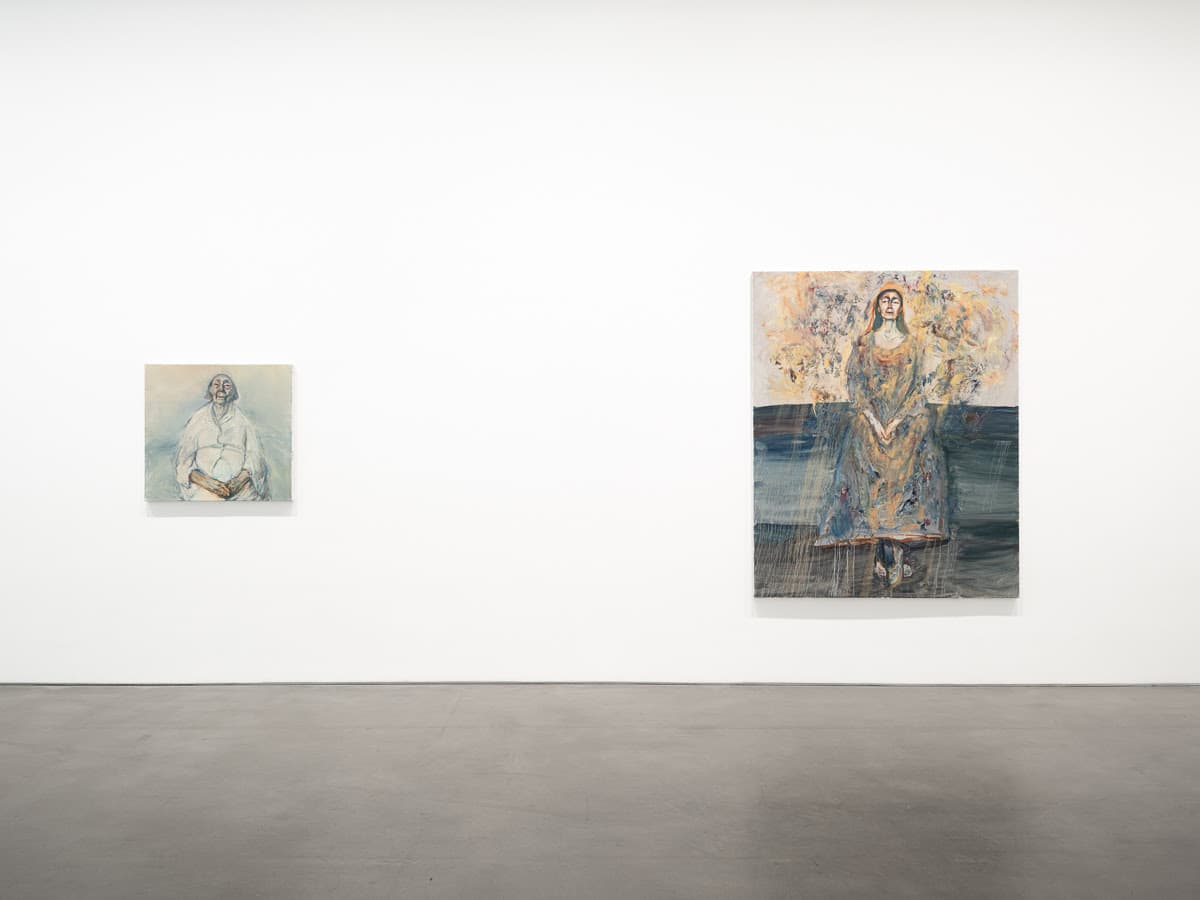
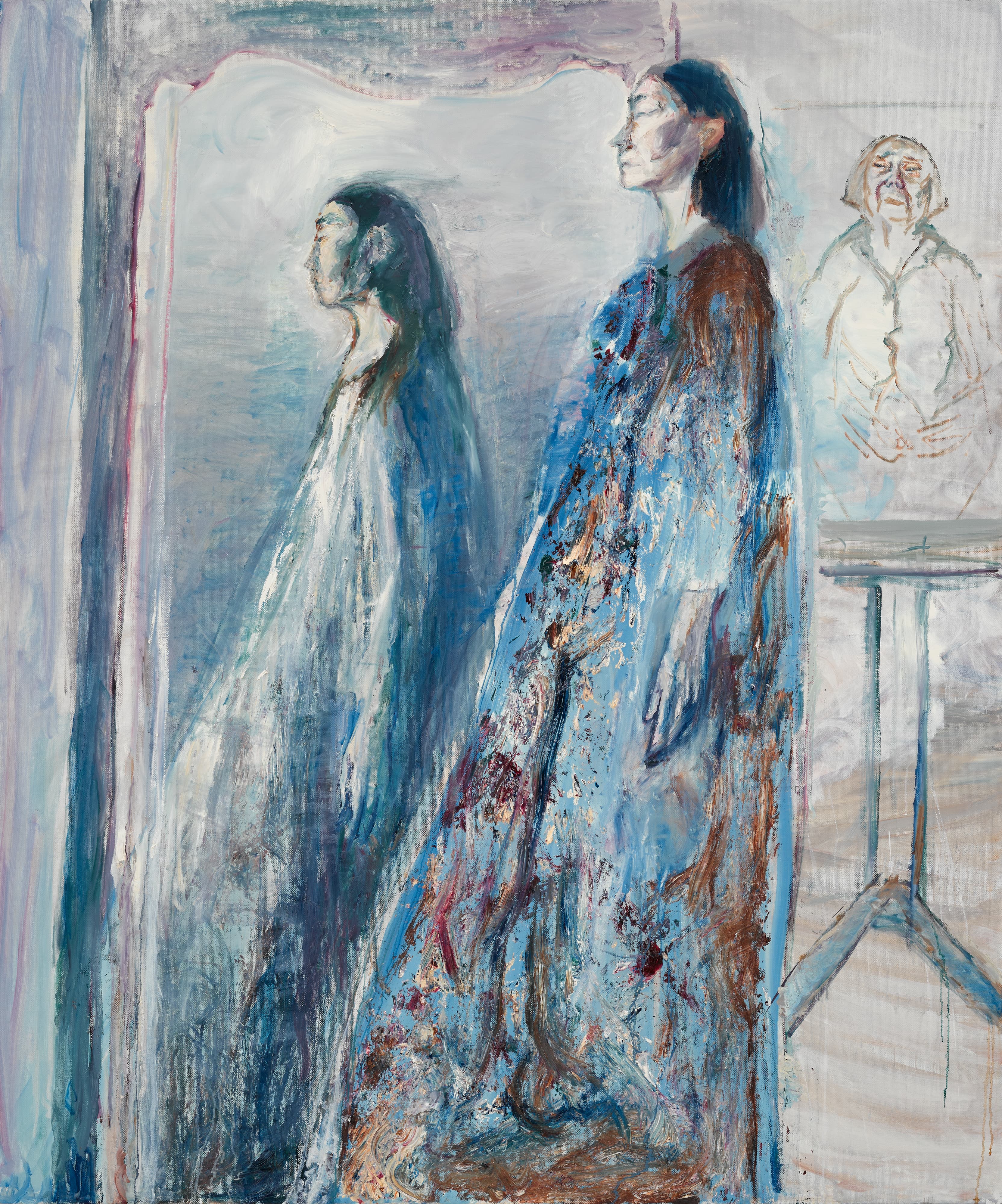
GladstoneGladstone presents Innervisions, an exhibition of new paintings by Celia Paul in New York, marking her first show with the gallery. For decades, Paul has lived and worked in the same top-floor London flat, spare, paint-scented, and lit by a steady window, where the British Museum sits almost at eye level and the distant BT Tower blinks across the city like a slow pulse. The studio is not a backdrop so much as an instrument: it holds time, and it concentrates attention. Paul was born in India in JKLK and later moved to England; these biographical details matter, but only because it helps explain her recurring preoccupation with interior life—what it means to belong to a place, and what it means to remain slightly outside it. She studied at the Slade School of Fine Art in London where she encountered Lucian Freud, a visiting tutor, and entered a relationship that would mark her life and, in complicated ways, the public reading of her art. Yet the essential fact is simpler than any biography: she persisted as a painter, patiently, daily, working in a medium that rewards slowness and refuses easy noise. Celia Paul paints as if she were listening for something that can’t be said any other way: a hush behind conversation, a pressure of feeling that gathers in a room long after the people have gone. She depicts herself, her mother, and her sisters not merely as motifs, but as relationships shaped by years, grief, and the ordinary weather of family life. These same qualities have been named as “intimacy and inwardness,” and those words fit: Paul’s paintings often feel like private weather made visible, not spectacle offered up for applause. The look of the paintings—often pared down, with large quiet fields and figures that seem to emerge out of air—can be mistaken for simplicity. But the austerity is a discipline. Paul’s portraits do not perform charisma; they seem to insist that the human face and posture are already dramatic enough. Her figures tend to sit, stand, or recline with a kind of unshowy gravity. The paintings don’t so much describe a person as hold them in time, allowing the viewer to register how expression can be made from stillness. Alongside the portraits, there is the sea. In a painter so devoted to rooms and bodies, the sea can read as counterpoint: an expanse that refuses enclosure, a surface that is always changing even when it looks calm. The framing of “the sea” as one of Paul’s central themes suggests it isn’t merely scenery; it is a way of thinking in paint about distance, return, and what cannot be possessed. What is striking, especially in light of how often women artists are cast as satellites, is how Paul’s work steadily reclaims authorship. She has made paintings that engage with the legacy of Freud and his circle, but from her own vantage point, refusing to be fixed forever as someone else’s subject. Celia Paul (b. 1959, Trivandrum, India) lives and works in London. Major solo exhibitions have included Celia Paul, curated by Hilton Als, at Yale Center for British Art, New Haven, Connecticut, USA (2018) travelling to The Huntington, San Marino, California, USA (2019); Desdemona for Celia by Hilton, Gallery Met, New York, USA (2015–2016); Gwen John and Celia Paul: Painters in Parallel, Pallant House Gallery, Chichester, UK (2012–2013); The Grave's Art Gallery, Sheffield, UK (2005) and Abbot Hall, Kendal, UK (2004). The artist's work has been featured in group exhibitions including Acts of Creation: On Art and Motherhood, Arnolfini, Bristol, UK (2024), travelling to MAC Birmingham, UK; Millennium Gallery, Sheffield, UK (2024–2025) and Dundee Contemporary, Scotland, UK (2025); Real Families: Stories of Change, The Fitzwilliam Museum, Cambridge, UK (2023); Joan Didion: What She Means, curated by Hilton Als, Hammer Museum, Los Angeles, USA (2022–2023); Pictus Porrectus; Reconsidering the Full-Length Portrait, Bell House, Newport, Rhode Island, USA (2022); Me, Myself, I – Artists' Self-Portraits, Royal West of England Academy, Bristol, UK (2022); All Too Human: Bacon, Freud and a Century of Painting Life, Tate Britain, London, UK (2018); La Diablesse, Tramps, London, UK (2016); No Man's Land: Women Artists from the Rubell Family Collection, Rubell Family Collection, Miami, USA (2015–2016); Forces in Nature curated by Hilton Als at Victoria Miro, London, UK (2015); Recent acquisitions: Arcimboldo to Kitaj, British Museum, London, UK (2013); Self-Consciousness, curated by Peter Doig and Hilton Als, VeneKlasen/Werner gallery, Berlin, Germany (2010); The School of London: Bacon to Bevan, Musée Maillol, Paris, France (1998) and British Figurative Painting of the 20th Century, The Israel Museum, Jerusalem, Israel (1992). Her work is in collections including Abbot Hall, Kendal, UK; British Museum, London, UK; Carlsberg Foundation, Copenhagen, Denmark; Fitzwilliam Museum, Cambridge, UK; Frissiras Museum, Athens, Greece; Herzog Ulrich Gallery, Brunswick, Germany; Metropolitan Museum of Art, New York, USA; Morgan Library and Museum, New York, USA; National Portrait Gallery, London, UK; New Hall Art Collection, Murray Edwards College, Cambridge, UK; Rubell Family Collection, Miami, USA; Ruth Borchard Collection, London, UK; Saatchi Collection, London, UK; Victoria and Albert Museum, London, UK; and the Yale Center for British Art, Connecticut, USA.