
Bushwick, New York
Byron Toledo
The Whole Water of a River
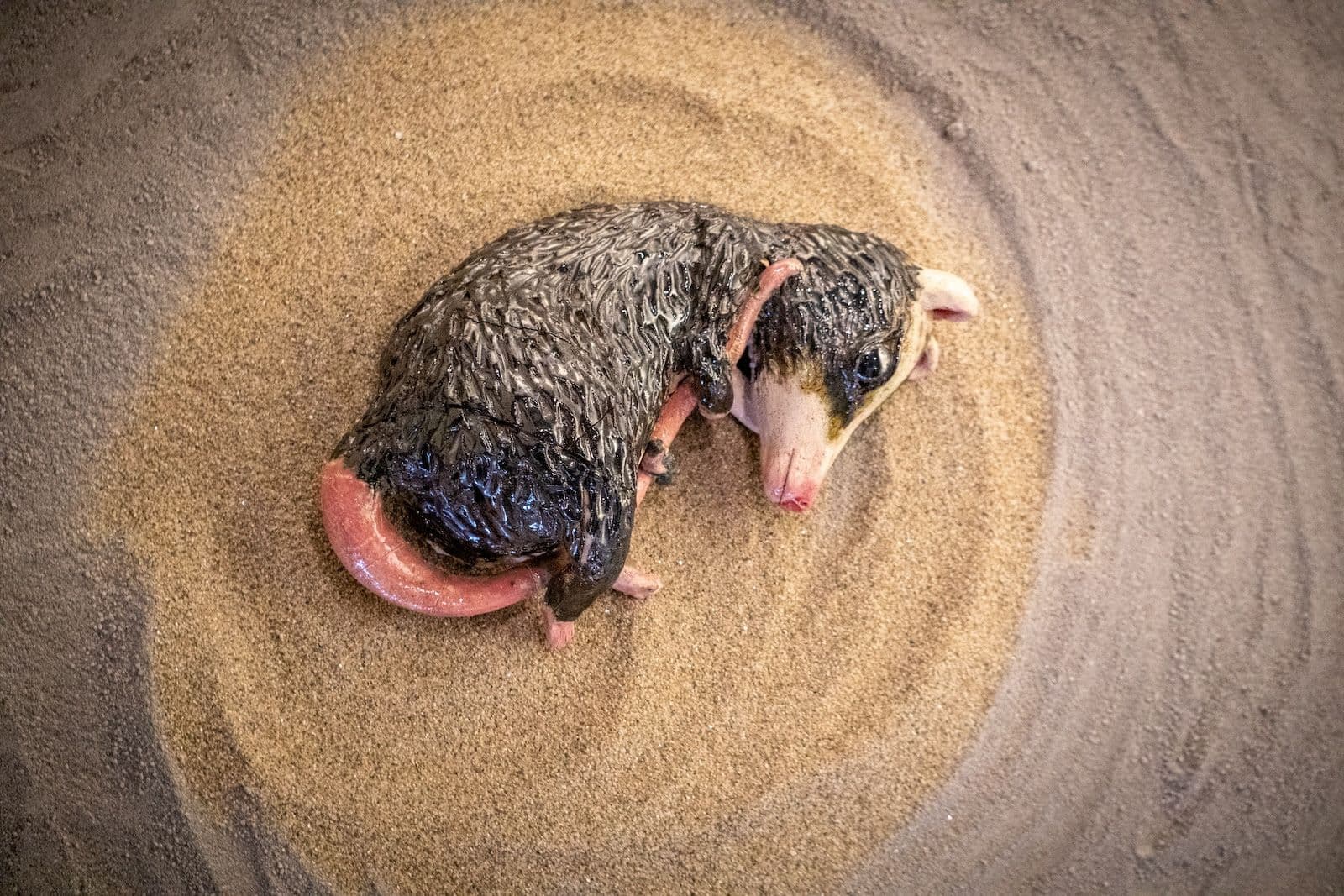
Tiger Strikes AsteroidTiger Strikes Asteroid New York is pleased to present Byron Toledo: The Whole Water of a River. The exhibition takes as its point of departure the Machángara River, which flows through Quito, Ecuador, the artist’s hometown. Rather than functioning as a fixed natural entity, the river is understood as a shifting urban system shaped by continuous processes of extraction, waste, and regeneration. Like many waterways in metropolitan contexts, it begins as a clean source and gradually becomes contaminated as it absorbs the city’s material and infrastructural excess. Within this framework, the artist traces its watershed over time, attending to both the forms of life it sustains and the contradictions it reveals. Within this landscape, urban and territorial forces intersect to produce layered and often conflicting narratives. The river emerges as both symptom and site of persistence, sustaining a complex web of human and nonhuman life alike. Water circulates through plants, animals, bodies, hills, and ravines, moving across visible and subterranean spaces as it threads through the fractures of urban expansion. In the exhibition, the river is approached as a living presence. Its sediments, sounds, smells, and textures are assembled into constellations that evoke memory, knowledge, and alternative forms of inhabitation. Ceramics function as the primary medium through which these sensory and ecological registers are translated and held, embedding traces of the river within sculptural form. In Zarihuella (2025), a ceramic opossum is presented—an animal native to Andean ecosystems that inhabits areas surrounding rivers and ravines, reflecting the biodiversity of these watersheds. The piece forms part of the series Animales de quebrada (Creek Animals), which renders riverine fauna in ceramic form. Many of these species retain symbolic and spiritual significance for local communities, even as they face increasing vulnerability due to urbanization. In Inventario Cascada (2025), ceramics function as a support that contains and preserves organic remains within its material structure. Its reliefs inscribe a microcosm of the river’s ecosystem, where leaves, flowers, and stones delineate the characteristics of a specific territory. The object can be understood as a sensory map in which the organic appears not as representation, but as trace. The work in the exhibition emerges from a space that both sustains and unsettles, gathering the desires, fears, and fascinations that arise from it. The exhibition brings together approximately ten ceramic objects in which aromas distilled from plants, recordings of water moving through the city, and inventories of collected leaves are embedded or attached, activating the river within the exhibition space. Rather than representing the river, the exhibition proposes it as a force that reflects back onto those who encounter it, revealing the conditions through which we are implicated in its transformations. Toledo collaborated with biologist Karla Barragán on the development of the distilled aromas and with sound artist José Salgado on the creation of the soundscapes. The project was developed with curatorial accompaniment by Eduardo Carrera. Byron Toledo (b. 1987, Quito) is a visual artist and educator based in Quito, Ecuador. He holds a B.A. in Visual Arts from the Pontifical Catholic University of Ecuador and an M.A. in Combined Artistic Languages from the National University of the Arts in Buenos Aires, Argentina. He is a founding member of No Lugar – Arte Contemporáneo and currently serves as Director of Q Galería, while also teaching ceramics and visual arts at the Universidad San Francisco de Quito. Working across installation, sculpture, painting, and ceramics, Toledo’s practice explores the relationships between territory, materiality, memory, and the body. His work has been exhibited internationally in Ecuador, Mexico, Venezuela, China, Turkey, Argentina, and the United States at institutions and cultural spaces including the Alianza Francesa de Quito, the Museum of Modern Art of Toluca (Mexico), Taoxichuan Art Center Jingdezhen (China), the Ateneo Center for Fine Arts of Maracaibo (Venezuela), La Paternal Espacio de Proyectos (Buenos Aires), Space Derbi (Istanbul), Pitzer Art Galleries (Los Angeles), and the National Museum of Ecuador. He has also contributed to curatorial and collaborative projects, including the first University Biennial of Multimedia Art in Quito (BUAM). Toledo lives and works in Quito. Eduardo Carrera is an Ecuadorian curator, art historian, and writer based in Philadelphia. He is a Ph.D. candidate in the History of Art at the University of Pennsylvania and a James D. McDonough Fellow in Queer Art History. Since 2021, he has collaborated with Wrightwood 659 in Chicago, first as a research associate for The First Homosexuals: The Birth of a New Identity, 1869–1939, contributing research on Latin America and, since April 2025, as associate curator of Dispossessions in the Americas.