
Hell'S Kitchen, New York
Aura Rosenberg & Egon Schiele
Champs Délicieux
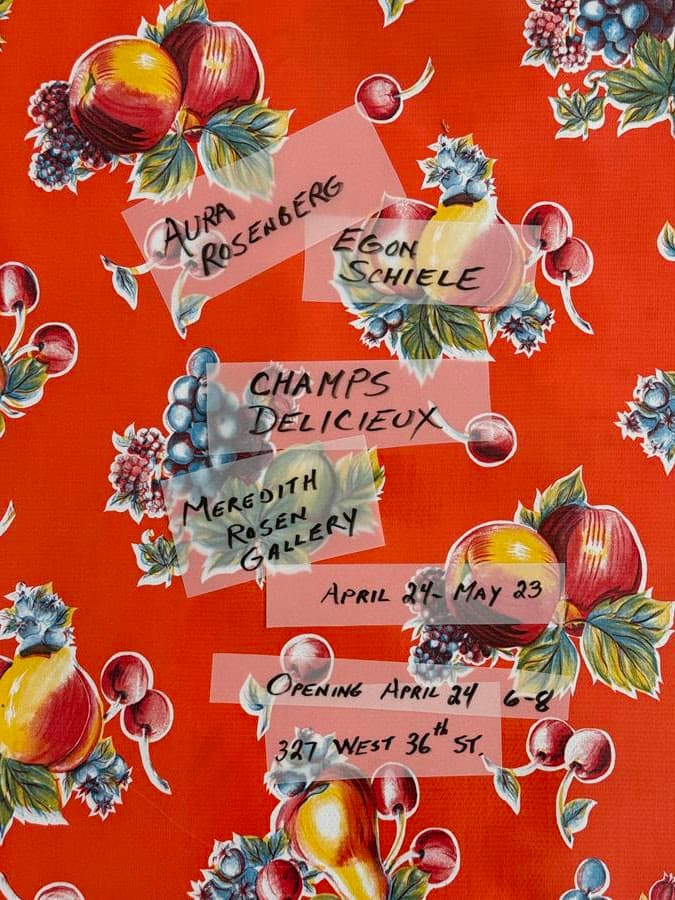
Meredith RosenMeredith Rosen is pleased to present an exhibition by Aura Rosenberg and Egon Schiele. Pairing a new series of Rosenberg’s paintings on oilcloth with rare Schiele drawings, the exhibition explores eroticism as an entanglement of ordinary pleasures where bodily limits transform through material exploration. Together the works on view, spanning over a century of artistic production, challenge the disembodiment of modernism through their rigorous enmeshment of the relationships and materials of everyday life. Rosenberg titled her new series of paintings Champs Délicieux (Delicious Fields) after Man Ray’s 1922 album of rayographs. He made these camera-less photos from an array of personal items, including a comb, a kitchen grater, and a gun. Rosenberg began her series by chance after buying a piece of oilcloth at a market in Mallorca. This fabric, sold at housewares stores, is used to cover kitchen tables and typically depicts things like coffee cups, pastries, fruits, vegetables, pasta, and flowers. Images of lemons against a black background covered the first material she bought, along with the inscription: “Un Zeste de Citron.” This phrase reminded her of Serge Gainsbourg’s infamous duet, “Lemon Incest,” which he sang with his daughter Charlotte. Rosenberg made this initial painting simply by mimicking the lemon pattern with bright green and black acrylic paint. What followed was a series that responded to the oilcloths’ decorative imagery with gestural drips and splashes, thus mining American abstraction and its erotic and abject associations, while contesting the genre’s ostensible modernist purity. They are about the pleasure of making and the pleasure of looking, offering themselves up as a field for associations. In the wake of the Vienna Secession, Schiele’s intimate and erotic figure drawings rose to prominence under the influence of his mentor, Gustav Klimt. His elongated figures, drawn from extensive observation of his subjects, emphasized human sexuality in shockingly direct drawings and paintings. In Reclining Couple, 1913, two nude figures are contorted into an angular embrace. On the verso of the pencil on woven paper work, an androgynous figure poses stiffly in an unembellished frock, as if to conceal the explicit scene on the other side of the paper. The works on view were made in the year following Schiele’s 1912 imprisonment for moral corruption. Schiele’s distortion of the gendered body speaks to the Viennese crisis of identity which would reach its climax in the 1918 dissolution of the Austro-Hungarian Empire, the same year as Schiele’s premature death. Aura Rosenberg lives between New York City and Berlin. She works with painting, sculpture, photography, video and performance. Her work thematizes eroticism, childhood, and the modernist foundations of painting. Solo exhibitions include Muzeum Sztuki, Lodz, 2024; Martos Gallery, New York, 2024; Mishkin Gallery, New York, 2023; Pioneer Works, 2023; Meredith Rosen, New York, 2022; the Bauhaus Museum, Weimar, 2022; RL16, Berlin, 2022; Galeria Studio, Warsaw, 2017; Joan, Los Angeles, 2016; daadgalerie, Berlin 2001; Kunsthalle St. Gallen, Switzerland,1993, and Johann Widauer Gallery, Innsbruck, Austria (upcoming). She has published several volumes of photo projects. In 2023, on the occasion of a five-decade survey of her work, the Mishkin Gallery of CUNY and Pioneer Works published a monograph titled What Is Psychedelic. Her work is in many public collections, including the Luma Foundation, Zurich, Switzerland; Muzeum Stuki, Lodz, Poland; The Bauhaus Museum, Weimar, Germany; The Guggenheim Museum, New York, NY; Lenbachhaus, Munich, Germany; NBK, Berlin, Germany; and The Bass Museum of Art, Miami Beach, FL among others. Egon Schiele (1890–1918) is known as one of the most influential figures of Viennese Modernism. Schiele began his studies at the Vienna Academy in 1906, under Christian Griepenkerl. After the formation of the Neukunstgruppe in 1909 Schiele became embedded in the Viennese art scene. Schiele’s existentialist focus was reflected in many self-portraits, landscapes and cityscapes. Schiele portrayed himself as a clairvoyant and a conduit for an intense sense of reality and truth. Using eccentric gestures and facial expressions, he urgently interrogated the body and the notion of selfhood–relentlessly combining corporeality and sexuality with existential questions.