
Chelsea, New York
Francine Tint
Open Color
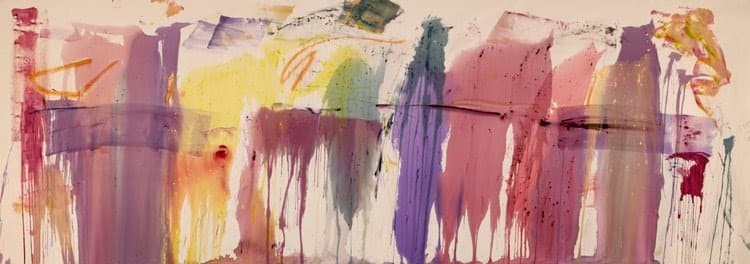
A Hug From The Art WorldA Hug From The Art World is pleased to present Francine Tint: Open Color. Tint has been painting for over half a century, remarkably her work only came to my attention as recently as August last year. By golly, how glad I am that introduction took place, what a gift! Shortly after 10 am on August 20th, 2025, an email arrived in my inbox. It was from Francine, introducing herself on the recommendation of her friend at the Brooklyn Rail. I was away on vacation at the time; I read the information presented. Curious, I took a deep dive into her work. I saw enough that I liked, extremely quickly, to warrant the response, “I’m intrigued.” I arranged a studio visit for early September, in other words, immediately upon my return. Once back in the city, I got myself to the village and Tint’s studio. Multiple unstretched canvases donned the walls and many more were laid out on the floor. Stacks of early work (stretched canvases) filled painting racks as well. The scale was very large, verging on gigantic. Everything was so organized, orderly, and also numbered. With the help of studio assistants, once the paintings were viewed, they were rolled and placed back where they came from. Paintings kept coming as I waited, unveiling after unveiling. It was clear that Tint is a true professional (we looked at about sixty paintings altogether that morning) and productive too, all the work I looked at was from the past year. It was a revelation to look at Tint’s work, but something was amiss. It was obvious this was not where she was making the paintings, it was simply all too clean. I was expecting to see paint, rollers, buckets and a yellow full-body painting suit, as my deep dive into her work had already led me to believe. So, I asked, where was the action at?! I was told her physical painting studio was in her apartment, adjacent to Washington Square Park. I was eager to go there, so upon leaving I asked for an invitation. I was directed to add my name to her signing in book. She’s meticulous at recording and documenting who’s been through. I was handed her recent monograph and was on my merry way, pleased to have secured a date to visit her actual painting studio the following week. Pressing the elevator buttons, I ascended and got out on the top floor where Tint’s apartment is perched. The apartment was not large but has a wraparound terrace and therefore streams of light and views of Manhattan’s sprawling skyline. She credits her apartment as one of the reasons she declined a marriage proposal, she never wanted to give it up, painting obviously the real reason. Made up of a kitchen, living room which acts as her entire living space, bed and all. We sat down on a two-seater sofa, where Francine proudly showed me a trailer of the now released short film she is the subject of, Panoramic View (I have since gone to the premier and, having watched the film, I must say it’s a wonderful resource, I just wish it was feature length). After watching the trailer, the time had come. The ‘actual’ bedroom had been converted into Tint’s painting studio. Surprisingly, the room was not big at all, maybe 15 feet square. The light came streaming in through two large windows along the south side. There was still ample room to have one canvas of scale pinned to the wall. Plastic covered all of the surrounding walls behind. If she wants to work in a super large scale, all she has to do is pin the canvas around the room to give her the extra space as needed. In the corner was a sink and shelves with all the acrylic paint she could want, and on the floor more paint and buckets and rollers. I was where the action happens. Her paintings are all intuition. If I have any intuition of my own, Tint is currently making the best work of her career. It’s free and open, and she’s completely unafraid to let the negative space play the active role. Her choice of soft, serene color makes the work really calmingly beautiful. The work is clearly rooted in Abstract Expressionism, which makes sense, as Francine is 83 and in the late ‘60s and early ‘70s when she says she became “serious about painting” AbEx and Color Field were dominant forces. Max’s Kansas City was the hangout spot for artists and that’s where she met the likes of Larry Poons and Brice Marden. At this stage in her life, Tint’s bread and butter was as a fashion stylist and costume designer. She worked with the best, David Bowie, Andy Warhol, MTV and also Saturday Night Live. Her paintings were in the windows at Bergdorf, at the same time she was making costumes for Ridley Scott. She was accepted as a special student at Pratt, meaning she could earn credits by attending night classes. First at The New School, and then from a museum school at the Brooklyn Museum, amongst others. Working as a stylist during the day and painting at night. Francine has reflected that she was quite embarrassed about being a stylist at the time, she kept it to herself, even though she was very successful at it, she did not tell anybody. Now, however, she is proud of it. It’s all part of her story. She even lectures about the experience, “there’s not a single artist from Rembrandt to Manet, who didn’t understand the importance of fabrics, textures, and layers. Think about Rembrandt’s jeweled slippers or the softness and sensuality of bedding and drapes. All that detail comes from a deep understanding of materials, and how to manipulate them. In a way, being a stylist was my artistic training ground, helping me develop a keen eye for color and texture.” Francine’s never been afraid to introduce herself to anyone, she also cold mailed Clement Greenberg (need I say any more). He responded on August 23, 1982. He commented that her slides looked promising, but he did not believe slides and shared his reluctance to add studios to those he already visits. Yet for Francine he made an exception. He went on to visit her studio for the next 13 years until he passed in 1994. That’s a little piece of art history in and of itself. As The New York Times says, Francine Tint is finally “having her time.” Francine Tint’s practice is rooted in the exploration of color as a means of capturing and embodying light. Her approach emerged within painterly abstraction, merging Color Field influences with the dynamic gestures of Abstract Expressionism. While grounded in this tradition, Tint continually expands its boundaries, exploring new forms of expression that challenge conventional abstract frameworks. Art critic David Ebony observes that Tint rejects rigid formalism in favor of an intuitive method, balancing energetic movement with moments of stillness. This interplay creates what he describes as a “Zen feeling”—a sense of clarity and resolution within complex visual structures. Marking a new milestone, the Open Painting series is Tint’s most recent body of work. It introduces a dialogue between pigment and negative space, where raw canvas plays an active role, fostering a sense of depth and openness. This approach enhances luminosity, allowing light to interact dynamically with the surface. By embracing reduction, Tint balances spontaneity and precision, pushing her practice in a bold new direction. Art historian Alex Grimley describes her works as “luminous climates”—immersive chromatic environments that extend beyond the canvas. This attention to light and spatial relationships is particularly evident in her latest works, where exposed canvas and pigment generate depth and movement. Over more than five decades, Tint has remained committed to discovery and reinvention. While sharing affinities with peers such as Larry Poons, her synthesis of gesture and color distinguishes her vision. Her contributions to contemporary abstraction have recently been recognized through several major milestones: the publication of a comprehensive monograph, Francine Tint: Paintings, now held in the collections of the Museum of Modern Art, the Metropolitan Museum of Art, the Whitney Museum of American Art, the Solomon R. Guggenheim Museum, the New York Public Library, the Los Angeles County Museum of Art, and the Art Institute of Chicago. Tint was also recently featured in The New York Times and is the subject of a documentary in which she reflects on her lifelong commitment to painting—from her Brooklyn childhood and early career as a leading New York City stylist, to her struggles within the male-dominated abstract art world, and her immersion in the vibrant New York club culture of the 1980s and 1990s. The documentary, directed by award-winning filmmaker Pola Rapaport and shot by Wolfgang Held - cinematographer of The Andy Warhol Diaries - premiered at the Newport Film Festival and was also selected for DOC NYC in fall 2025. Her work is held in the permanent collections of more than thirty museums, including the Neuberger Museum of Art, the El Paso Museum of Art, the Tampa Museum of Art, and the Aïshti Foundation. Tint’s paintings are exhibited across the United States and Europe, further solidifying her influence in the field of contemporary abstraction.