Ridgewood, New York
Group Exhibition
How I Learned to Carve, and How I Don’t Need to Know That Anymore
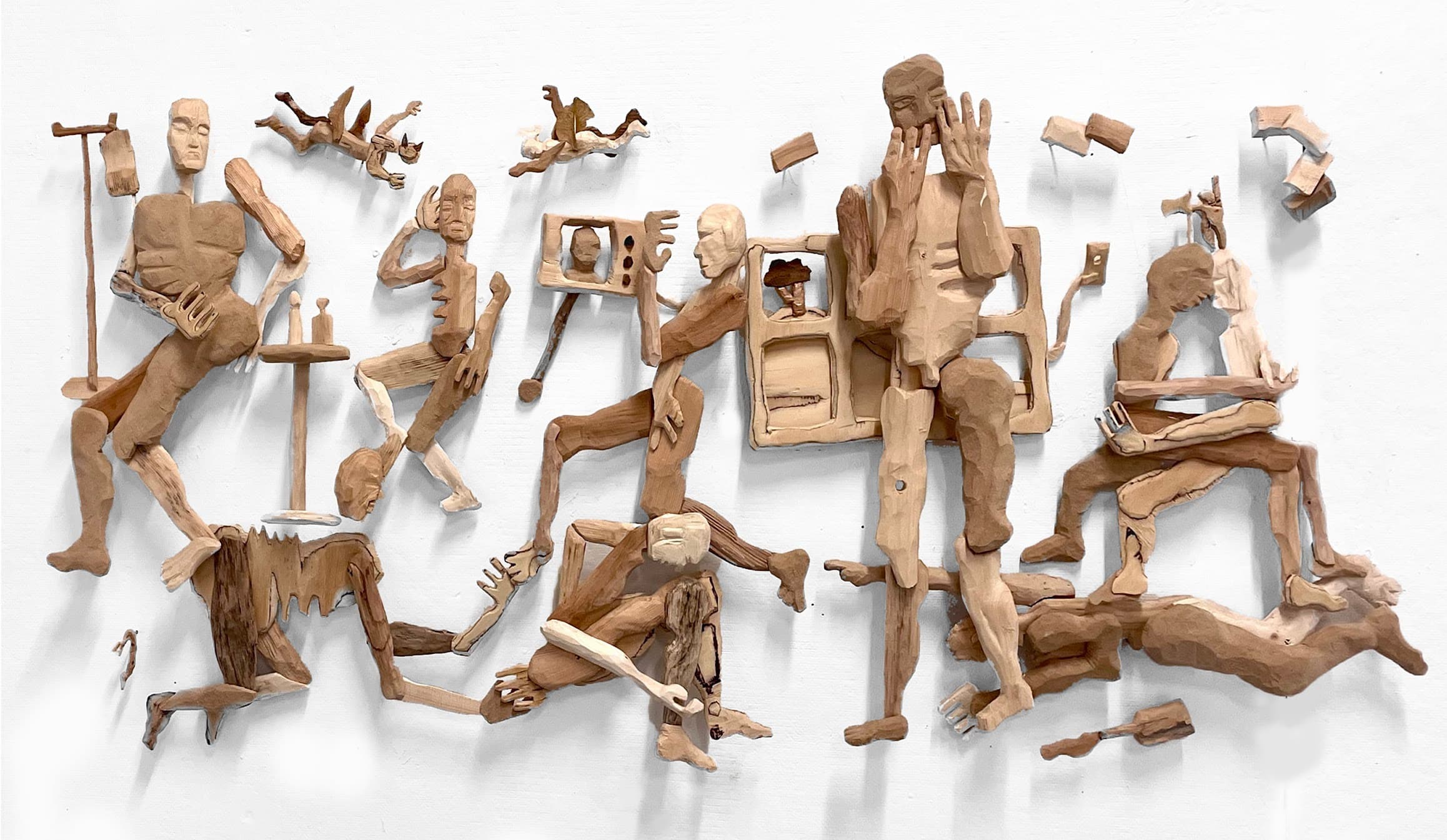
TempestAmanda Guest Jordan Segal Alexander Zev How I learned to carve, and how I don’t need to know that anymore, a Proustian sentence texted to me by Amanda Guest, brings to mind our inner resourcefulness for coming up with ways to heal from trauma, lived or inherited. Once those tools are no longer useful, we may start to lay down our arms and armor. A new sense of calm and resilience is a gift bestowed by our proclivity to create. Although I misunderstood Amanda’s text (she was referring to how she was taught to carve meat at the family dinner table, but seldom has reason now to brandish this skill) I see potential in the expression. I’m drawn to the idea of putting one’s claws to different use, wielding our strength and prowess to hone new skills. It simultaneously recalls the materiality and techniques used in the works of Amanda Guest, Jordan Segal and Alexander Zev and gives us someplace to go once combat is over. Amanda Guest - My work emerges from the experience of growing up in homes designed by my father, a British modernist architect. The formal language I inhabited and the experiences in those spaces formed the basis of my artistic vocabulary. Development of imagery may be incremental or impulsive. Some works are part of a series, marking time, while others are unique, allowing collaged shapes to move into abstraction. They explore rigidity and fluidity, movement within and away from the grid, violence and restraint. Pages are spaces/sites inhabited by lines traced by thread, cut paper, paper pulp, and pencil. Collaboration with Dieu Donne Papermill allowed me to use the papermaking process to investigate these impulses, to embed lines in sheets as they are made, or allow the paper to sculpt itself as it dries against restraint. In installations, nails are drawn into a wall, paper “pieces” are collaged directly on the wall, in dialog with the architectural space. The imagery moves through grid systems to idiosyncratic drawings, referring to existence within those beautiful, monochrome, light-filled spaces; surrogates for sites of experience. Jordan Segal was raised in New York City, a gritty environment that continues to shape his work. He earned a B.A. in Studio Art from Bard College in 2014, where he received the Studio Arts Award. Now based in New York, he works as an artist, curator, and educator. Segal has exhibited widely in both traditional and experimental spaces, including Bob’s Gallery, the New York Hall of Science, Artcell, and Established Gallery. His experimental, material-driven practice explores the tension between fragility and strength within the human body. Moving fluidly between painting, sculpture, and drawing, his work constructs a textured world that is dark, humorous, and emotionally charged. He has completed residencies at ChaNorth, Ox-Bow’s Conversation in Practice Residency, and Byrdcliffe. His work has been featured in ShoutOut LA and Create! Magazine. Segal’s curatorial project, Curmudgeon, is part of the Chinatown-based gallery Nine, where he is a founding partner. Alexander Zev - I am a queer Queens-based artist whose practice encompasses sculpture and installation, exploring themes of connectivity, the surreal nature of societal human experiences, and our collective relationship with trash systems. Motivated by a fascination with the open-endedness of waste systems, I create almost exclusively with found substrates. Over the past few years, I have developed my own supply chain of sculpture materials, sourcing scrapped wood from local cabinet makers, felled city trees, and the ground. While I am interested in the social aspect of peer-to-peer waste collection, I also find the discarded objects themselves to be imbued with meaning. Trash, to me, represents the most accurate reflection of our culture—a narrative untouched by self- mythologizing. Just as archaeologists study garbage to understand past societies, I believe our present-day refuse offers invaluable insights. Through my art, I aim to showcase and distort this refuse, creating tiny ruptures in our unprecedented waste cycle and challenging the legacy of our trash. My passion for making art accessible to all drives me to install works in unexpected public spaces, bringing art to diverse audiences and sparking conversations in everyday environments. I foster artistic communities through curatorial and collaborative projects, believing that the creative process is an overpass that connects people and enriches humanity. Through these efforts, I aim to cultivate a sense of collective responsibility and inspire a deeper understanding of our unusual place in the natural world.