

South, London
Hilary Lloyd & Dennis Potter
Seeing the Blossom
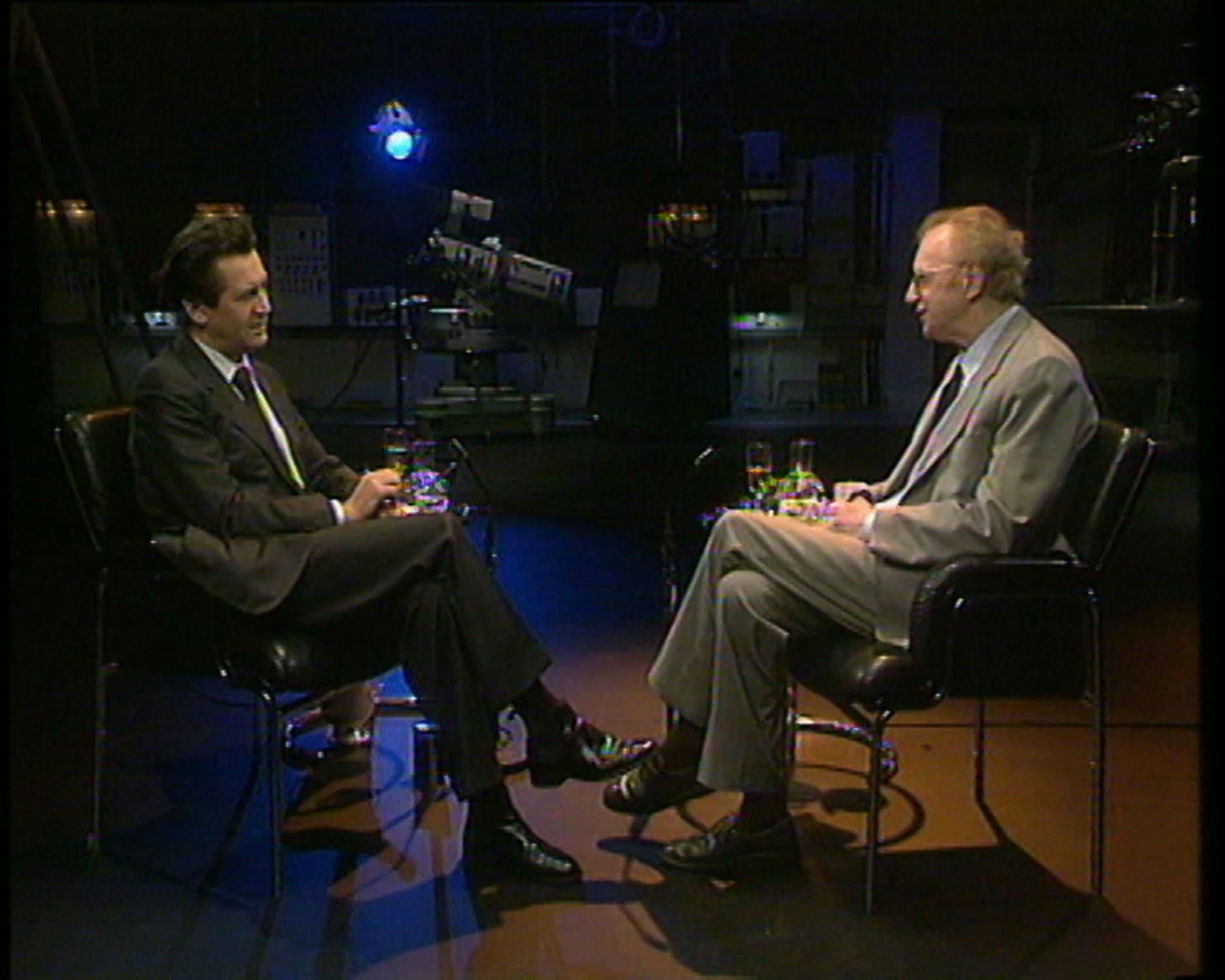
Studio VoltaireSeeing the Blossom centres on Dennis Potter's ‘final interview', which is shown in its entirety. Conducted by broadcaster Melvyn Bragg, the interview aired on Channel 4 just weeks before the writer and dramatist's death in 1994. Recorded with the knowledge that he was dying, the interview represents an extraordinary epitaph delivered by Potter himself. Examining his long career in television, the legacy of the post-war settlement, and the impact of media on democracy, Potter's analysis of public life and political discontent crackles with prescience. The interview is arguably the notoriously exacting dramatist's final, virtuoso performance. Filmed on a largely empty television set, the sparse staging comprised two chairs and a side table for Potter's cigarettes, champagne and the liquid morphine he relied on to control his pain. While the conversation ranges between politics, childhood, and religion, Potter's discussions of his experiences with chronic illness and mortality are most striking. The lucidity with which he discusses his own death was startling at the time, and over thirty years later, it remains deeply emotive. In one of the interview's most memorable passages, Potter recalls the blossom in his garden that Spring as "...the whitest, frothiest, blossomest blossom that there ever could be. Things are both more trivial than they ever were, and more important than they ever were, and the difference between the trivial and the important doesn't seem to matter". The interview is presented alongside Hilary Lloyd's video Blossom (2017). The work, which employs a static camera and single take, captures a swaying floral, brightened and blurred to pink impressions by hot white sunlight. By focusing on this singular motif, Lloyd enacts a slow and attentive gaze that balances stillness and motion, as well as affective close-up with distanced observation. Seeing the Blossom is presented as part of Hilary Lloyd, Very High Frequency. Hilary Lloyd (b. 1964, Halifax) lives and works in London. She has exhibited internationally, with solo exhibitions including: Ok darling, show's over!, Roland Ross, Kent, England (2024); You want it to be art and I want it to be a magazine, International Centre for Contemporary Culture, San Sebastian (2024); Dog bEar Scarf, Josey, Norwich (2022), Car Park, Sadie Coles HQ, London (2019); Chance Encounters V, Loewe Foundation, Miami (2019); Bar, BAR, Turin (2019); Theatre, Focal Point Gallery, Southend-on-Sea (2017); Awful Girls, Dorich House Museum, Dorich House Fellowship & Dora Volume 1, Kingston (2017); Blaffer Art Museum, Houston (2016); Robot and Balfour, Sadie Coles HQ, London (2015); Museum für Gegenwartskunst, Basel (2012), Artists Space, New York (2011); Raven Row, London (2010); Tramway, Glasgow (2009); Le Consortium, Dijon (2009); Kunstverein München (2006); Waiters, Henry Moore Foundation Contemporary Projects, Venice Biennale (2003); Kino der Dekonstruktion, Frankfurter Kunstverein (2000); and Chisenhale Gallery, London (1999). Lloyd was nominated for the 2011 Turner Prize for her 2010 exhibition at Raven Row, London. Dennis Potter (b. 1935–d. 1994) was a journalist, novelist, cultural commentator, broadcaster, producer, director and playwright. Born in a mining village in the Forest of Dean, Gloucestershire and graduating from Oxford University, he briefly worked as a journalist and entered politics, unsuccessfully standing as a Labour candidate in the 1964 general election. However, his most significant cultural and artistic contributions were made within the realm of British television drama, where he authored more than forty single plays, serials, and adaptations. His notable contributions include many of the BBC's Wednesday Plays and acclaimed series such as Pennies from Heaven (1978). The latter, conceived as a 'television novel', marked a pivotal moment in Potter's career, as one of the earliest instances in which his characters engaged in stylised performances of popular songs—lip-synching and dancing to original 1930s recordings. Although Potter consistently denied that his work was autobiographical, many of his dramas were informed by personal experiences. Perhaps most notably, his lifelong struggle with psoriatic arthritis was reflected in The Singing Detective , in which the protagonist's illness closely parallels Potter's own condition. Prior to his death in 1994, he completed two final scripts, Karaoke and Cold Lazarus. Remarkably, he successfully proposed that the productions be a joint venture between rival broadcasters, the BBC and Channel 4 – marking a landmark collaboration in British television history.