
Saint-Germain, New York
Philippe Mayaux
Lost in the American Dream
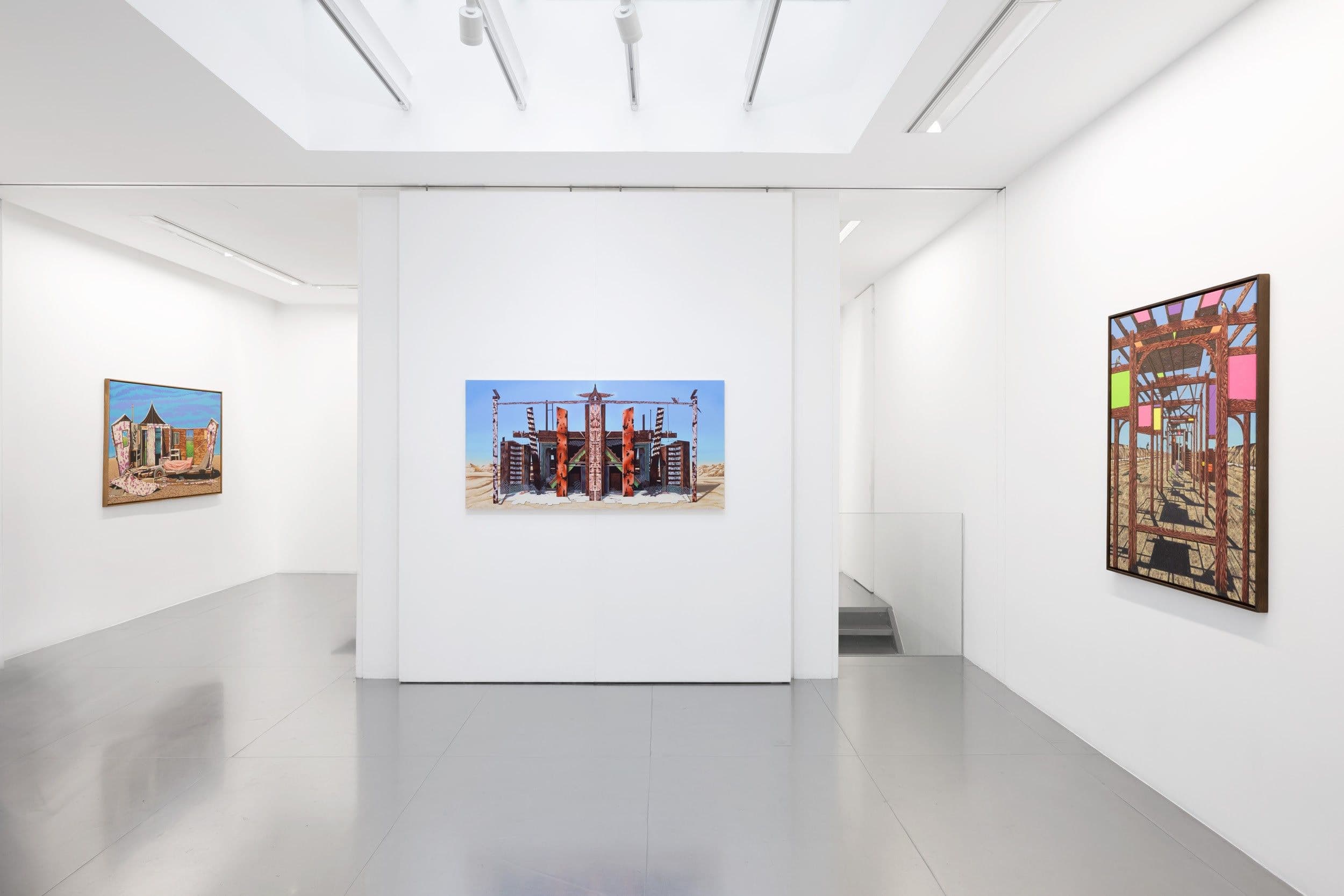
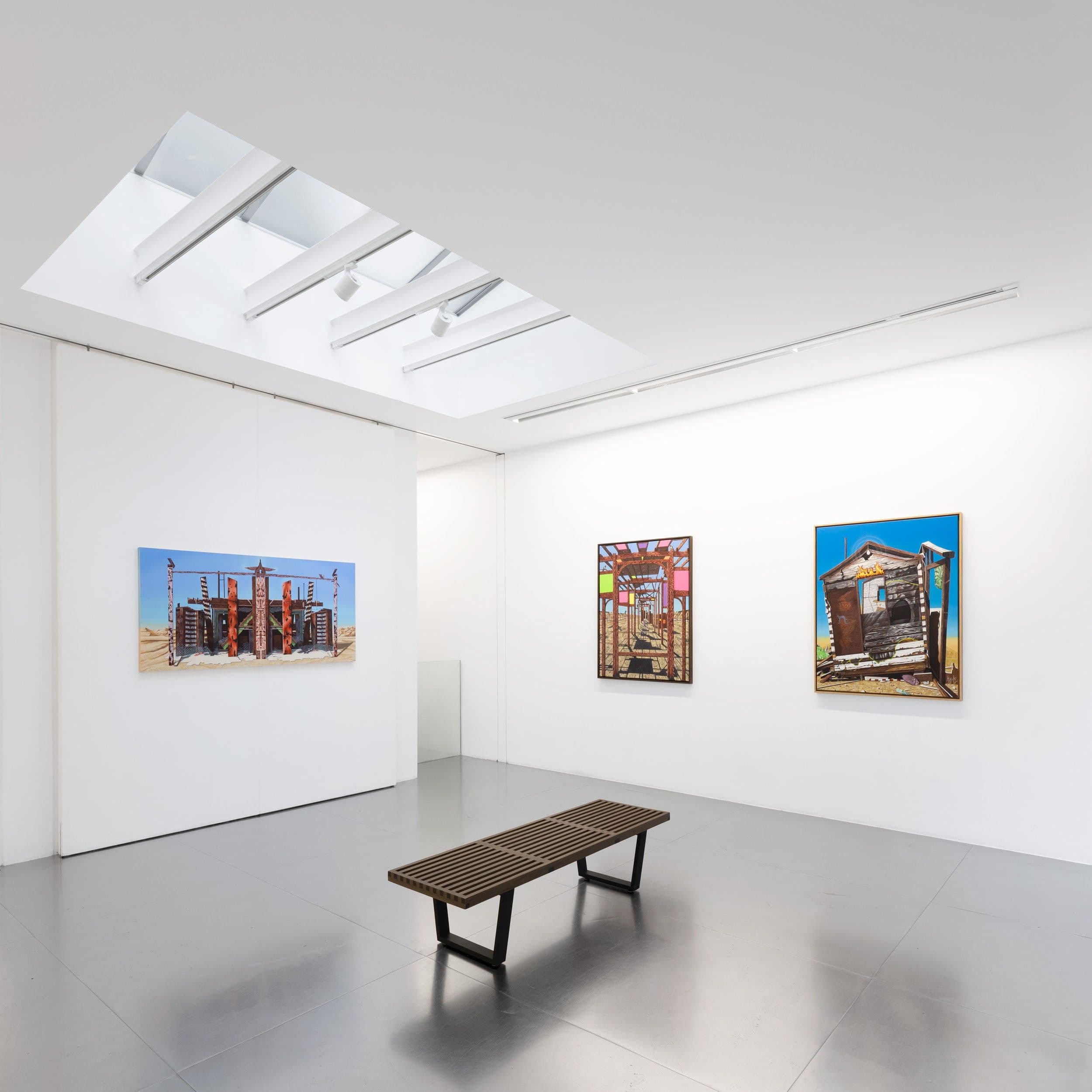
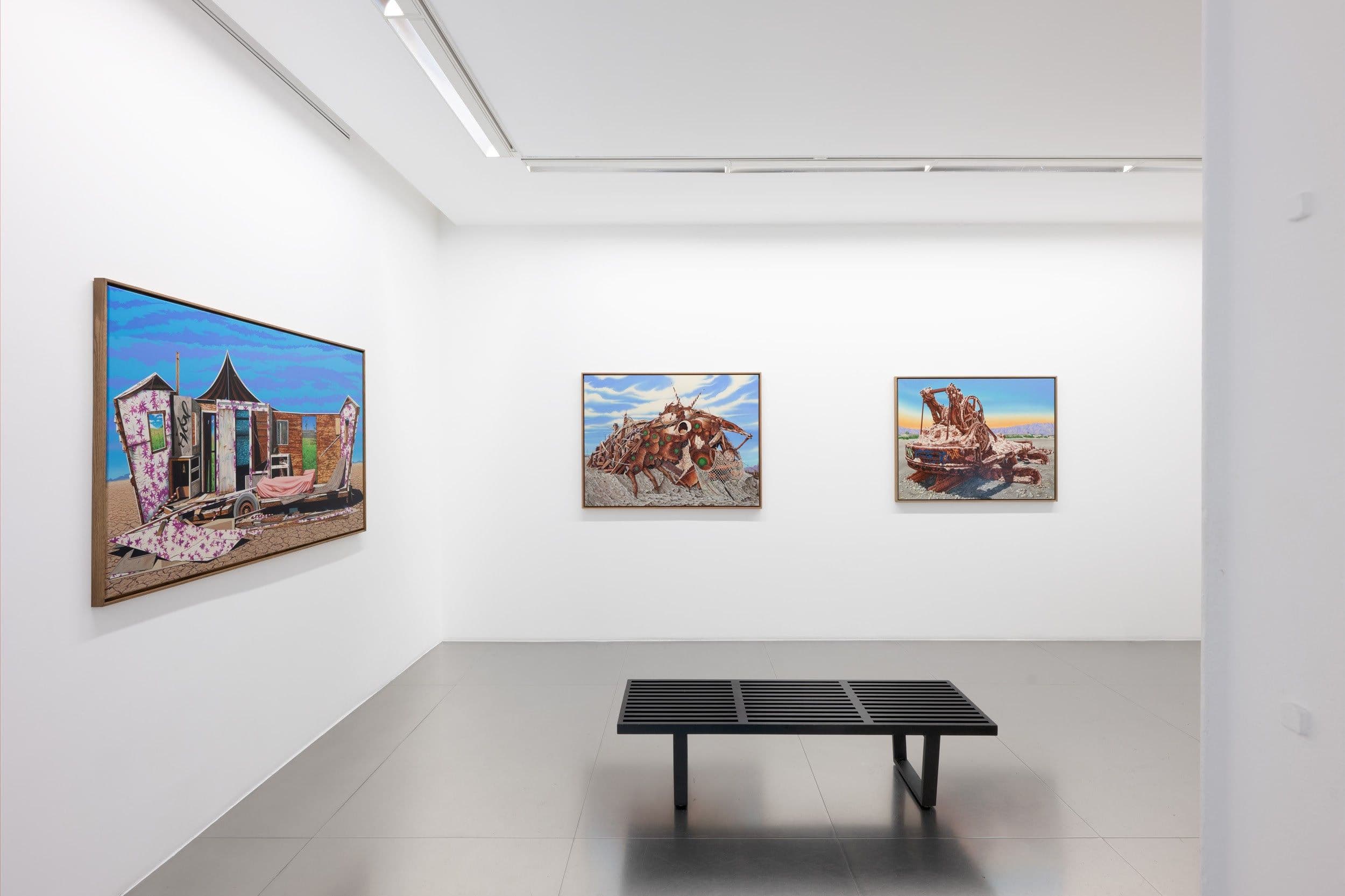
LoevenbruckWith this series of works inspired by a journey into the wacky, dreamlike reality of Salton Sea, Philippe Mayaux invites us on a pictorial drift through the neglected fringes of the American Dream. This exhibition explores our relationship with history, nature and the disillusionments of modernity, sketching the contours of a Solar Punk future and inviting us to meditate on ruins, the betrayed promises of technology and the fragility of our environment. Indeed, in this exploration of the groans of a crippled world, a ray of hope flickers, an alternative vision of a possible future, at once slightly utopian and terribly urgent. A journey to the heart of a heterotopia. Salton Sea, California, a former party paradise turned toxic hell, serves as the starting point for our pictorial exploration. This artificial sea, born in the middle of a salt desert as the result of an industrial accident in 1905, was once the playground of Hollywood stars, then it turned into today’s post-apocalyptic landscape, where the ruins of past glory sit in a mutilated and oxidised natural environment. Philippe Mayaux sees it as a mirror of our times: a place where past, present and future overlap, revealing the absurdity of our capricious and selfish pursuits, and where the emblems of our power simply go back to being natural substances – iron, wood, sand and bone. His paintings speak to us of collapse and memory, vanity and responsibility, inviting us to contemplate the disturbing beauty of a scene in its death throes. But this is no simplistic observation of decline; in this shattered world, there are also signs of resilience, the beginnings of change, the seeds of rebirth, of a possible harmony between nature and sustainable innovation opening the path to a brighter future. Paintings like epiphanies. The works on display do not merely represent Salton Sea; they become its epiphanies – those moments when fiction tips over into reality, when the spirit becomes food for thought, when the symbol reaches beyond its context. Each canvas is a door ajar onto a topsy-turvy world, where certainties waver and, behind the fog of future mystery, the possibility of new perspectives emerges. Salton Sea – paintings of disfigurement. In these obsolete pantheons, the bygone symbols of triumphant modernity are now nothing more than abstract relics, the vehicles of our conquests, rusty dinosaurs, fossils from another era. The chaos of the blind scramble for progress has been frozen in salt, as if history itself ended there. The multiple and unstable vanishing points of certain paintings (including The Lost Palace, 2023) evoke the collapse of myths, while nature, once tamed, reasserts itself in the tragic irony of a return to the wild. Yes, at the heart of this devastation, signs of transition can already be glimpsed: a tree in bloom grows on a sand-covered boat (La Nef des fous, 2025), swallows invade the debris of our dilapidated palaces (L’Annonciation, 2025), as metaphors for a world in which, despite it all, life always finds a way to be reborn, in the spirit of Solar Punk, in which the symbiosis between humans and the environment seems to become a possible ideal. Take for example, the painting entitled La Niche de Diogène (2022): inspired by Diogenes the Cynic, a philosopher who rejected the vain artifices of civilisation. It presents a tumbledown hut as an allegory of our blindness. Between an electric blue and artificial sky, a lamp lit in broad daylight (wastefulness? last hope?), a fish far out of water, a jungle or paradise turned into amnesiac wallpaper patterns, we perceive that the beauty of nature has retreated into its agony. Distorted perspectives, windows opening onto other windows, one horizon overlooking another, indecipherable tags like hieroglyphics – it all works together to blur our bearings. The works play with paradoxes, as if to remind us that reality at Salton Sea is reflected in fiction and vice versa. “I seek Man, but I prefer his dog.” These visual poems, at once incantations and observations, sum up the exhibition’s obsession. With his powerful images of desolation, Philippe Mayaux asks: where are the humans in this chaotic scenery? They have disappeared. When nature is expiring and ruins crown our sovereignty, when fiction is already too true, what remains but human madness, lost between mystification and reality, illusions and utopias, cowardice and belief? Nevertheless, in the very contrasts of the Solar Punk imagination, a possible answer emerges: that of a failed civilisation which, by reconnecting with the vitality of nature, might reinvent its relationship with progress by cultivating harmony and resonance so as to build a future full of serendipity and humour. A dreamlike realism. What is striking about these paintings is their too-false realism. Every element – the rickety architecture, the immobile caravans, the suffocated fish, the cloudless sky streaked with chemtrails, the boats sailing on waves of sand – really does exist at Salton Sea. Yet bringing them together creates an almost fantastical strangeness, as if the artist had captured the moment when reality went belly up as nightmare. The beauty of these moribund landscapes haunts us: it is the beauty of a world which has exhausted its representations, its icons. But behind this end-of-time façade, between the visible and oblivion, there is a glimmer of hope where destruction gives way to metamorphosis, where ruins become the niches of a liveable, sustainable, funny and sharing utopia. An invitation to lucidity and action. Lost in the American Dream is not an environmentalist diatribe or a nostalgic elegy. It is the cry of fish, a call to see beyond appearances, to accept the warning signs of an impending collapse, but also to glimpse paths to regeneration. By blending history, mythology and current events, Philippe Mayaux reminds us that the remains of Salton Sea are also those of our passions, that the carcasses of our machines are also those of our bodies – and that the future is already taking shape there, between cynicism and hope, between abandonment and resistance. Echoing Solar Punk, a space for thought in which today’s morbid tendencies can be reversed, the artist challenges us to turn the end into a beginning: but how far will we be able to go to achieve this, what will we sacrifice, and how can we turn a utopian fiction into a true philosophy?