
Red Hook, New York
Group Exhibition
Till Human Voices Wake Us
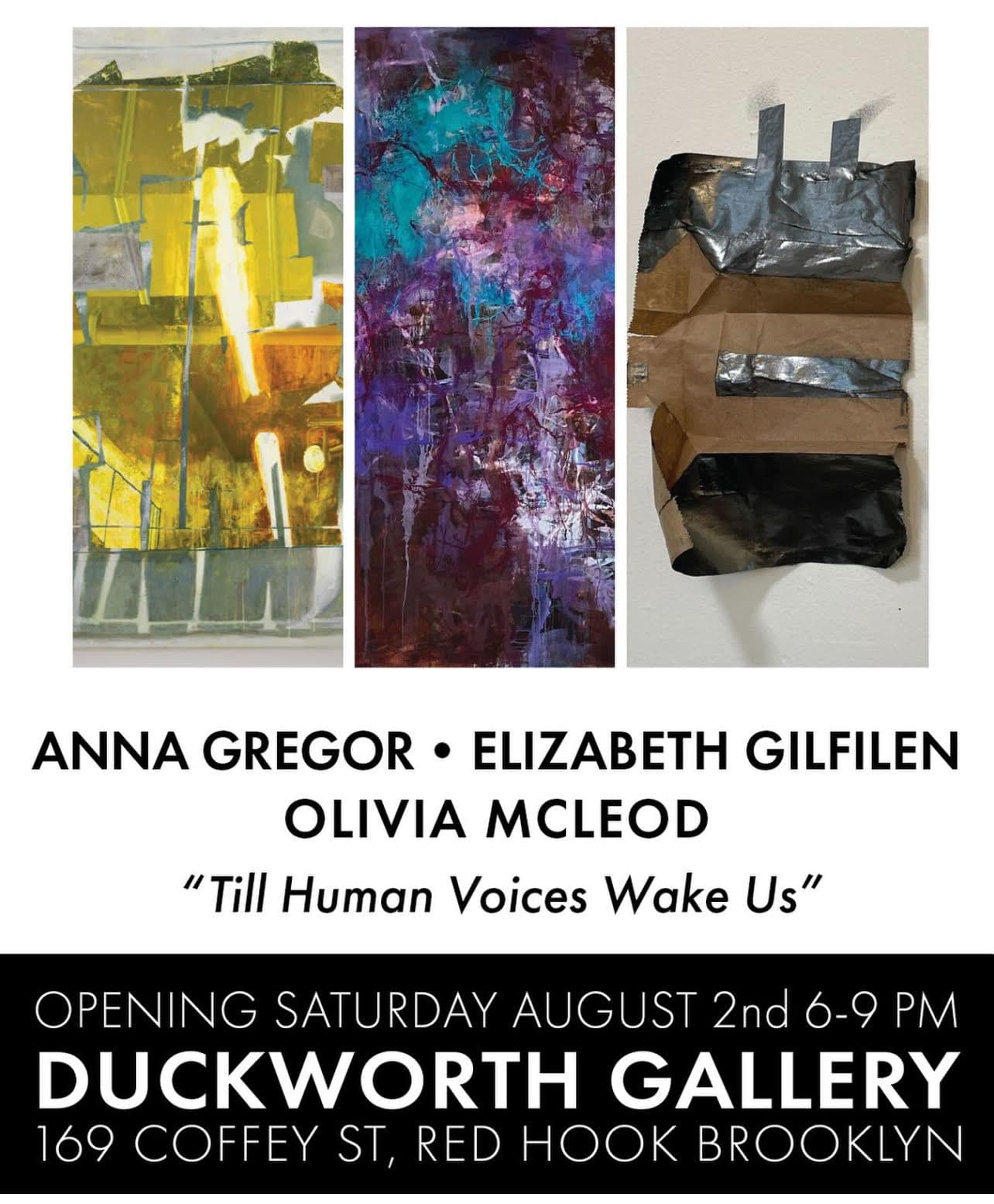
Duckworth GalleryAnna Gregor Elizabeth Gilfilen Olivia McLeod Duckworth Gallery is pleased to present Till Human Voices Wake Us, a group exhibition curated by Craig Stockwell. Borrowing its title from the final line of T.S. Eliot’s The Love Song of J. Alfred Prufrock, the exhibition explores the liminal space between reverie and recognition — where internal states surface in gesture and material. Each artist engages with painting, sculpture, or time-based practices in a way that reclaims methods and languages often considered obsolete, forbidden, or unfashionable — and in doing so, breathes them back to life. Elizabeth Gilfilen’s works on paper and canvas channel the immediacy of mark-making as a visceral extension of the body. Her paintings are built from recurring gestures — looping, scratching, surging lines that seem to move as though guided by impulse rather than image. Rooted in abstraction but resisting detachment, her works exist in a state of emergence. Gilfilen’s practice carries forward the bodily urgency of gestural painting, not as revival but as renewal — revealing a language that is far from depleted. Anna Gregor approaches painting as both inquiry and devotion. Working with historical materials like rabbit skin glue, egg tempera, and oil, she uses additive and subtractive techniques that give her surfaces the feeling of excavation. Her work resists fast reads: while often abstract, the paintings contain flickers of figuration and space that reward prolonged looking. With a practice that blends research, memory, and emotional intelligence, Gregor asks painting to hold what’s sacred — even when that sacredness feels difficult to name. Olivia McLeod works with materials that behave, resist, and decay — hair, concrete, flowers, breath. Her work straddles sculpture, installation, and performance, often unfolding in time as an event or subtle transformation. Rather than seeking permanence, McLeod leans into ephemerality, emphasizing sensitivity, pressure, and touch. Her work speaks to a feminist and embodied lineage — recalling Arte Povera and post-minimalism — while remaining rooted in the present moment and the intimacy of physical experience. I first met Elizabeth Gilfilen during my time at the Sharpe-Walentas Studio Program in 2013–14. She had been there a year earlier, and I visited her studio soon after. I’ve always been interested in artists who work within visual languages others have declared “over”: Beth paints gestural abstraction — a mode dismissed by many as exhausted, or associated too heavily with a masculine legacy of aggression. But Beth’s work shows how a language can be reborn through discipline and sincerity. Over years of constraint and exploration, she continues to produce work that feels vital and fully her own — an expressive force unbothered by the assumptions surrounding it. Anna Gregor first came to my attention through Patricia Miranda’s critique group. I remember a moment during a group crit when Anna spoke about her work and, unexpectedly, began to weep. But it wasn’t frustration — it was something sacred being touched. Her work at the time explored religious iconography not with irony, but with genuine reverence. That kind of earnestness, that willingness to confront the sacred as a painter, felt like an old breeze returned — unsettling and necessary. I’ve followed her practice since and have been consistently moved by her curiosity and refusal to settle. Her writing, too, reveals the same drive: I especially appreciated her recent essay “paintings and Paintings.” Olivia McLeod was introduced to me by artist and educator Jonathan Van Dyke. We met via Zoom after I’d seen her work — I was struck immediately by the material sensitivity, the way her pieces communicate physically. Artist statements rarely move me, but hers did — balancing a clear conceptual foundation with vulnerability. What caught my attention most was how her work quietly echoed 1970s Arte Povera — though, as it turned out, this reference was entirely unintentional. That unconscious kinship to history — deeply felt but unforced — stayed with me. This show is also, in part, a gesture toward my late brother-in-law, Aidron Duckworth, for whom the gallery is named. Aidron was a modernist and a complex man. While this exhibition doesn’t reflect his aesthetic directly, it engages something he believed in — the enduring value of rigorous form, honest gesture, and the capacity of art to speak in voices that may have been once lost, or simply waiting to be heard again.