
Belleville, Paris
Liddy Scheffknecht
Now
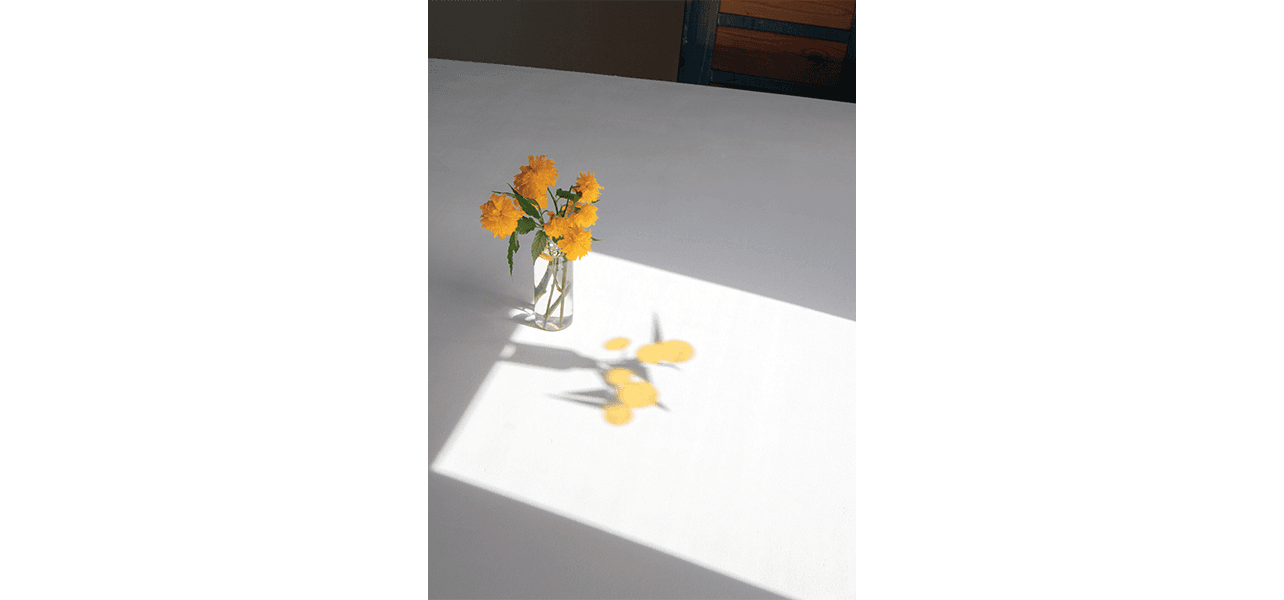
,48 m²[Scroll down for French version / Veuillez trouver ci-dessous la version française] Now. Liddy Scheffknecht's invitation to live hic et nunc (here and now) manifests itself in the manipulation of sunlight, which allows her to create forms that are both simple and delicate. Scheffknecht's works do not praise speed; on the contrary, they invite the viewer to become immersed in the present moment as it unfolds, focusing attention on the effects of the earth's rotation. This way, Liddy Scheffknecht produces striking illusionistic effects, yet in a non-demonstrative way, which disturb our senses. The photographic series Untitled (kerria japonica pleniflora) and sunpan, as well as the video wipeout, record moments when the artist uses natural light, thanks to a cut-out system affixed to a window, in order to produce optical effects. We are left wondering:‘Is it just the stroke of a sponge ? Is it really a shadow of the vase?’ In the work entitled “-”, the artist uses this typographic sign to create a hollowed-out rectangle glued to a pane of glass. Light passes only through this rectangle, which is then redrawn by the artist every seven minutes on paper laid out on the floor. Depending on the position of the sun, this shape moves across the paper, creating geometric superimpositions. The lines refer to a period of time (here, a morning), made up of intervals or pauses, and constitute a trace of the sun's movements. By revealing the writing of light, the artist unveils the invisible pact between heaven and earth. This is reminiscent of the Japanese concept of ma, which invests what exists between things: “the ma is a space-time interval, a transition, a breath, an in-between whose function is to link (en), not to separate. [...] It is a hollow from which form emerges, as in Lao-tseu's parable according to which a vase would be useless if the potter, in turning the clay, did not hollow it out at its center”. (Serge Bramly, La Transparence et le Reflet). In this way, the line is not only used to outline a thing, it exists in itself and in relation to other lines. In this sense, Liddy Scheffknecht's productions willingly discuss the categories and typologies into which we tend to classify them, playing with materiality and immateriality. The light veil that opens the exhibition, bearing the word now translated into different languages, is a clear example of this attitude. The continuity of the living world can be seen in that of the materials, which seem to melt into one another. Poetically sculpting light, the artist powerfully questions our relationship with the image and, by extension, our visual relationship with the world. —Camille Prunet ***** Now. L’invitation de Liddy Scheffknecht à vivre hic et nunc (ici et maintenant) se traduit par une manipulation de la lumière solaire qui lui permet de créer des formes à la fois simples et délicates. Les œuvres de cette artiste ne font pas l’éloge de la rapidité ; au contraire, elles proposent de se laisser pénétrer par le moment présent qui s’écoule en portant l’attention du public sur les effets de la rotation terrestre. Liddy Scheffknecht produit ainsi des effets illusionnistes saisissants, bien que non démonstratifs, qui perturbent nos sens. Les séries photographiques Untitled (kerria japonica pleniflora) et sunpan, ou encore la vidéo wipeout, enregistrent ainsi ces instants où l’artiste utilise la lumière naturelle, grâce à un système de découpe apposé sur une vitre, afin de produire des jeux d’optique. On se demande alors : « s’agit-il vraiment de la trace d’une éponge, est-ce bien l’ombre du vase ?… ». Dans l’œuvre intitulée « - », l’artiste s’inspire de ce signe typographique pour créer une forme de rectangle évidé collé sur une vitre. La lumière ne passe que dans ce rectangle, qui est ensuite redessiné par l’artiste toutes les sept minutes sur un papier disposé au sol. En fonction de la position du soleil, cette forme se déplace sur le papier, créant ainsi des superpositions géométriques. Les traits renvoient à une période de temps (ici, une matinée), constituée d’intervalles ou pauses, et constituent une trace des mouvements solaires. En mettant à jour l’écriture de la lumière, l’artiste révèle ce pacte invisible entre le ciel et la terre. Cela n’est pas sans rappeler le concept japonais de ma qui investit ce qui existe entre les choses : « Le ma est un intervalle espace-temps, une transition, une respiration, un entre-deux dont la fonction est de faire du lien (en), non de séparer. […] C’est un creux d’où surgit la forme, comme dans la parabole de Lao-tseu selon laquelle un vase serait inutile si le potier, en tournant l’argile, ne l’évidait pas en son centre. » (Serge Bramly, La Transparence et le Reflet). Ainsi, la ligne ne sert pas seulement à dessiner les contours d’une chose, elle existe en elle-même et dans son rapport aux autres lignes. Les productions de Liddy Scheffknecht discutent en ce sens volontiers les catégories et les typologies dans lesquelles on aimerait les classer, jouant entre matérialité et immatérialité notamment. Le voile léger qui débute l’exposition, habité du mot now traduit dans différentes langues, en est un exemple. La continuité du monde vivant se lit dans celle des matériaux qui semblent se fondre les uns dans les autres. Avec poésie, sculptant la lumière, l’artiste interroge puissamment notre rapport à l’image et, ainsi, notre rapport visuel au monde. —Camille Prunet