
Hamptons, New York
Rachel Scott
With My Hands
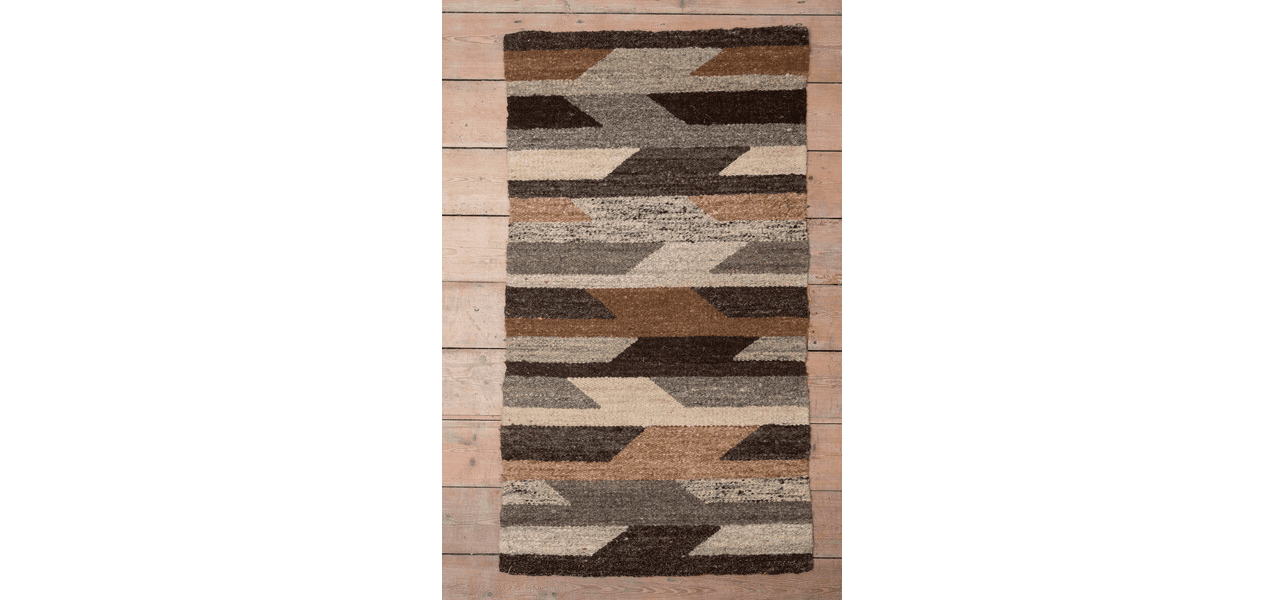
Hauser & WirthHauser & Wirth is pleased to present a special exhibition of works by noted British artist Rachel Scott to launch our Make Southampton's summer 2023 season. With My Hands features a medley of Scott’s celebrated hand-woven rugs alongside select early oil paintings. This juxtaposition offers a glimpse into the evolution of the artist’s practice from her initial training as a painter to her prolific textile work, developed over the last five decades. True to the nature of traditional weaving on a frame loom, Scott constructs her rugs primarily using straight lines, forming geometric patterns and shapes that echo those found in her canvases. The subtle gradients of color in these rugs, often composed of undyed blacks, browns and grays, recall the earthy, neutral color palettes that comprised the foundation of her paintings. When conceiving the designs of her rugs, Scott uses the act of weaving itself as a guide, allowing the process to determine gradations of hues and textures—dark to pale, soft to coarse—and how these elements blend and contrast with surrounding colors. Fascinated by the traditional techniques of textile work as privileging raw materials, Scott works daily; she weaves yarn each morning and spins natural sheep wool each evening in order to most carefully consider how her chosen materials will harmonize. Her works are made from the fleece of rare breeds of mainly native British sheep, including Shetlands, Manx Loaghtans, Black Welsh Mountains, Jacobs and Herdwick—the character of the raw materials creates an intensely felt connection to both Scott’s home country, Britain, and the rich history of British wool. Rachel Scott studied painting at the Royal College of Art from 1959 to 1964 and was elected a member of the London Group in 1964. Scott’s early paintings feature rooms, passages and staircases in earth tones, sometimes depicting a figure sitting on a chair or sofa. By 1970 Scott’s paintings evolved into black, white and gray depictions of empty rooms and tunnels inspired by Kennington and Oval Underground, London. From 1976 to 1979, Scott depicted landscapes inspired by the Somerset and Dorset countryside in nocturnal washes of greens and blues, before turning to weaving in 1976. During the 1970s, Scott had her own kiln and made pinch bowls, plates and cups with animal heads as handles, and small farm, tea and chess sets in red and buff clay. Scott made small toys out of pipe cleaners bound with wool, sold through numerous prestigious outlets in London at the time. Spurred on by the need to replace the staircase rug in the home, Scott began weaving in 1976, using a spinning wheel that her brother engineered with a bobbin screwed to a Singer sewing machine base. Scott’s fleeces come from a variety of British sheep, mainly raised in Devon, Buckinghamshire and Cheshire: Shetlands (fine brown, gray, black), Manx Loaghtans (soft brown), Black Welsh Mountains (black), Jacobs (black and white) and Herdwicks (coarse pale, mid and dark grey). The wool is spun directly from the fleece and the yarn is never dyed. The designs are true to the nature of traditional weaving, utilizing straight lines to construct geometric shapes. From 1990 to 2018, Scott spent the spring and autumn seasons in New York with her husband, the artist Sir Frank Bowling. During this period, and without her loom, Scott turned her focus to knitting, crochet and patchwork as a more sustainable practice outside of her home studio. As a result of this shift in her practice, Scott designed and produced an expansive collection of jackets, scarves, cushion covers, bags, hats and furniture covers. Scott is now based in London and spends her mornings weaving and her evenings spinning, making a limited number of rugs every year.