
Marais, Paris
Hugo Guérin
Qui Compose le Chant des Grillons?
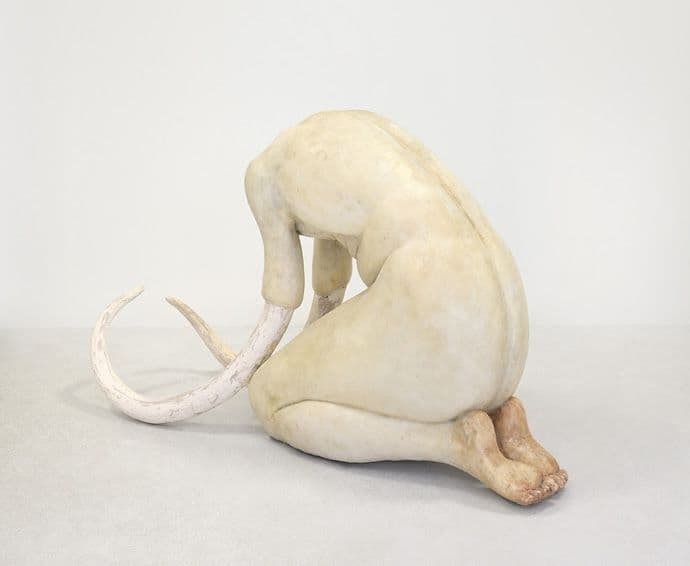
Suzanne TarasieveWho composes the song of the crickets We think we know what the song of the crickets is. No sooner do we hear it than nature seems to be right there. This sound carries a memory: that of a summer’s night, of an imagined countryside, of a landscape we recognise even before we have looked at it. Who composes the song of the crickets arises from this confusion, at the moment when the obvious begins to crack, when the natural reveals the forms that have made it familiar. Hugo Guérin’s sculptures emerge as forms that are as much animal as they are object, as much archetype as they are its distortion. One thinks one recognises a she-wolf, a carcass, tusks, a human figure; yet nothing remains in its place. The she-wolf perhaps nourishes as much as she threatens. The carcass becomes a head, a cocoon. The tusks seem to come from an older, almost mythical age, whilst, upon the remains of a ruined piano, human bodies seem to reach towards the insect. The exposed reinforcing bars and framework lend the sculptures their strangeness. The structure becomes a nerve, a bone, a limb or an outgrowth, as if the body could only hold itself together by revealing its construction. Their calm is never quite peaceful: it may be that of a constricted body, of a power that has become so familiar it no longer needs a name. The exhibition questions the obvious. The mother, the animal, nature, the figure of the great man, the order of things: all entities that seem to precede language, yet are already permeated by narratives, norms and dogmas. Hugo Guérin allows them to reappear in a state of flux. His works transform at a precise moment, when their recognition is disrupted. Do we see a breast or a caterpillar? An ancient head, or a carcass? An insect or a human? The sculptures occupy this liminal space. It is there that they find their visceral power, at the moment when what we think we see begins to elude us. In Who Composes the Song of the Crickets?, the song is therefore not a sound but an atmosphere. It refers to that fleeting moment when a construction finally seems natural. Like a nocturnal landscape too silent to be innocent, Hugo Guérin composes a scene where nothing is stable, nor original. Nature appears here as a dreamlike image, a belief we hold onto, a song that someone or something may already have composed for us. —Manon Canto