

Chelsea, New York
Melissa Stern
The Talking Cure
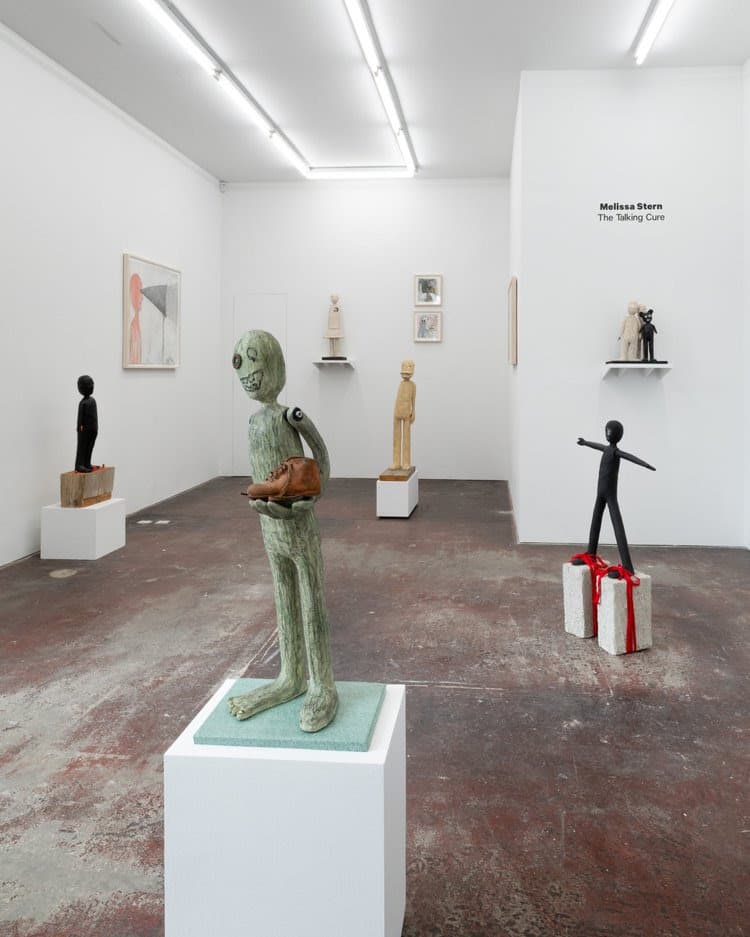
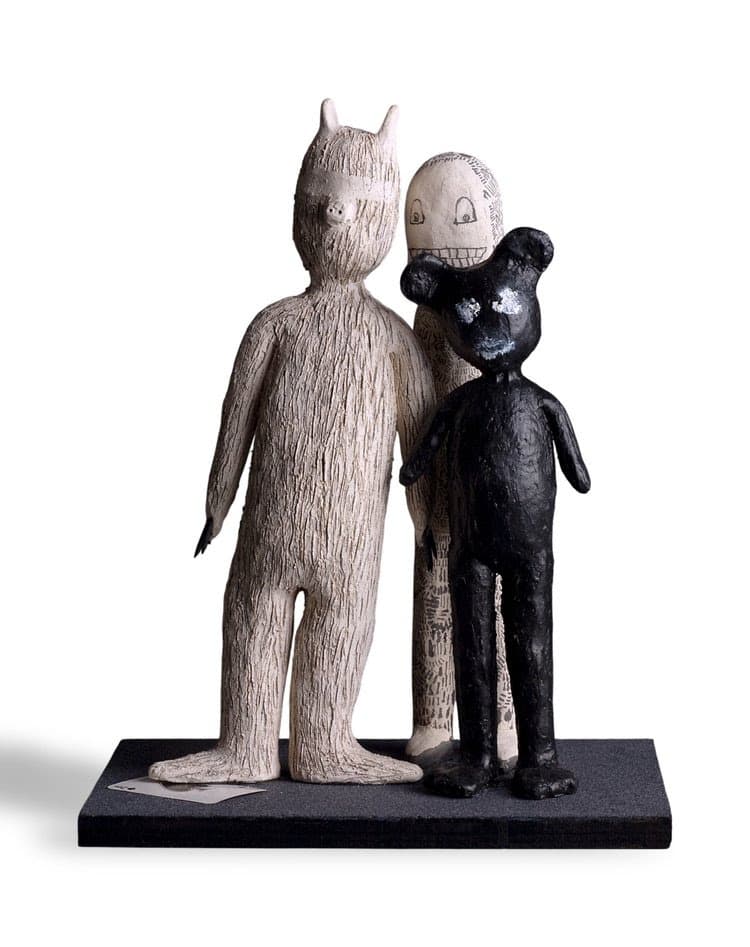
A Hug From The Art WorldA Hug From The Art World is pleased to present The Talking Cure an exhibition by Melissa Stern. For the past fifteen years Melissa Stern’s The Talking Cure has been on a cross country tour gracing many of America’s finest museums from the Akron Museum of Art in Akron, Ohio to The Weisman Art Musuem in Minnesota, Minneapolis with stops at institutions in Hartford, Connecticut; Charleston, South Carolina in between and St Louis, Missouri and Brockton, Massachusetts along the way. A little over a year ago, I was invited to Stern’s studio. Upon entering I had an overwhelming sense of belonging. I was confronted by a multitude of quirky objects made from ceramic, bronze, resin and a whole world of other found materials with which Stern is akin. Adorning the floor and walls these objects all seemed slightly out of whack, absurd and off-balance, yet the experience centered me. I felt at once stable and secure. Stern’s work puzzled me, the objects on view landed somewhere in between Joyce Persanto and Robert Therrien, with a bit of Dada thrown in. I cataloged them further within my own visual lexicon and arrived betwixt Tim Burton and Maurice Sendak, yet very quickly they laid their foundation and set root as a unique language unto themselves. After an hour or so of exploring (all) the work presented in the studio, Stern then pulled out her publication The Talking Cure - explaining that this travelling exhibition was currently touring museums and institutions around The United States. I immediately knew I wanted to show this body of work. Stern was initially hesitant, however, instinctually she knew her work resonated with me, but I was surrounded by her recent work which she was itching to share with the world. For whatever reason, a few things went my way and A Hug From The Art World was selected to host the last stop in The Talking Cure’s journey, the grand finale if you like. I got my way. Borrowing its name from Sigmund Freud’s original description of psychoanalysis, The Talking Cure features twelve humanoid ceramic sculptures and drawings, each one born from Stern’s own imagination. Stern then asked twelve writers- poets, novelists, screenwriters, and playwrights- to each choose a sculpture to which they related most intimately. Each wrote their imagined monologue of the goings on in the sculpture’s mind. Next, Stern cast twelve actors and had them each record one of the monologues with minimal direction from her. They spoke their interpretations of the written pieces that had in turn been inspired by each sculpture. Stern said, “It was like a game of ‘whisper down the lane,’ with each participant interpreting what they saw or read and giving each next step a little tweak of their own.” Those audio recordings are available to listen to in front of each work they relate to. Simple to use, by scanning a QR code and triggering the audio. The viewer (as audience) now looking, and listening, will complete the cycle of collaboration. Like the figures I initially experienced in Stern's studio, the humanoids from The Talking Cure are also off balance. “They look like they could fall down at any moment,” Stern says, “and the secret is they never do.” I now realize why my initial gut response was so visceral and why these off-balance humanoids centered me. Ask anyone who knows me, I never stop moving. Close friends accuse me of moving too quickly. Constantly maneuvering and gesticulating. This affliction has been with me for some time, my father too, it runs in the family. Whilst completing my masters in Contemporary Art (many eons ago) I decided to focus my thesis on the subject. The subject of spasmodic bodies and the space in between the edit. Stern’s figures represent that space in between the edit. That sequence of film that has been cut and then cut again and removed from the main frame. That space in the middle, off-balance, out of kilter but somehow still stable. Stern’s art slowed me down, calming my own internal monologue. The space in between a spasm, off balance yet serene and anchored. This body of work was, by design, produced to encourage interactive engagement. So, it’s perfectly positioned at the gallery’s 112 10th Avenue location, at the corner of 17th Street, completely visible from the street. Simply walking past the gallery, let alone entering the space, will activate the sculptures (even though entering is highly recommended and encouraged). Melissa Stern is an artist, professor and journalist living in NYC. She has worked in sculpture, photography and drawing for over 30 years, exhibiting throughout the U.S., as well as Europe and Asia. Starting in 2012, her multi-media installation exhibition, The Talking Cure, has traveled to nine museums around the States. Her work is featured in a number of prominent corporate and museum collections including - The Bunker, News Corporation, JP Morgan/Chase, The Arkansas Art Center, the American Museum of Ceramic Art, Racine Art Museum, International Center for Collage, Bucknell University, Lewisburg, PA, Library of Congress: Rare Books and Special Collections, Washington, DC, Museum of Art and Design, New York, NY, The Arario Gallery, Seoul, Korea and the Weisman Art Museum in Minneapolis. With a background in anthropology, Stern’s work reflects both non-Western and outsider-art influences. Her drawings, collages, and figurative sculptures are richly drawn and deeply layered, with quirky, often dark humor. She was the lead art critic for The New York Press and City Arts from 2006-2014 and is a contributing writer for Hyperallergic, Romanov Grave, artcritical and ArtSpiel. She has taught and lectured throughout the New York area, including School of Visual Arts, Parsons School of Design, Brooklyn College and NYU. “I work like a handyman, cobbling together drawings and sculptures from elements found, borrowed, and imagined. I use a wide range of materials, from encaustic to clay, pastel to steel. The drawings and sculptures, often made in tandem, resonate with one another, the ideas in one reinforcing the themes of the other. All of my pieces share a thematic thread. Childlike and goofy, my figures live in a dream world, cower in relationships or stand tall in the face of adversity. They are at once dark and funny, expressive of the absurd world around them.”