
Elliott Templeton Fine ArtsPast
Posture Study Photographs
William H. Sheldon
Sep 20 – Oct 14 · Chinatown
This exhibition presents, for the first time publicly, original prints from the research project The Posture Study by the American psychologist and eugenicist William H. Sheldon (1898-1977). The depiction and perceptions of naked bodies in photography have evolved over time. Factors such as the purpose of photographing and the context in which the images are viewed can significantly impact viewers’ reactions. Shifts in social norms or new research findings can turn once-acclaimed photos into sources of controversy or even taboos. Eugenics, Somatotype, and The Posture Study In the early 20th-century, the Eugenics movement in Europe and the United States aimed to “improve” the genetic quality of the human population and extensively used photography to advance its pseudo-scientific notions of racial purity and genetic superiority. Sir Francis Galton, the “father” of Eugenics, used “composite photography” to create “average” images of various groups, claiming these could identify and promote desirable hereditary traits. William H. Sheldon, directly influenced by Galton, developed the field of Somatotype and Constitutional Psychology, categorizing human bodies into three types: “endomorph” (relative fatness), “mesomorph” (muscularity), and “ectomorph” (linearity). Rooted in behavioral genetics and social Darwinism, his work attempted to correlate physical attributes with personality traits, such as intelligence, temperament, moral worth, and probable future achievement. The Eugenics movement flourished in American universities, with elite institutions like Yale, Harvard, Columbia, and Wellesley College, implementing “postural analysis” programs and “corrective classes” for freshmen students. These programs aimed to identify “postural deficiencies” among students and use targeted exercises and education to “correct” them. Sheldon utilized these programs to support his studies, gaining him financial and logistical backing with little resistance. Throughout his decades-long academic career, he successfully published several books, including The Varieties of Human Physique: An Introduction to Constitutional Psychology, The Varieties of Temperament: A Psychology of Constitutional Differences, and his magnum opus Atlas of Men: A Guide for Somatotyping the Adult Male at All Ages. Sheldon's study had clear racial biases. In his data collection, he predominantly focused on white males; Jewish people were indicated separately, Asian people were omitted completely, while Black people were initially excluded and were sporadically included post-1945. In this extensive work, Sheldon formulated his research by creating rigorous instructions for photographing, collecting, and comparing body measurements and ratios. He and his team meticulously visited schools, military facilities, and mental health institutions, collecting photos and data of tens of thousands of men, women and teens. Most individuals were fully naked when photographed, with Aluminum pointers attached and markers drawn on their bodies to indicate their posture. Approximately 20,000 people were photographed, most of whom were freshman male students from universities across the country, with around 9,000 men photographed at Yale alone. This exhibition features photos taken at Yale after the spring of 1952, when Sheldon’s team installed the “PhotoMetric equipment” to create four-view images of the individuals photographed. —Omer Ben-Zvi, “Body Mechanics”
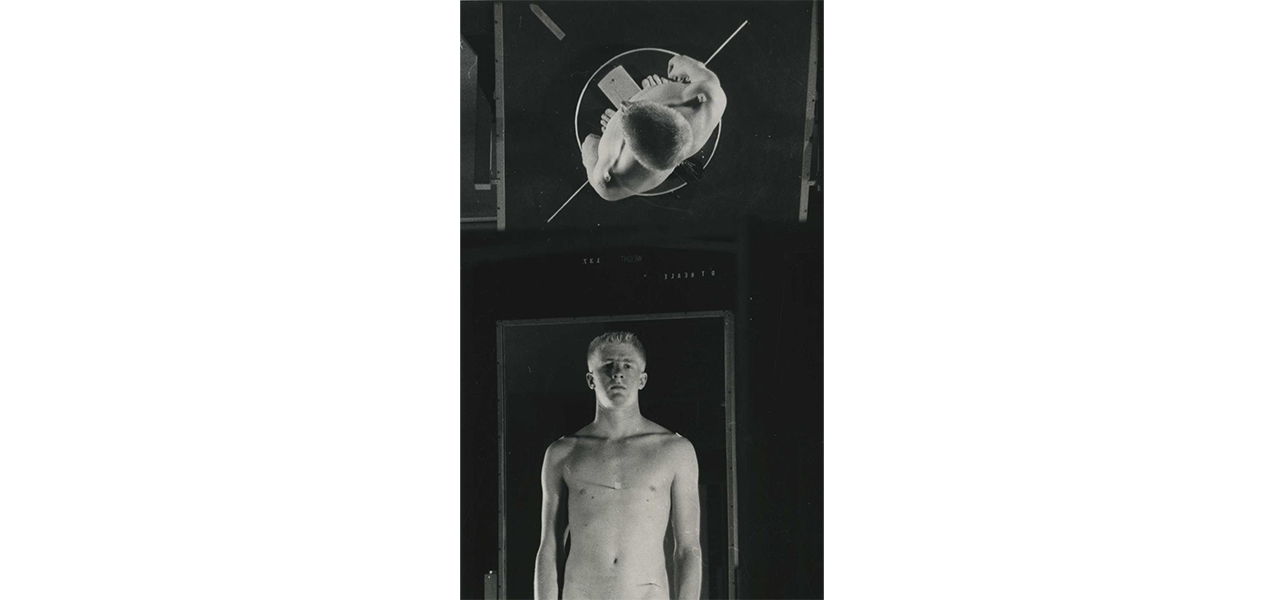
Installation views
At the gallery
Elliott Templeton Fine Arts
Chinatown · 105 Henry Street